
Work Text:
Shouto has been putting this off for a very long time.
All the excuses he’d been able to come up with had, for a time, been working. He’s too busy with school. He has to focus on his practicing. He has a very important rehearsal on the times when he wants to come.
Shouto has finally found a consistent source of happiness in his tiresome life. Because Izuku was able to break down his walls and get him to start writing music again, he’s felt more free and unrestrained than he ever has. And Izuku’s smile, fond and endearing and everything Shouto never got to have growing up, is the brightest part of his world.
Still, his father is a stubborn and prideful man, and he doesn’t back down without a fight. Shouto’s time has finally run out.
“You’re coming home on Saturday for lunch,” Enji had told him over the phone earlier that week. “If anything comes up, cancel it. If you have somewhere more important to be than meeting with a real world-class musician who has things to teach you, I’d love to hear it.”
Shouto hadn’t argued with him, just grumbled his agreement into the phone and hung up. He knows fueling his father’s temper probably isn’t going to be without consequences, but at this point he can’t bring himself to care. Not that he’s ever been particularly careful about how he acts around his father anyway.
So here he is, riding the train far from the life he’s gotten so used to lately, away from his friends and the sound of practices overlapping, away from the experiences that have changed him so much from who he was when he first left home. The ride is unbearably long, and the cold fall air seeping in through the glass of the window cools the side of his face as he leans toward it to look out.
He’s left his oboe and music behind, lest bringing them along gives his father any ideas. With his hands free, he can shove them into the pockets of the hoodie he’s wearing and save them from the chill. The walk from the station to the house is short, out of familiarity rather than proximity, which is unfortunate, because it means he can’t push off his arrival any longer.
The house is just as large and imposing as he remembers it being, even after having lived in it his whole life. The path leading up to the door is calming if only for its traditional style. His hand wavers when he reaches out for the latch and curses his nerves. The couple of months away have softened him.
After everything that’s happened to him so far since he moved out, Shouto isn’t going to let a trip home hold him back from the things he wants to do. In an attempt to restore his courage he finally opens the door and steps into the house.
He’s slipped his shoes off and started on his way inside before anybody finally hears him, and the first face he sees is Fuyumi’s, intrigued by the sudden entrance.
“Shouto!” she calls when she recognizes him, and comes out from around the corner she’d been peeking out from behind. “Dad told us you’d be visiting.” She gives him a quick welcoming hug before looking him over.
“You know he’s not happy…”
Shouto rolls his eyes and shoves his hands back into his pockets. “Of course he’s not.” He looks around her for a moment and takes in the quiet around them. The calm before the storm, he thinks. “Is anybody else here?”
With a shake of her head she steps aside and motions for him to come in further. “Just us. He’s waiting for you in the lesson room.”
Shouto manages a small nod before padding through the halls and toward the side of the house that fostered most of his childhood memories. All of the instruments, lessons, practices, music… the part of the house his siblings scarcely spent any time in.
He’s running on muscle memory now, watching the halls pass by and realizing that nothing has really changed, at least not for everybody else. While his world has become filled with vibrant color this house remains as black and white as it had been when he had left.
Unsurprisingly, the door to the lesson room is open when he finally gets to it. Everything inside is just as he remembers it, too: the baby grand sitting proudly in the center of the room, the music stands and chairs set up neatly, the files of music carefully organized on the bookshelf to the side of the room, and his father wearing a look of disappointment.
“Shouto,” he nearly growls when the boy finally steps into the room, as if it counts as some sort of greeting. “It’s about time we finally had some time to talk.”
Even with the winds of autumn starting to develop a chilling bite, Shouto feels sharp heat in the room. Not warmth, gentle and kind and enveloping like he gets around Izuku or sitting in cozy coffee shops; it’s harsh and sharp like flickering flames too close to his skin, like an overture in G# minor.
“Why the long face?” Enji asks when Shouto doesn’t respond, “I merely want to congratulate you for your work with the orchestra.”
Enji is sitting on a chair at the side of the room beside a table, which appears to be empty. Shouto wonders if it’s going to remain that way. He walks in and takes the seat across from his father, his response a deadpan, “Thanks.”
“A shame that the rest of that good-for-nothing ensemble is just hindering your obvious capability.” And there it is, out in the open so early on in their discussion. He supposes he should be used to his dad’s blunt disapproval by now.
“If this is about me switching schools, it’s not going to happen,” Shouto states, but despite the amount of finality he attempts to place on his words, he knows he has no control here.
“It’s not just the school, boy. You’re throwing away your true potential by refusing to compose.”
Shouto suddenly feels extremely hot. “I’m not throwing away anything,” he says with as much composure as he can. Looking off to the side and scanning over the names of the pieces of music on the shelf make it easier. He hasn’t told his father he’s written music. He isn’t going to.
“There are better universities you could be attending. That Toshinori doesn’t know what he’s doing. If you’re serious about music you should be able to see that.”
“I am serious about music,” Shouto bites, anger seeping into his voice. He wills it away before he can do something careless. Admitting his love of music had felt easier in the empty hallways of the auditorium. The eyes looking back at him had been so much softer.
“The next time you say that to me, I expect you to mean it,” Enji says, dismissively.
It shatters Shouto’s entire world in that instant.
“You didn’t even bring your instrument with you.” Enji stands and walks toward the piano. He misses the way Shouto’s mask instantly resurrects itself. “Not even your solo work.”
“You said we’d meet for lunch.”
“Yes, well, I suppose we all say things we know aren’t true.”
All things considered, it isn’t the worst time Shouto has ever spent at home. He saved himself by leaving his oboe and music at school, so at least his father couldn’t push him past his mental and physical limits today (even if he did still try).
If nothing else, he’s grateful for his sister’s cooking. He hasn’t eaten this well in weeks, and it’s not like it’s her fault their father is a tyrant. Her sympathetic smile truly got him through lunch.
After saying his goodbyes and all but running out of the house, Shouto decides he really needs to go for a walk. He isn’t quite used to the cold yet, but it doesn’t matter. His ears and nose are red from the cold, but his sweatshirt keeps him warm enough.
The familiar scenery soothes him a little, but it’s not like he’s ever really found comfort here. Any memories he has are all from his childhood, living in that house with his father full-time. He just really needs the fresh air.
He’s about to finally start heading toward the train station when the phone in his pocket buzzes with an incoming text. He’s internally thankful that it didn’t go off while he was with his dad.
< how did it go? when will you be back?
It’s a message from Izuku, not that he was expecting it to be anybody else.
> I’ll be heading back soon.
It takes him a second to stop staring back at the screen, but he eventually finds it in him to shove his phone back into his pocket and start walking for the station. The cold distracts him on the way over, but once he boards the train he finds it hard to keep his mind on just the passing scenery. When his phone goes off again, he’s too lost in thought to realize.
He’d been able to hide so much from his father thanks to his practiced composure. It’s not like Enji hadn’t been used to Shouto’s rebellious side, either. His compositions are still a secret to everyone besides his boyfriend, and said boyfriend is still a secret to everyone besides their friends.
Because of this, he counts the visit as successful. He won’t have to go back there until winter break anyway, so he can keep his father out of his mind until then.
< wanna get dinner together tonight?
He doesn’t read the text until he’s making his way back to campus, his feet leading him instinctively toward the music building. He isn’t sure why but his entire body is screaming at him to practice, to catch up, to get better. He feels just like he did back in high school.
> Okay.
Shouto has never been particularly easy on himself during practices. Part of that is due to the fact that his father was there for so many of them growing up, but Shouto holds himself to a high standard, too.
Needless to say, a two hour practice session isn’t exactly what he needs to lift his spirits. His frustration makes his number of missed notes increase, and slow practice is painful on his embouchure. As hard as he tries, he can’t seem to get things exactly how he wants them, which is so much more frustrating when it happens with the music he’s been playing for a while: the music he’s supposed to know forwards and backwards by now.
The fourth movement of Vivaldi’s oboe sonata in C minor is still playing on repeat in his head when he finally slumps back through the doors and into the main dorm lobby. It’s as quiet as ever, until suddenly it isn’t.
“Todoroki-kun!” Izuku yells from one of the seats lining the wall of the lobby. He must have been waiting there for a while - his laptop is open in his lap and is plugged into a socket in the wall behind him. “Welcome back.”
Shouto changes his course from the stairwell to the row of cushioned seats by the wall, sitting himself into the one beside Izuku, who watches him walk over without a second glance at whatever had been open in front of him. The laptop gets closed before he can even sit down. “Thanks.”
Izuku studies him for a moment, not pressing or judging, just roaming. “You alright?” he asks as his eyes finally land on Shouto’s.
The response he gives is a hum, but Izuku doesn’t seem satisfied by it. Shouto isn’t satisfied with it either.
“Wanna talk about it? We can go upstairs if you want. Or we could sit in my room for a while. Iida-kun is with his brother this weekend.”
When he nods back, Izuku is up in an instant, his charger gathered from the wall and his laptop tucked under his arm. He leads the way, letting Shouto linger at his side close enough for their shoulders to bump. The gentle contact is enticing.
Izuku doesn’t say anything on the way to his room, not that Shouto is jumping on the opportunity for conversation either. When they get through the door, Shouto stands off to the side for a moment and watches his boyfriend put down his laptop on the desk and settle onto the bed.
He motions for Shouto to join him and, really, how can he resist?
They sit cross-legged across from each other, knees touching, and when Izuku reaches for his hands Shouto lets them be taken. It takes all but a second of Izuku running the soft pads of his fingers over Shouto’s hands for him to decide they’re too far away. His solution to this is to lean forward until his forehead lands on Izuku’s chest.
He’s finally satisfied when Izuku’s right hand comes up and runs through his hair. With a sigh he lets the walls come down again and relaxes against Izuku. Touch starved, Izuku had called him the first time he’d hugged Shouto and found that his boyfriend was reluctant to pull away.
“It could’ve been worse,” Shouto responds to an unasked question.
“That doesn’t mean it was good.”
“I’ll be okay,” he whispers, but he’s not sure if he believes it.
Shouto is contemplating laying his head down on the cold, hard surface of the reed room countertop when he hears a knock at the door. He gets up in a daze to answer it and is met with the familiar head of dark curly hair and eyes brighter than the lights in the hall.
“Hi Sh-shouto…” Izuku greets, still getting used to the way the name feels on his tongue.
“Izuku,” Shouto says back as he lets him in, sounding smooth but burning up inside.
When the door closes and Izuku realizes there isn’t anyone else in the room, he nestles his way into Shouto’s arms. When he links his hands together on the small of Izuku’s back, he gives a contented laugh.
After a moment of just standing there like that, Izuku asks, “Are you busy right now?” with his head still pressed against Shouto’s shoulder.
He glances back at the counter, thinks about the things he still wants to get done before he resigns for the night, and says, “No, why?”
“Can we play through the duet?” The way Izuku pulls away to look up at him is extremely cute.
“Yeah, okay.” The way he beams is even cuter. “Why now?”
“Oh, it’s just...” he says as he pulls away, much to Shouto’s disappointment, “We haven’t done it yet, and I’ve been thinking about it all week. I really want to hear it.”
“You’re making it sound like such a big deal.”
“It is a big deal!” Izuku exclaims, making Shouto’s hand jump where it’s in the process of pulling his oboe off of its shelf. It slides down with a soft hiss before swinging by his side. “At least, it is to me.”
“Ah…” The glitter in Izuku’s eyes tells him he means it. “Sorry.”
“No need for that! Let’s go.”
As Izuku spins on his heels to bound out of the double reed room, Shouto grabs his keys and music and heads out after him.
They walk down to the basement so that Izuku can retrieve his clarinet and music, but it feels like a maze to Shouto who hardly ever comes down here. He’s surrounded by walls of instrument lockers, from the ones for smaller instruments to the ones designated for tubas and euphoniums and trombones. There are even studio lockers for holding the shared instruments, like the various different saxophones, or the piccolos for the flutists who don’t have their own. He’s at a bit of a loss, and a little overwhelmed.
Sticking close to Izuku prevents him from getting lost, at the very least. His private room on the first floor seems a lot more convenient to him now.
Through the halls, filtering in between the spaces around them and around the bends, Shouto can hear the sound of practicing. The practice rooms would be packed around this time of day.
“Let’s go up to the second floor,” he states when the clarinet locker clicks closed. Something unspoken passes between them when Izuku nods, but he’s not good enough at reading people to understand what it is besides the feeling of security it gives him.
The practice rooms on the second floor are significantly emptier than the ones in the basement, which is not surprising at all. The luxury of not having to climb any stairs is awfully alluring. Regardless of the reasoning, it makes finding an empty room (and another to take an extra music stand from) a hell of a lot easier.
The piano, not needed for what they’re doing, gets used as a table for their cases. In preparation for playing, besides putting his instrument together and getting a reed ready, Shouto starts singing through the piece in his head. His Duet in E♭, his own familiar melody that he’s harmonized and given life.
“You’ve looked at the tempo markings, right?” Shouto asks as his music lands with a percussive tap onto the stand in front of him.
Izuku looks across at him with a smile that’s as apologetic as it is bright. “Of course. I’ll do my best.”
It isn’t until they’re tuning with each other, sounds melting together once they find the perfect match of pitch, that it sinks in for Shouto that they’re going to be playing one of his compositions. His first in over ten years. If it weren’t for Izuku’s resolve, the elated look on his face as they both glance down at their first notes on the page, he’d have walked right out and never looked at it again. His mother’s livid face looms over him. His scar aches.
“Shouto?”
He’s pulled back into the claustrophobic space of the practice room. Clouded brown eyes are replaced by vibrant green. “Right. I’ll count off.”
Izuku nods in time with Shouto’s thudding heart.
“One, two-” Breathe-
The piece begins as a waltz. He’s marked it as an even 100 bpm, a triumphant dance. The middle is a chorale, or as close as he could get with only two parts. The ending, a march in the original tempo. His song is a story that the music wants desperately to tell.
The melody goes back and forth between them, the one Izuku had found himself so fond of, the one Shouto had hummed in vacant hallways, quiet music rooms, and cozy cafés, is given to the clarinet.
Though Izuku may not be the best at always keeping steady time, the plus side is that his playing is always soulful and real, not mechanic or stiff at all, and Shouto’s music writing software, the MIDI that played back what he wrote, even just imagining it in his head- it could never live up to the real thing in front of him.
Because Shouto wrote the piece, he knows all of its ins and outs, ups and downs, every note and how they’re supposed to fit together, so even straying from the metronome markings isn’t a problem as far as staying together. So long as he keeps on following what Izuku does, uses his passion to enhance his own playing, nothing can go wrong.
The waltz is heroic, but mixed with minor progressions that give it dark undertones. Its rhythms are elegant and trade off smoothly between both parts, exactly as he’d heard it in his head, and then more. When the oboe sound mixes with the clarinet, Shouto realizes that this composition, figuratively as well as literally, was made for Izuku. He was made for playing triumphant music, heroic music; he sounds at home in their key of E♭.
The chorale section is much darker, reminiscent of the second movement of Beethoven’s Eroica. It’s the section Shouto spent the longest time writing. Getting it right, just as he’d wanted it, took multiple tries and several hours of frustration. So much of that time pays off when he hears the parts played together, and he can feel Izuku’s sound change to match the tone. Grief, dread, an impending battle: that’s what he had wanted to capture here, and he can hear it all so clearly.
This transitions, through the addition of major chords and building rhythms, into the conclusion of the duet, a celebratory march, a procession, the cries of victory. Parts of the waltz are overlaid onto the new music, as well as the addition of subtle pieces from the chorale. Even Shouto melds into the tone, getting caught in his own music. Listening to it played back to him on his writing software had never touched him the way he’s being touched now, by their playing.
It’s not a perfect run, not that either of them were expecting it to be, but it was still so much more than Shouto was expecting. He’s already planning ways to play differently, to get different results with what he’s already written, and ways to fix things for future works. This duet won’t be his best work, but for now… he’ll let it be the one closest to his heart.
Izuku, out of breath from the merciless orchestration that comes with duets, is breathing heavier than normal when Shouto finally looks back up at him.
“I love it,” Izuku says without hesitation, genuine.
“Want to play it again?”
“You know it.”
The wind quintet has been working on its three pieces for quite some time by the time Thirteen announces that they’ll finally be giving a recital. Because of the length of their pieces, it won’t be long enough to include an intermission, just a small performance to show off the work they’ve all been doing, but they all get excited for it anyway. Even Shouto, who plays primarily in ensembles or solo works, is eager to perform with the quintet.
They collectively agree to hold their recital around halfway past midterms, when finals are starting to appear on everyone’s minds, but not close enough that people are actually worrying about them yet. The end of the semester is prime time for concerts and recitals because of what needs to be done before break starts, so holding it before all of that happens is a good way to ensure that their peers aren’t sick of sitting in performance halls yet.
Izuku is getting busier and busier the deeper they get into the semester, but Shouto isn’t too worried about him. “I have to work harder than most in order to get to where I want to be, but I’m fine with that,” he had said when asked about the work piling up for him. Being an education major has him taking a couple of extra classes.
Even so, they still find time to play together and they still get dinner as a group. Shouto is, slowly but surely, warming up to Iida, Uraraka, and Tsuyu, though they still don’t talk much outside of the group. As much as he’d like to change that, Shouto isn’t the outgoing, persistent kind of person that Izuku is, and he finds it difficult, especially with how busy everyone is.
Shouto manages to avoid his father on claims that the semester coursework is too much for him to spare even one second of his precious time keeping contact when he’s working so diligently toward his goal to improve. Enji had, of course, given him shit for it, but it got him to leave Shouto alone.
For whatever reason, in the practicing leading up to their recital Shouto finds himself falling back on his old habits. He can’t turn his mind off of his soloistic playing methods and keeps having to stop himself from trying to lead the group. He gets scolded for it a couple of times before the work he’d done to fix these things starts to sink back in.
The weekend before their performance, the five members of the quintet somehow manage to coordinate schedules enough to meet outside of their rehearsal time to run through their repertoire and make sure they’re comfortable with where they are in terms of preparation. Even though they don’t meet for long, it does wonders for cementing their starts, transitions, and cutoffs.
Their last Friday rehearsal on the music is just a runthrough, a chance to meet one last time before they perform. Thirteen doesn’t have anything they want to fix specifically, so their rehearsal is shorter than usual. They mention how proud they are of everyone and the work they’ve all done, how much playing together has helped them all in various ways, and how much they’re looking forward to watching them finally bring that work to fruition.
The performance is on a Saturday afternoon, a popular time for recitals. The quintet members pointedly spend their time not practicing the quintet music, or practicing at all really, lest they jinx the work they’ve done or overwork their embouchures (or wrist, in Izuku’s case).
Because Shouto isn’t practicing Saturday morning, he isn’t sure what to do with his time. Him and Izuku tend to spend time together when they can on Saturday afternoons and evenings, either attending concerts together or getting food or sitting together under a blanket watching videos of famous conductors or composers and commenting on their styles. Most of that leads back to Yagi Toshinori, despite the fact that he conducts their orchestra. They never talk about Shouto’s dad.
Tokoyami tends to stay in his room on the weekends when he isn’t out practicing, which he prefers to do at night, so inviting his boyfriend over isn’t on the top of his list of things they could do. He’s still new to all of this, so he isn’t sure what exactly to do. Go see if Izuku is in his room and ask to hang out? Wait until closer to lunch and invite Izuku then? Hope that Izuku contacts him first? Just hold out until after the concert?
After some internal debating Shouto picks the first option and hopes that Izuku is still in his room. He passes Ashido in the hallway on Izuku’s floor, likely going to breakfast, but he’s surprised she’s up at the ripe hour of 9:30 A.M.; he had always pegged her for a night owl. They exchange waves and then continue uneventfully onward to their prospective destinations.
Shouto pauses in front of the door, runs through his mental list of things he’d come up with for them to do one last time, then knocks three times and waits.
After a few seconds with no response and no sign of movement on the other side, he gets a little nervous and raises his hand to knock again. Three more knocks and he waits for another moment. Still nothing. He’s about to leave when the door finally opens, and he looks up at Iida.
“Good morning, Todoroki-kun,” he greets, but he looks confused to see him. Hell, Shouto supposes he’s surprised to be standing there. “This is unexpected.”
“Hey, Iida. Is Izuku here?”
“Sure am!” Izuku suddenly pops up around Iida’s side to peek out the door. It startles Shouto so much that he nearly jumps out of his skin and has to take a deep breath to recompose himself. “Good morning!”
“Morning.” Iida steps back to let Izuku at the door and goes back to… whatever he must have been doing before.
“Sorry it took so long to answer the door. We both thought we misheard it the first time. Your knocks were so quiet.”
“Oh.” He hadn’t even realized how timid his knocking must have sounded. “Sorry.”
“No need!” Izuku reassures and beams at him, the same smile that rivals the sun in the morning sky and pulled Shouto in the very first time he’d seen it. “What’s up?”
“Do you, uh…” He backtracks through his mental script. “Do you want to do something before quintet?”
“Yeah, of course. Did you have anything in mind?”
Izuku retreats back into his room a ways, and Shouto follows him halfway, just enough to close the door behind him.
“I was thinking we could walk around campus. And then have lunch. Or something like that.”
As Shouto’s boyfriend, Izuku has the unique opportunity of being able to observe Shouto pretty closely without it being weird. Sometimes Shouto will stop him and ask what he’s looking at, or why he’s staring, but Izuku’s answering shrug and “Just looking,” usually ends his inquiries. Izuku is very good at observing people, figuring out how they work and why; he’s been doing it his whole life. His justification is that understanding the intent behind somebody’s music is easier when he can recall things about the person who wrote it.
If asked, Shouto would never admit to having stage fright, or even to having pre-performance jitters. Even so, he has trouble enjoying their walk through the fall foliage because he can’t help but think of the quintet. He doesn’t even notice the tension he’s holding in his shoulders; it’s almost second nature now.
Shouto tries to redirect his focus, keep his mind on the walk. He catches a bright red leaf as if falls from the tree above them, and gently places it in Izuku’s hair, behind his ear. The smile on his face is genuine, and Izuku gives one back. The bright autumn mornings will be gone soon. The air is starting to chill.
“How do you think it will go?” Shouto asks suddenly, eyes pointed up to stare into the open blue sky above them.
“The recital?”
“Mm hmm.”
Izuku gravitates toward a bench at the side of the path they’re on. He takes a seat and Shouto joins him, wordlessly. They sit pretty close to fight the bite of the late autumn wind.
“I think it’ll go great. Why wouldn’t it?”
Shouto glances toward the bright red leaf in the dark hair beside him, then looks forward again. “I guess I just have a feeling. That something is going to happen, and it won’t go as well as we want.”
Izuku frowns, a small motion Shouto catches out of the corner of his eye. He hates making Izuku upset, and this is probably the worst time to be doing so. They should be unwinding before their recital, not stewing over his own doubts. “I’m sorry, I shouldn’t have said anything,” he forces out before Izuku can say anything back. “I guess I don’t actually have a good reason.”
When he feels Izuku grab his hand, he looks down to watch him, lets his eyes wander over his scars. Izuku takes a deep breath, exhales a soft hum. “Do you remember what I said to you, back during the concert?”
And Shouto does. Vividly. Fear creates mistakes just as much as mistakes can create fear. He nods.
“If you let yourself think something will go wrong, then something will!” Shouto looks over, and somehow Izuku is smiling. He wants to burn the image into his mind forever, of Izuku framed by the bright blue sky and the colored leaves on the trees, the red leaf he’d put there still sitting in his dark hair, that bright smile that seems to keep saving him. He wants to remember it. He starts to mirror it back, though not nearly as brightly.
“You’re right,” he says, and some of the tension in his shoulders releases.
The two of them sit there on the bench amongst the trees for a little while longer before deciding they ought to get lunch. Shouto continues to replay Izuku’s words in his head, reminding himself that everything will be fine, trying to stay optimistic. It works, or at least he thinks it does. By the time they go back to their respective rooms to change into their concert attire, he can hardly help the smile tugging at his lips.
They meet up in the lobby of their dorm building, and it’s not the first time Shouto has seen Izuku in concert black, but he still finds that the effect is the same. His suit jacket is a little big around the shoulders and could overall benefit from a bit of fitting, but otherwise, he looks as handsome as ever. There’s nothing to be done about the wild hair, unfortunately.
Izuku must notice his change in demeanor when they meet again to walk to the recital hall together, because his steps get lighter and his own smile grows wider. Izuku’s contagious brightness sustains him until, once they reach the recital hall, he realizes he’s just pretending.
He doesn’t want the others to know that the confidence he’s wearing is a mask. After all of the trouble Izuku went through to try to keep his spirits up and the trust his peers are putting in him to work together, their entire ensemble really would fall apart if they found out he was having doubts about it.
As they put their instruments together backstage, the five of them - Shouto, Izuku, Tsuyu, Hagakure, and Koda - manage to find things to talk about to fill the space before they perform. Tsuyu shows off the thread on a new bassoon reed she made, a new style that’s variegated. Koda gives everyone bunny updates, sparking Hagakure to ask if she can visit after the recital to see his little white rabbit after he shows them all a picture of Uraraka holding her. It’s easy for Shouto to just sit back and listen to the others talk since he’s known as the reserved one, anyway.
In no time at all, the lights dim and the quintet walks onto the stage together, bows, and takes their seats. From what he can tell, the small recital space is filled. Even though it’s going to be a relatively short set, the others undoubtedly invited all of their friends to come see it.
The five of them all look to each other, tune, and then begin.
Their first piece is Malcom Arnold’s Three Shanties. It has three short movements, all based on sailor shanties. The first movement is based on the Drunken Sailor shanty, and trades the theme back and forth between every member. It’s chaotic and fast, with the theme overlapping in places and completely disappearing in others. The middle is a slower, tango-like section that they really have fun pulling back before the quick finale.
The second movement is much slower, featuring the soft sounds of the muted horn and flute to play most of the melody. There’s a lazy, swaying kind of rhythm that underlies the entire thing, making it reminiscent of being on a quiet boat swaying on the sea.
The third movement is skittish and jumpy, with lots of short, quick notes that overlap each other and give the piece an urgency that carries through the entire movement. The contrast between the quieter and louder moments makes it all the more playful. They trip up once on one of the transitions, which does nothing to stop Shouto’s general unease.
Their second piece is Ewazen’s Roaring Fork, a quintet made to imitate a river. The first movement, “Whitewater Rapids,” is upbeat, with a feeling of constant momentum. The rolling eighth-note melody like a constant stream of flowing water is accented by quicker parts in the flute and punctuated by the brassy sound of the horn. To Shouto’s frustration, he finds he has to push the tempo when he plays to stop it from slowing down and becoming sluggish.
His frustration continues into the second movement, “Columbines,” when he realizes after Tsuyu’s opening bassoon solo that the tempo Izuku took to play the rest of the piece was going to make playing the oboe solo a bar later nearly impossible. It was too slow, too stiff, couldn’t flow well. With the help of some deliberate eye contact and the subtle beating of time to speed things up, it became more manageable, and he could enjoy playing it. The second movement is beautiful and utilizes the tone of each instrument in the group to portray a glistening, still lake. The oboe solos are written to really bring out the rich range of the instrument: deep and full in the lower range, and singing in its upper range. Toward the end of the movement when he has the melodic part with the flute, Shouto finds he can really let go and put everything into the line.
The third movement, “At the Summit,” is aggressive and insistent, with an opening horn line that sounds triumphant and encouraging. The quieter moments push and pull like waves along river banks, then jump right back into the quick-paced staccatos of turbulent river rocks. Hagakure’s fanfares are lively and precise, and the flute runs are all clean and smooth. Shouto lets his doubts slip away until, near the end of the piece, one of the meter changes trips them up. Their playing is unsteady until they can get back on solid ground for the ending, but it throws Shouto off enough that he’s beginning to wonder if they were really ready for this recital.
The last piece they play is Piazzolla’s Libertango. It’s flashy and loud, a high energy piece that’s meant to leave the audience with a sense of excitement. The dance they create sounds like a mix of black and crimson, with every anticipatory note and improvisatory solo adding a touch of anxiety to the sound. Maybe it’s because they’re tired from the other music, or perhaps there really is a touch of anxiety mixed into their playing, because some of the horn notes crack, some of the bassoon notes falter off the beat, and Shouto picks up on every little thing that goes wrong. He can’t tell if the piece sounds frantic on purpose or by accident.
By the time the final chord is finished and Izuku gets to end their last piece with his high clarinet flourish, the rest of the ensemble seems satisfied, proud, thrilled that it’s over; and Shouto just feels tired. He tries to absorb their successes, their beautiful moments, but runs into every misstep instead.
He smiles, bows with the rest of them, walks off the stage, and pretends.
He’s not really sure why, but in the downtime following the quintet recital, Shouto tries to write more music. He’s only managed to write the oboe-clarinet duet so far, and so many of his melodies continue to circle around his head. He thinks its the stress of his growing workload that’s making them all surface at once, but acknowledging that isn’t making them go away.
He starts with one of the melodies, writes it out into the music software on his laptop, then realizes he doesn’t know what kind of piece he wants to write. A sonata? A piano solo? A full orchestral work? Something for a chamber group?
Thinking about all of the options makes his head spin.
He plays the melody back in his head and tries to imagine what else he would write around it. When he was younger he could hear everything so clearly, down to every instrument and every note.
The only instrumentation he can hear in his head is the wind quintet, so fresh in his mind. He decides he might not actually mind that, if it meant getting to write more music for Izuku who always has so much fun simply playing music with others. He thinks of his smile, the way the light hit his freckles on the stage as they stood to bow, and decides maybe writing for quintet won’t be so bad.
He starts to work, and immediately hits a block. Mistakes and regrets cloud the writing as he tries to add harmonies to the opening. He plays back the audio that he’s written already, and it doesn’t align with what he’s hearing in his head.
He starts over, writes the parts again, plays it back. It still doesn’t sound right.
He tries again.
And again.
He gets the same result every time. The melody is written out exactly how he wants it, put exactly where he wants it, but every time he tries to fill it in the notes grate against each other when he listens to them play back through the software.
Shouto closes his laptop and leaves it - and the rest of the melodies still trying to make their way into the world - for another time.
Shouto has been getting calls from his father for the past couple of weeks, and has ignored every one of them. He’s also ignored every text he’s gotten, preferring to leave his father on read than actually give the man a response. It’s a routine he’s gotten quite good at since leaving for college.
He figures that at some point it’ll come back to bite him, but he isn’t prepared for it to be at midday on the Sunday following the quintet recital. He’d even visited his dad not too long ago.
He’s alerted to the potential incoming threat when he gets a text from Fuyumi as he’s sitting at the desk in his dorm trying to study for his applied theory class.
< Shouto I am so sorry
< He forced it out of me
Shouto hardly has time to process these two messages before his phone lights up again with an incoming call from his dad. He considers ignoring it like he usually does, but Fuyumi’s texts and his own intuition tell him that if he ignores the call, Enji will come visit him in person instead, which is much worse. He looks around, remembers Tokoyami is out to lunch right now, takes a deep breath, and answers the call.
“Hey,” he says in an attempt to remain cool and collected. It works, he thinks.
“Hello, Shouto,” Enji says back, and it has the same forced calmness that Shouto just used, which is not a promising sign.
“Do you need something?” Shouto asks, making a point of loudly flipping one of the pages in his applied theory book in the hopes that it can be heard on the other end, “Because I’m-”
“If you’re about to tell me you’re busy, again , you can cut the shit.”
Shouto doesn’t say anything.
“You have enough time to call your sister, but not to answer me?” Enji bites, and it makes Shouto cringe. He holds his phone away from his face so the voice isn’t so close. Enji continues before he can even answer. “You’ve got some nerve if you think you can be keeping secrets from me, especially if they involve your music.”
There’s an emphasis on the last part of that sentence that scares him. “What did Fuyumi tell you?” he asks, not even sure what all she knows. He’s said a lot to a lot of people over the past few weeks. It all started to blend together somewhere along the way. He’d forgotten he’d even called her.
“That you’re composing.”
Shouto waits a beat.
“I’m not,” he answers, but it’s not convincing.
“Quit trying to lie to me. She told me you wrote a piece for that sorry excuse for a clarinet player that almost turned the Moldau into a trainwreck.”
Shouto panics. He hadn’t expected Izuku to be tied to this. “What does it matter to you if I did?”
“For starters, I need to hear the piece you wrote.” He resists the urge to hang up the phone immediately. “It’s the first thing you’ve written since... the incident with your mother. And I need to finish your teaching. If you’re composing, you should be learning from me.”
“No.”
He says it too fast, too desperate. The line goes silent for a moment.
“What do you mean no? All of the composers at that school are second-rate, if you really want to be good at-”
“I don’t,” Shouto interrupts him. He can practically hear his father fuming, and probably cuts him off again when he continues. “I don’t want to be good at composing,” he says, but it’s a lie. “I only wrote the piece for him because he’s my friend. It probably won’t ever be performed.”
“And that’s the other thing,” Enji says, and Shouto’s heart sinks, “I made her tell me about him, too. Midoriya Izuku, a clarinetist who’s seemingly a nobody, attending university to be in one of Yagi Toshinori’s ensembles. There are so many other, more talented people you could’ve written for, but you chose him. I asked her why. It didn’t come easy, but she told me.”
“It’s none of your business.”
“Of all the people-”
“It’s none of your business,” he says again, sharper.
“What happened to you and Yaoyorozu?”
“It didn’t work,” he says, honestly. It never actually happened, he doesn’t say. He won’t mix her in with all of this, too.
“Your reputation will seriously-”
Shouto hangs up the phone.
> It’s not your fault.
< Did you really hang up on him?
> Yeah.
< I’m really sorry Shouto
> I had it coming.
“Um, Shouto?”
Shouto lifts up his head from the counter. He feels groggy and exhausted; did he doze off? He doesn’t even remember closing his eyes. There’s a hand on his back, and when he blinks up to find its source he sees dark curly hair, a constellation of freckles, and worried green eyes.
Oh no.
“Izuku?” He responds when words come back to him, and a quick glance around finds them alone in the double-reed room. “How did you get in?”
“I asked Tsuyu where you were and she let me in before she headed out. I tried texting you, but you weren’t answering. Are you alright?”
“’m fine,” Shouto mumbles and sits upright in the chair to stretch out his back, which aches from the time spent leaning over the cold countertop. He mentally curses himself for being so careless. He doesn’t want Izuku worrying about him, that expression always makes Shouto feel terribly guilty. “What time is it?”
“A little past nine.”
“Oh.”
“Oh?” Izuku parrots back, concern still evident in his voice. The hand he has on Shouto’s back hasn’t moved, and feels heavy. Even so, he’s grateful it’s there. “How long have you been in here?” Judging by the glances between Shouto’s tired face and his phone still sitting on the counter beside him, he feels like Izuku already has an idea of what his answer will be.
“Since five.”
“Again?” The steady pressure on his back is suddenly gone and he feels a little lost without it. In an effort to have the touch back, he turns and reaches out to his boyfriend, who catches his hand and holds it between both of his own.
“You missed dinner,” Izuku says accusingly.
“I wasn’t hungry.”
“You haven’t gone to dinner with us all week,” he says, this time with more weight. Shouto can tell the gears in his head are spinning. Izuku has always been extremely perceptive.
“I’m sorry. I’ve been busy,” Shouto responds, but it sounds half hearted coming out of his mouth. He isn’t used to somebody worrying about him when he skips meals to work. He isn’t used to being told that his health is as important as his productivity.
“Busy with what?” As he asks, the words ring quietly in the room against the sound of Izuku pulling out the chair beside him and sitting in it. He keeps watching Shouto, going between his face and their joined hands.
Shouto looks back to the counter, where his things are still laid out in front of him. “I was finishing a paper… and after that I started on the theory assignment. But I wanted to study for applied theory too, and that led to…” He trails off and follows his mess to where a sheet of manuscript paper is sitting, small creases formed from where he’d been sleeping on it. “...writing....”
He looks around frantically, trying to remember what all he’d done today and realizing there’s still something he has to do. He stands abruptly from his chair and pulls his hand from Izuku’s grasp, suddenly full of energy (or at least appearing to be).
“What…?” Izuku asks before seeing he’s headed for the cabinet housing his oboe case and music.
“Sorry, I still have to practice.” Shouto quickly gathers everything he’ll need in his arms and rushes out of the room before Izuku can stop him.
Shouto has had a stressful week. When he finally gets home from his late-night practicing, he practically falls into bed and gets to sleep, committed to sleeping in the next morning to really get his Saturday off to a good start. Unfortunately, the stress of everything that’s been happening running through his head wakes him up at the ungodly hour of 8:30 in the morning, and he finds it impossible to get back to sleep despite his best efforts.
At some point, he’d given up on sleeping and opted instead to scroll down whatever he could think of on his phone to pass the time. He doesn’t get very far. He hears a knock at a little past nine, and Tokoyami is the heaviest (and latest) sleeper he’s ever met.
Shouto gets up to answer the door, groggily dragging his feet on the way over. He doesn’t know what he was expecting, but it wasn’t for his entire group of friends to show up with what smells like grilled fish and rice.
“Good morning, Todoroki-kun!” Uraraka calls in her best hushed shout, seeing how tired he still looks.
“Good morning, Shouto,” Izuku greets next, holding what looks like a wooden bowl covered in cloth. He can guess where the smell of food is coming from. He looks up to meet Izuku’s eyes, then glances at Iida and Tsuyu, who give him small waves.
Shouto considers saying something, but his brain is still moving too slowly to come up with a response in a socially acceptable amount of time, so Izuku fills the silence instead. “We brought you breakfast.”
“Wh-” Shouto finds his mouth moving in time with his head, finally. “All of you? Why?”
“It was Midoriya’s idea.” Iida motions to Izuku, who is still standing in the middle of their crew with the brightest, most pleased grin on his face. “We noticed you weren’t doing well lately, and we wanted to help.”
Shouto’s mind goes blank as it tries to process what’s happening. “That’s…” he tries, but his mouth stops working again. If he was as in-tune with his emotions as Izuku or Uraraka, or as open about his feelings as Iida or Tsuyu, he’d surely be in tears. The walls he’d quickly resurrected following his phone call with his father start to chip and fall away. His friends care about him enough to notice he’s been having a hard time and went out of their way to bring him a freshly cooked breakfast on a Saturday morning. He stares blankly down at the cloth covering the bowl in Izuku’s hands. His blank expression betrays the whirlwind of emotions he’s experiencing. He has a feeling they can tell, anyway. “Really?”
The four of them all nod back at him.
Shouto reaches out for the bowl, and Izuku holds it out to meet him halfway. It’s warm when it touches his fingertips and comes to rest in his palms. So is the brush of Izuku’s fingers when he hands it over.
“Um…” Shouto says after a moment, and then quickly places the bowl back into Izuku’s hands. “Hold on.”
He quickly disappears back into the dorm room, accompanied by the sounds of drawers sliding and a couple thumps from inside. It only takes a moment, but when he opens the door again and finally steps out into the hallway to join them, he looks much more presentable, having changed out of his pajamas and tidied his hair. He holds out his hands again for the bowl of breakfast and Izuku happily delivers it back to him. “We should go to the lounge. Tokoyami is still asleep.”
“Fine with me,” Izuku responds, and the rest of the crew nods along with him. Shouto looks back to his sleeping roommate, still baffled he’s managed to sleep through this, and then gently lets the door close behind him.
The walk to the lounge isn’t long, but Shouto feels awkward the whole way. It’s quiet, and even though the rest of the group seems to be in high spirits (there is a particular bounce in Uraraka’s step that contrasts the sluggish way he feels like he’s moving) Shouto feels weird to be in the center of all of this effort. If he’d been able to keep himself together, then all of this-
His thoughts get cut off when they reach the lounge and he notices an odd jingling sound come from the bag that he just realized Tsuyu has been carrying. He wonders if that’ll be relevant soon.
He sits down at a circular table with his warm bowl and finally takes the cloth off of the top. He was right, it’s grilled fish and rice, and seeing it makes his mouth water. The seats around him get taken up by his friends, and for the first time in a while he feels close to them.
“So, how has that cadenza been going, Iida-kun?” Uraraka asks once they’re all settled, which earns her a long sigh.
“I tried asking Tensei about it and he still thinks I’m following the time too strictly.”
Shouto hadn’t heard anything about this cadenza before. He listens intently, putting the first bite of fish in his mouth. It’s nothing special, but it’s good and his friends made it for him. It makes him feel warm.
The rest of the conversation follows the same general sequence: one of them brings up a topic that Shouto had missed in his self-induced seclusion, and the others elaborate on it. They don’t prompt him to answer, letting him observe silently over his breakfast, and catch him up on all of their life updates.
“You should’ve seen what Deku did while we were doing some sightreading the other day-” Uraraka starts, to which Izuku promptly hides his face in his hands and stifles his own laughter. “We were writing our own melodies to practice, and Deku wrote one for us and-”
She’s cut off as she opens up something on her phone, sees it, and laughs. “He forgot what a treble clef looks like and drew this.”
When she turns the screen toward him, not even bothering to hide her laughter any more, what Shouto sees is barely recognizable as a clef at all, save for the fact that it’s drawn on top of a staff. It looks like a wiggly ‘S’ with a line through it. Shouto snorts. “That rivals Haydn. I’m impressed,” he says, having long since finished his breakfast while the conversations transitioned from one to the next. The entire table is laughing now, and Shouto feels more rejuvenated than he possibly could have by staying in bed.
As the laughter fades away, Shouto looks up and notices Tsuyu whisper something to Izuku with a nod toward the window. When he looks, he sees nothing but the bright sunlight filtering in. In the background, Iida is saying something to Uraraka about not teasing Izuku so much over his bad treble clef, which only drags out her laughter.
He’s still looking out the window when he notices Izuku grab the bowl from in front of him and wrap it back up in the cloth he’d brought it in. “I can clean that for you,” he says, reaching for it as Izuku tucks it away into a bag.
Izuku waves him off, supplying only a “No need!” and standing from the table.
“Oh!” Uraraka says as she’s finally broken from her giggling. “Is it time?”
Shouto looks at the lot of them, confused. Izuku nods, and she gets up with an excited bounce. “Time for what?” Shouto asks as everyone gets up and looks to Izuku to lead. Tsuyu’s bag jingles again when she throws it over her shoulder.
“You’ll see,” Izuku says with a smile that’s kinder and brighter than the morning sun, and heads for the door.
Shouto isn’t sure what to expect as he tags along with his merry group of friends out of the lounge and down to the dorm lobby. Uraraka still has a bounce in her step, and seems to be humming nothing in particular as they walk. She giggles when Tsuyu bumps into her, teasing, and then goes right back to her happy humming.
He expects the air to bite when they lead him outside, but it’s warm for a mid-autumn day. He’s comfortable in just the shirt he’s wearing, so long as he stays in the sun, which doesn’t seem to be a problem when Izuku points to one of the stone benches in the courtyard.
Tsuyu carefully puts the bag down on the bench, and when Shouto finally stops basking in the sunlight long enough to catch up to them, he sees her pull out a ukulele, a recorder, a tambourine, and a melodica.
“Where did you get these?” he asks, picking up the ukulele and inspecting it. It looks nice, better quality than just a cheap toy. He sets it back down with the others.
“The melodica is Ochako’s,” Tsuyu says, picking it back up after the bag is out of the way, “And Izuku got permission to sign out some of the instruments from the music education department.”
“We just thought maybe it would cheer you up,” Ochako says, grabbing the ukulele and checking the tuning. She fixes them by ear as she talks. “Deku told us you’ve been having a hard time lately.”
“We’ve been wondering why you haven’t come to dinner with us.” Iida takes the tambourine at the same time that Izuku reaches for the recorder. The jingles ring in the courtyard when he lifts it, and he tries to stifle them, which only makes them ring more.
“Feel free to sing along, or ask to play something if you want,” Izuku says, lining up his fingers on the bore of the wooden recorder. “Any requests?”
Shouto looks at all of them, holding instruments that his father would only refer to as “toys.” They’re small, simple, and the kinds of instruments that kids play on for fun. Izuku had gotten them from the music education department. His mind goes blank. He can’t think of anything that would normally be played on a recorder or a ukulele or a melodica. He can only think of Tchaikovsky, Britten, Bach, organized orchestras and sophisticated sonatas. He shakes his head. He sees the childish instruments in their hands and thinks of chaos.
When they play, he hears joy.
He has no idea what they’re playing, maybe some nursery rhyme he never had the good fortune of being raised on, or something simple out of a lesson book, but if he had to put money on it he’d guess they’re all improvising. Uraraka plays chords on the ukulele in her hands with a level experience he had no idea she had. He can tell from their hours studying applied theory and learning how to recognize chords that she’s playing simple progressions, I-IV-V-I, something they can easily follow. Iida’s tambourine beat is steady and precise. Tsuyu’s experience with jazz gives her the ability to throw embellishments and arpeggios on top of the chords, making them more interesting. Izuku and his recorder add a melody on top of the light backgrounds that give it direction and phrasing.
Shouto sits among their group and listens, swings his finger along with the tempo they’ve chosen, and lets their carefree expressions stick in his mind as he closes his eyes. The music continues around him as he sits there, and he’s surprised by the sophistication and simplicity of it. He thinks about his playing recently, and realizes that his expensive oboe, handcrafted reeds, and attention to detail have never produced music that is as full of life as the sounds echoing through the courtyard on this warm autumn morning.
As they play, the most peculiar thing happens. The melody that Shouto had been hearing in his head, the one he’d wanted to write after their quintet performance but couldn’t seem to get right, resurfaces over the simple chords of the ukulele, plays off of the noodling melodica, mingles with the recorder, supported by the jangling tambourine sound. He can hear it so clearly. He starts to sing it with them.
The group is caught off-guard when Shouto joins them, but they continue on, adapting to the new melody he provides. Izuku even stops playing for a time to sing countermelodies back to him without his fingers getting in the way. They fall into a groove that seems to float along so easily. When Izuku notices the melodica starting to fall away as Tsuyu’s air grows weaker, he goes back to his recorder, and she sings with Shouto instead. They go back and forth, trading parts, singing with each other, and creating new melodies.
Shouto had forgotten how much fun music could be. He had forgotten everything he loved about improvisation, about playing, about music. And he’d just found it again.
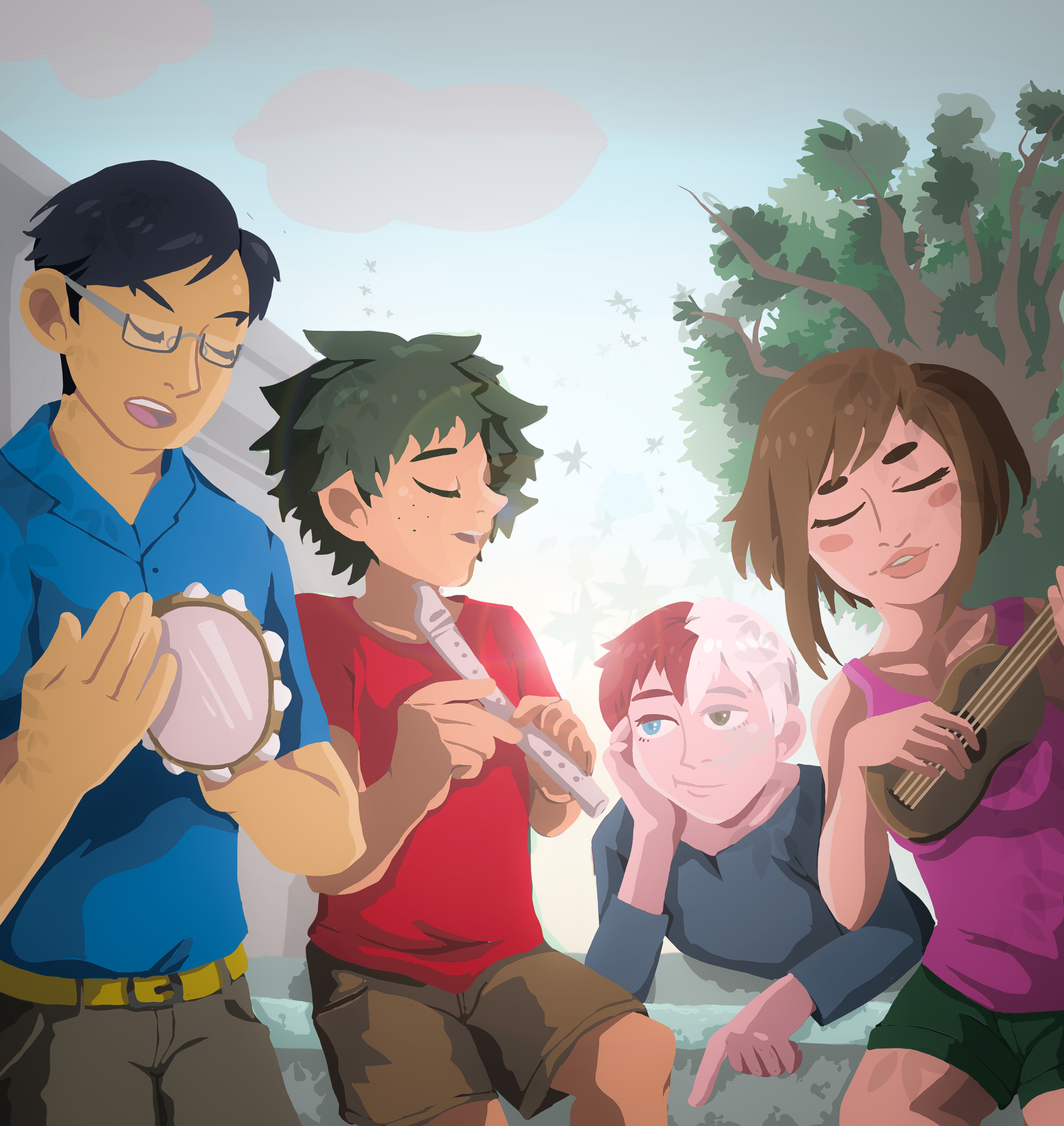
When Shouto gets home that evening, having spent some much needed time with his friends, he digs out his manuscript paper and begins to write. He doesn’t capture the essence of their courtyard jam session, but he does his best. It takes a while and keeps him up well into the night, but when he’s finished with it and looks over the notes he’d written, he decides he’s happy with it.
He manages to sleep in a little into Sunday, his spirits still high from the day before. His practicing is more productive than it’s been in weeks, and he meets with Izuku that afternoon to talk about conductors and new music technology and watch cheesy score analysis videos online. He thinks about his father, but it doesn’t pull him down like it would have just a few days before.
When he walks into the music building on Monday for class, he doesn’t feel like the walls are restricting him any more. He has a lot to do, of course - ensembles and class work and practicing never stop - but he no longer feels rushed for time.
Their next orchestra concert is rapidly approaching. In just two more weeks they’ll give another performance, and Shouto feels ready for it. The music he’d become numb to has been given new life after the weekend. He has plans to get lunch with Izuku, and isn’t rushing straight out of rehearsal like he’s been the past few weeks.
“Young Todoroki!” he hears from the front of the room as he’s stuffing his cleaning swab back into his oboe case. Izuku pats him on the shoulder and then walks out of the room with a wave, leaving Shouto as the last wind player left besides Tsuyu, who is also still packing up. Yagi-sensei walks toward him from the podium, his usual encouraging smile plastered to his face. “Do you have anything right now? I wanted to talk to you.”
Somehow, despite his lack of proof, Shouto feels like Izuku has something to do with this.
He supposes he can be a little late to lunch.
“No, I’m not doing anything right now.”
“Wonderful!” Yagi exclaims in his bright, booming voice that always manages to turn heads. Most of the other people still trickling out from rehearsal stop and look back at them, but then continue on. “We’ll walk up to my office together.”
Shouto nods, quickly finishes zipping his case closed, and grabs his music off the stand. Yagi waits for him to stand before leading him out and toward his office. “Your solo in the Beethoven is absolutely wonderful, by the way,” he says once they leave the rehearsal room. “Not that I doubted that it would be, especially after your solo in the Grieg in the first concert.”
“Thank you very much, Sensei,” he responds, feeling a little starstruck. “It means a lot to me.”
“Hm? How so?”
Shouto glances at the others walking through the hallway as they pass, not really acknowledging them. “I just really love those solos,” he says, and while it’s not a lie, he doesn’t want to tell him the whole truth, “and I worked really hard on them.” Peer Gynt was my mother’s favorite. I did it for her. I did it for Izuku. It’s all for Izuku.
Yagi nods, as if he understands the whole meaning behind his half-truth. It’s comforting to know that it wouldn’t bother Shouto if he did.
It’s not a very far walk to Yagi-sensei’s office, but the anticipation makes it feel like an eternity. Shouto really hates awkward walks. He also hates the awkward way he walks into the office once Yagi-sensei finally unlocks it and sits behind his desk. Shouto takes the seat on the other side, a little too stiff, a little too uncomfortable.
“Don’t worry, my boy, you haven’t done anything wrong. Quite the contrary, actually,” the professor says when Shouto shows no signs of relaxing at all. He’s searching through his desk for something, which he finally finds and places in front of the both of them unceremoniously. Shouto doesn’t have to look at it long to recognize what it is. He’s the one who wrote it.
“It’s no secret that I write music,” Yagi begins, motioning to the film posters hanging in his office. Aside from the All Might posters, Shouto also recognizes some of the more obscure movies from his time spent with Izuku. His eye catches on the movie poster for Kamino Ward, a crime movie with a big fight scene at the end that had to be meticulously scored for. Yagi had admitted during an interview that it was “the hardest film job he’d ever taken,” and announced his retirement from writing film music after it debuted. It won multiple awards.
“I have been informed, however, that it is a secret that you write music.” Yagi motions to the composition sitting in front of him. Duet in E♭ , a copy of Izuku’s score. “I won’t ask you to explain why, and I didn’t ask Young Midoriya to either when he handed this to me.”
Shouto is fine with that. He has a feeling Yagi-sensei already has an idea. He nods.
“I looked over this composition. It’s rather good, especially for a first work.”
“Thank you,” Shouto says, still stiff.
Yagi’s expression becomes more serious, and he puts a hand over the duet sitting between them. “I know I focus primarily on conducting now, but if you’re interested at all in taking composition lessons while you’re here-”
“Yes,” Shouto blurts, too fast, too enthusiastic. He backtracks. Much calmer, he says, “I want to become a better composer.” As he does, he feels something in him loosen. He breathes a little easier, looks a little stronger.
When Yagi smiles at him this time, it’s not as bright, not as loud as his normal smile. It’s subtle, content. Shouto has never seen it before.
“That’s wonderful, Young Todoroki. You have great potential. How soon do you want to start? We can always wait until next semester if you want to take your time.”
Shouto restrains himself before answering this time. “Can we meet on Friday?”
Yagi-sensei blinks a couple times, surprised. “Oh, yes, of course. Sorry my boy, I wasn’t expecting you to be so eager. Midoriya told me you were still being quiet about composing.”
“I have something I want you to look over,” Shouto responds simply, and there’s a hint of something more in his expression.
Fuyumi does not believe Shouto when he tells her he’s coming to visit on Saturday, and wonders if he’s okay when he asks if their dad is going to be home. When Enji tries calling him later, probably to ask why he’s planning on coming home the weekend before their next orchestra concert, he never picks up. He doesn’t answer the texts either.
When he shows up on Saturday morning, chilled from the walk and very much actually there, Fuyumi hurries to the kitchen to make him some tea. “I’m sorry!” she shouts as he toes off his shoes in the entrance and hangs up his scarf. “We really didn’t think you were being serious when you said you were coming home.”
“Why not?” he asks, padding his way in and following her to the kitchen. It smells nice, like fresh rice and spices.
She turns from the hot water on the stove to raise an eyebrow at him. “Well, for one, you never picked up when dad called.”
Shouto shrugs. “I figured I would just talk to him now.”
Fuyumi sighs and looks him over. She can’t tell if he’s being serious or sarcastic, and it throws her off, because he’s never really been the sarcastic type. “I’m glad you came, really I am,” she says, turning back to the hot water as she hears it start to steam in the kettle. “I think dad is, too, despite… y’know… everything.” She pours it into a waiting cup and sets the kettle back down. “But it’s strange for you to stop by, especially without us asking. Is there a reason?”
“I have something to show him,” is all he says. He jostles the bag on his shoulder but doesn’t take it off. “I’m not planning on staying too long.”
She deflates a little, but she doesn’t seem surprised. “Sorry,” Shouto offers before she can say anything, “It’s probably best if I don’t stick around. Let me know if you end up coming to the concert next week. We can get coffee or something.”
“Oh!” she says suddenly, surprising him. “I just realized I never really apologized. For what happened a few weeks ago.”
Shouto knows what she’s referring to immediately, and he feels the dull tug at the back of his mind again that tells him to leave and shut himself away. He understands why she didn’t believe him when he said he was coming. He’d forgotten how awful he felt after that conversation. But he remembers, too, the past week, the sunny morning, borrowed toy instruments, and his very real convictions.
“I already told you it wasn’t your fault.” He remembers the tea sitting on the counter for him and grabs it. It warms his hands immediately. He thinks of grilled fish over warm rice. He knows his sister cares. “I’m going to try to move forward.”
Shouto drinks the fresh tea and sets his cup back down on the counter, and regrets that his sister got wrapped up in this at all. He tried so hard to keep his bitterness away from his siblings. As much as he can’t stand this house, he knows it isn’t their fault.
“I’m going to go see him now,” he says, and as he turns he sees the whisper of a smile on her face. It’s all the reassurance he needs.
The hallways feel cramped and suffocating, but then again, they always have. Running on autopilot would help him not to notice, but the last thing Shouto wants to do now is to continue on the way that things have always been. It’s a day of change. A day of new beginnings and finally letting himself dream. He would rather see the hallways as they are - narrow and imposing, tied to images of a large hand around his wrist, the feeling of his feet dragging on the floor, resistance - than to allow these feelings to go unattended in his mind.
He hesitates at the door. It takes more of his willpower than he had anticipated to reach for the handle, and even more just to prepare himself to slide the door open. The muscles in his shoulders tense automatically, a nervous habit he only knows he does because Izuku pointed it out to him. He forces them to relax- a surprisingly difficult task- and opens the door to the lesson room.
When he walks in, he finds himself face-to-face with almost an exact replica of the scene he happened upon almost a month ago, on his last visit home. The room is immaculate, save for his father’s violin sitting atop the piano, the multiple books on orchestration and instrument tendencies sitting open, and his father leaned over the table, looking through them. When Enji looks up, he seems annoyed more than anything, which is the most familiar part about it all.
Shouto strides in and places his tote on top of his dad’s books and papers. “Hello.”
“I was wondering if you were really going to show,” Enji says, pretending not to notice the shoulder bag that is now sitting on top of his work. “If you’re here, then that must mean you’ve finally realized that-” He squints. Shouto already feels triumphant. “You didn’t bring your oboe? Any of your repertoire? No manuscript?”
“Nope.”
“I thought we talked about you not taking this seriously-”
“Oh we did,” Shouto interrupts, wholly unaffected by his father’s attempt at biting into him. “Fortunately, I’ve figured out what ‘seriously’ means to me, and it wasn’t one of our conversations that made me realize it.”
He reaches into the bag he’d brought along, which contains only one folder. Its plain black covering and Shouto’s deadpan expression completely conceal its contents. “Contrary to whatever you believe, I’ve been taking my music very seriously. So seriously that it was making me completely apathetic to any and all of the music in my life. I didn’t notice how miserable I was until Izuku showed me how much I could really love music.”
Enji has that disgusted look on his face again. It’s the one he wears when Shouto plays a wrong note in a well-practiced passage, hits a note too flat, or talks about a certain clarinetist that Shouto has grown rather attached to. Shouto has long since learned how to look at his father’s disgust head-on without flinching. He presses on.
“And speaking of Izuku, yes, I did write a piece for him. And I’m going to continue writing pieces for him, and for myself, and for whoever else I want. I’ve let your approval dictate my success my entire life, and I’m not going to tie my composing to you any more.
“I’m finally enjoying what I’m doing,” he admits, more to himself than to his dad. “It may have started here with you, but it won’t end here. I’m taking music seriously by doing it the way that I want to do it.”
As Shouto finishes his confession, he’s surprised to find his father staring at him with a blank expression. They stand in silence for an agonizing couple of seconds, at which point Shouto considers just leaving. He’s said his part. It’s his father’s choice now to say something back.
Enji looks down at the folder covering his books, and finally says, quieter than Shouto can ever recall him speaking in the lesson room before, “What did you bring me?”
“A gift,” he supplies. “For starting me down this path.”
He turns then, steps toward the door. There’s no protest from his father, no telling him to wait, no asking him where he’s going, no forcing him to stay. His father isn’t holding him back now, and he doesn’t think he’s going to in the future, either. As he leaves the room and walks back down the hallway to leave, he finds that it seems to open up for him. The days of feeling bound by the walls of this house are over.
He doesn’t smile. Even after everything, he doesn’t know if he’ll ever be able to smile here. But, for the first time, the melody in his head is a cheerful one, and it’s pointing him back to the place where he knows somebody is waiting for him to play it.
When Enji finally opens the black folder on the table, after he hears the footsteps in the hall die away to niente and a quietness fall over the house once again, what he sees inside knocks the wind out of him.
Solo for Violin, it says, in bland typeface at the top of the score, beside Shouto’s signature.