
Work Text:
“...Foresight came upon Felagund as she spoke, and he said: ‘An oath I too shall swear,
and must be free to fulfill it, and go into darkness. Nor shall anything of my realm
endure that a son should inherit.”
-The Silmarillion
Then sudden Felagund there swaying
Sang in answer a song of staying,
Resisting, battling against power
Of secrets kept, strength like a tower,
And trust unbroken, freedom, escape;
Of changing and of shifting shape
Of snares eluded, broken traps,
The prison opening, the chain that snaps.
-The Silmarillion, Finrod’s Song
It is said by some that in Valinor, deep in the halls of Mandos among the deep dark places, are miles and miles of tapestries. The lives of the Eldar, inscribed in colored threads—their pasts, their presents, their futures. They hang silently upon the walls of long echoing hallways, only to be seen by those that wander there.
Sometimes, one might catch a glimpse. A dream, a feeling of deja vu, a sudden knowledge . Threads in the corner of your eye, just tangled enough to not quite make out.
Sometimes, these glimpses are not entirely accurate. A work of art is never truly finished, a life even more so. A slight nudge, a slipped stitch, and the tapestry changes.
Celegorm and Curufin come to his gates first. The sky burns, the air reeks. The High King is dead.
Their horses stagger bloody and broken. Their clothes are worn and soot-black, stained with ash and the blood of friends and foes alike. The glory of the House of Feanor, fleeing, fled.
Celebrimbor, standing beside his father, sways, and Curufin puts out a hand to steady him. Celebrimbor is still lanky with youth, and his eyes are wide, young, looking out from a face that has seen far too much war for its years.
Finrod looks at them.
Angrod and Aegnor his brothers lie dead, months ago in the heat of the battles at the beginning of the Dagor Bragollach. Finrod himself had been saved, but too late too late too late—
Celegorm and Curufin stand before him now. They ask for aid, for shelter, for friendship.
What can Finrod do but accept?
The gates open, and Doom enters Nargothrond.
Finduilas is not like her great-aunts.
She is not fierce and stubborn like Aredhel, or like Galadriel, noble, proud, and mighty. She has only met them in passing, listened with wide eyes to stories of their exploits and adventures from long before Finduilas was born.
Finduilas does not miss Valinor, for she has never been there. She has only known Beleriand, its glories and wonders, its darkness and despair. Nargothrond is beautiful, and safe. But Finduilas misses her home, misses the tower of Minas Tirith and the sun shining through the windows and the birds that would sing to her outside. She misses her mother, lost in the flight to Nargothrond in the chaos of the smoke and the cloud of fear and panic sent by the Sorcerer. She misses her father.
Orodreth is alive, yet the loss of his wife and his father and an uncle all at once has made him quieter, colder. He had taken the brunt of Sauron’s attack, braving the clouds of enchantment and fear in multiple attempts to go back to save her mother. It has been months, but Finduilas can still see the fear lurking deep in his eyes, in his shaking hands.
He doesn’t talk to Finduilas anymore, and she knows it is because she looks like her mother.
Finduilas is not like the heroes of the tales. She had been bundled out of Minas Tirith like a child, unable to even escape on her own two feet. She is not trained in swordplay, can not fight, has no interest in hunting.
Finduilas haunts the halls of Nargothrond, mapping out the halls and hidden secrets hidden within. She sits by what windows she can find and sews. Sometimes she draws, little birds and hidden rivers and half remembered faces.
Sometimes, she fills up pages and pages with black swirls, adding more and more until the page is black and her hands are covered in charcoal.
Sometimes, her great-uncle the king will sit with her. His golden hair is long and shines in the sun, glistening with jewels. His smile is often sad, but his laugh rings sweeter than honey. He doodles bad caricatures of family members, shows Finduilas how to sketch architectural designs. Once he let Finduilas braid his hair. It hadn’t been very good, but he had left it in all day, showing it off to anyone that would listen.
Finduilas rarely wanders down to the forges, the noise and heat keeping her away, but sometimes when she is in the lower levels she crosses paths with Celebrimbor, son of Curufin. Many years older than her, but young still, and her cousin of some sort or another. He’s not at all how she thought a Feanorian would be. He has kind eyes. They walk together sometimes, stretching their legs through the halls or venturing outside on a sunny day, safe under the eyes of the many archers that protected every border.
Finrod will occasionally go out hunting with Celegorm. Celebrimbor invites her every time, but Finduilas never accepts. She has never liked hunting, especially the boars. Something about the spears send a shiver down her spine.
Once, Finduilas crosses paths with Celegorm alone, coming back into Nargothrond from a hunt. He has had a good hunt and is in good spirits, and his great hound pads companionably at his side.
“Ho, little cousin!” he says, smiling. Finduilas shrinks against the wall to let him pass.
She doesn’t trust his smile. He smiles like a wolf, all teeth.
Time passes, as time is wont to do.
Reports gather of a human man, a warrior, wanted by Morgoth with a price on his head as large as the High King himself. Reports of a person passing through the hills and forests of Nargothrond, coming in haste from the east and passing unharried through the borders of Nargothrond.
Finduilas, unaware of the storm brewing, continues to wander the halls, her footsteps echoing in the silence. She sketches a small bird on a scrap of parchment, her fingers deftly tracing the delicate lines. But as she works, a sense of unease begins to creep into her heart, a whisper of something dark and foreboding.
She puts down her charcoal, staring at the bird she has drawn. It looks wrong somehow, its wings too heavy, its eyes too wide. She crumples the parchment, tossing it aside. The darkness lingers, a shadow at the edge of her mind, and she cannot shake the feeling that something terrible is coming.
Finrod needs no ring to recognize his friend’s features in the young man’s face as soon as he sees him. Covered in dirt and sweat as he is, Finrod immediately embraces him warmly, laughing in delight, and welcomes him to Nargothrond.
Beren speaks of his quest, his love, his need, and Finrod goes quiet, serious. He feels his Doom grow nearer, yet it changes nothing. He will help Beren. There was never any other option. There will never be any other option.
The consequences are exactly as Finrod expects.
Even as Finrod speaks before the court, he sees it happen. The way Celegorm straightens, instantly dangerous like a cloak falling from his shoulders to unveil the danger beneath. The gleam that appears in Curufin’s eyes.
They stand, interrupt. Their voices are commanding, their words cutting through the air like a blade. Celegorm speaks powerfully, capturing the people’s emotions and flaming them high. Curufin takes after his father, no less a smith of words than of iron, soft words smoothly slipping into minds and changing hearts.
They speak of visions of war and ruin, the need for safety, freedom, and to not to trust the quests of men. But their words are laced with something darker—a desire for power, a hunger that cannot be sated.
Finrod listens, his heart heavy with the knowledge of what is to come. He watches his people slowly overcome, pulling away from him.
He pulls the crown from his head, sending it clattering to the floor.
Days later, and the people of Nargothrond are assembled in the courtyard, watching in silence as horses are saddled and bags and packages packed.
Finduilas watches from the outskirts as Finrod takes something out of his pack. It is his silver crown, the one he had thrown to the ground that day in the hall. He holds it out to her father.
Orodreth hesitates. Finrod waits.
Eventually, Orodreth reaches out and takes it, never quite meeting Finrod’s gaze.
“Goodbye, nephew,” Finrod says —and turns to leave, Beren following close behind.
Finduilas calls out, the words falling from her mouth surprising herself just as much as those around her. Finrod turns, pauses.
Her words stick on her tongue. “Don’t,” Finduilas begs, the only word she can produce. Celebrimbor hovers somewhere behind her, but she cannot bring herself to look at him right now.
Finrod smiles one of those sad smiles, presses a kiss to her hair, and mounts his horse. Wheeling around, he leads the small group to depart from Nargothrond with a clatter of hoofs and the snap of flags.
The courtyard feels empty and cold, even full of people.
Finduilas watches with tears in her eyes as Finrod disappears beyond the rocks and trees. She is not sad, she realizes with some surprise. She is angry. Furious at her father for letting this happen, at Celegorm and Curufin for forcing Finrod out without aid, at everyone who stood by and let him leave, even at the man, Beren, for coming and ruining this last little piece of home Finduilas has acquired.
A shadow moves over the stones below. She looks up behind her, and sees Celegorm and Curufin standing on a ledge high above them, looking down over the courtyard. They’re laughing.
Finrod, Beren, and their few companions journey across the land in disguise, swallowing down disgust at the shapes they take. Finrod finds great joy in speaking with Beren at first, but as the days go by the words dry up until the only communication is a nod here, the sound of footsteps there. The horses must be left behind, and they pace single file until their legs ache and shake with weariness.
They do not make it far.
Sauron finds them. Finrod sings, throwing a defense of words and Music around them, but he stumbles, trips upon the memory of Alqualonde, and his song falters. Sauron sweeps past his defenses, throwing Finrod to the ground.
Thrown in the deep, they are left to the mercy of Sauron, who knows no such thing. The darkness closes in around them, and hope begins to fade.
One day, Celegorm and Curufin come back from a hunt with a girl. She is beautiful, towering in spirit and power.
She does not come out of her rooms, and the chambers are kept locked.
They claim she is to be protected, that she must stay inside Nargothrond for her own good.
Celegorm and Curufin see in her an opportunity—a way to secure their power, to win favor with her father Thingol, and to turn the tides of war in their favor.
The people of Nargothrond look away.
Finduilas does not. Her steps through the halls begin to take her more and more often past the door in the hallway that leads to the chambers where Luthien is being held.
She sees Celebrimbor there often too, bringing meals and other necessities. They don’t speak anymore. Finduilas does not speak much to anyone at all anymore.
One night, she is out late in the hallways, when she sees Celegorm’s great dog, Huan, pad softly past—alone. Curious, she follows.
Huan leads her to Luthien’s door, where Huan has walked up to sit next to Celebrimbor, who is half crouched on the ground.
He is speaking softly through a crack in the door, and jumps guiltily when he sees someone watching. He has a bag of keys spilled upon the ground, and has evidently been trying unsuccessfully to open the door.
Finduilas and Celebrimbor stare at each other a moment, then Finduilas reaches into her braids and pulls out a hair pin, passing it to Celebrimbor. Finrod had given it to her many months before, and it is made of a pure metal only found in Valinor, with the light of the trees still glittering in the jewelwork.
A few minutes more and the door clicks open. Huan noses past them to vanish inside, reappearing with Luthien a moment later. Celebrimbor and Finduilas silently lead them down quiet corridors and abandoned passageways, until they finally reach the doors to the outside.
“Be careful,” Celebrimbor says.
“I’m not going to be careful,” says Luthien. “I am going to save Beren.”
With a swish of her clock she and Huan vanish into the darkness, leaving Celebrimbor and Finduilas standing alone behind in the tunnels.
Finduilas stares after her, her heart in her throat.
In the throne room of Nargothrond, the air is thick with tension.
Celegorm and Curufin, furious at Lúthien’s escape, turn their wrath upon Orodreth. They spit fire and foul words, accuse him of treachery, of aiding in her flight. They seek to turn the people of Nargothrond against her father as surely as they turned them against Finrod.
Celebrimbor hovers behind them, hands twisting anxiously yet staying silent.
The energy of the room rises to dangerous levels. It’s agonizing, unbearable, the way they look at her father.
Finduilas stands suddenly, rushed, knocking over a chair in her hurry. The clatter brings all eyes directly focused to her, and she swallows.
Curufin moves towards her, but Celebrimbor catches hold of his arm, holding him back.
Everything is still, waiting.
Finduilas stands tall, and for once, she speaks. Her voice rings out over the court in defense of her father.
She is no warrior, but in this moment, she is strength, she is courage. She denounces Celegorm and Curufin’s actions, appealing to the people of Nargothrond to see reason, to stand against the tyranny that has taken hold. For once, the words fall easily out of her mouth, falling like rain to wash away the lies of Celegorm and Curufin.
Her words strike a chord. The people begin to turn, their loyalty shifting back once more. Celegorm attempts to take back control, and for a moment their voices soar and crash against each other, but Celegorm’s words falter, overcome by the sheer strength and energy of Finduilas’ speech.
Finduilas does not stop there. She appeals to the people of Nargothrond, speaking of Finrod their king, his courage and kindness and bravery.
The people of Nargothrond rally, and Orodreth, seeing the strength in his daughter, finds the strength in himself to steps forward, throwing his support behind her.
Celegorm and Curufin are cast out, one leaving with a curse and one with a smile.
Celebrimbor stays.
In the dungeons of Tol-in-Gaurhoth, the air is thick and stifling, the kind of oppressive darkness that clings to your skin and fills your lungs with rot. Each breath comes slower, heavier, tasting of decay and despair. There is no day, no night—only an endless stretch of time, broken only by the sounds of chains rattling or the quiet scuffling of feet on cold stone as Sauron’s servants move through the shadows. Eyes peer out from unseen corners, watching, waiting.
One by one, Finrod’s companions are dragged away. His loyal companions, his dear friends. They followed him despite everything, and as payment they are taken, screaming, into the blackness beyond their cell. Though their voices echo back for a time—sometimes a long time—their return never comes. Each time, Finrod forces himself to to listen. His hands tremble, fingers clenched into fists by his sides and bound in chains. His hair, roughly shorn, hangs in uneven tufts, a mockery of all that he once was. They have not eaten in days, weeks, and his body falters. But his mind is clear.
He catches Beren’s eye in the flickering torchlight, both understanding that their turn will come. Sauron’s game is cruel, meticulous, stripping away all hope one prisoner at a time. The torment is not in the killing itself but in the waiting, the knowledge that death is inevitable. It’s dark, but Finrod can see the acknowledgement in his eyes. They both know who it will come for next.
Time passes, the evil pressing in so thick that it makes it impossible to speak. Beren’s hand brushes against Finrod’s and he holds it fast. Sauron’s presence looms over them, a dark shadow that saps their strength, their hope.
And then it comes. The distant snarl of a beast approaching, the shuffle of claws against stone. The air thickens with dread. Finrod tenses, every muscle in his body drawn taut as the iron gate swings open with a screech, and the beast lumbers into the cell. The smell of it is overwhelming—blood, wet fur, something sickly sweet, like the stench of death itself.
A werewolf.
It sniffs the air, drawn to Beren, who stands rooted in place, defiant but vulnerable. The creature’s eyes glint with malice, and as it lunges, Finrod pulls desperately at the chains with all his might. The iron chain binding him to the wall snaps, and Finrod moves. There is no hesitation, no thought, only instinct. He throws himself between the wolf and Beren, the force of his body slamming into the beast with all his strength.
The impact rattles through Finrod’s bones, and they tumble to the floor in a tangle of limbs. The wolf snarls, its jaws snapping inches from his face, its hot breath a rancid gust of foul air. Finrod’s fingers grip the creature’s fur, pulling it back, and in the dim light of the dungeon, they wrestle, a deadly dance of teeth and claws. He feels the sharp sting of fangs tearing into his shoulder, the warm gush of his own blood spilling down his side, but he grits his teeth, refusing to let go.
The wolf is stronger, larger, but Finrod fights with a fury born of love and desperation. He strikes the beast’s muzzle with his fist, feeling the bones in his hand crunch with the force of the blow, and claws and teeth raking his body but still, he holds on. His vision blurs, red-hot pain shooting through his body, and he knows—deep down—that this is the end. He knows that he cannot win, not like this, not with his body broken and bleeding.
The memory of his Doom, forseen so long ago flashes through his mind.
But he fights anyway.
With a roar that tears from his throat, Finrod sinks his teeth into the werewolf’s neck, biting down with all the strength he has left. The taste of blood floods his mouth, metallic and vile, but he bites harder, feeling the wolf’s thrashing weaken. His hands claw at its fur, his fingers digging into the creature’s throat, tearing, ripping, until at last the beast goes still beneath him, its body collapsing in a lifeless heap.
For a moment, there is only silence.
Finrod sways on his feet, every inch of him aching, every breath a struggle. His hands, slick with blood, tremble as he pushes himself up, standing unsteadily. His vision wavers, the room spinning, and the weight of exhaustion bears down on him. He feels the cold stone under his hands, feels Beren’s hand on his arm, trying to steady him—but even that touch, too light to be a burden, is almost more than he can bear.
The last of his strength is leaving him, seeping out like the blood pooling at his feet. And then, through the fog of his fading consciousness, he hears something, faint and distant, but growing louder—a song. A voice. Clear and beautiful, cutting through the darkness like the light of the stars. Lúthien. She is coming. She is here.
The cell door bursts open, and a soft light floods the room, driving back the shadows. Lúthien stands in the doorway, radiant and fierce, her song still ringing through the air. Another figure brushes past her, moving quickly, yet with a grace that belongs to no servant of Sauron, running past Beren and straight to Finrod.
He hears a voice, familiar, loved, and his heart stirs with a faint, distant recognition.
“Finrod,” the voice calls softly, but firmly. “Finrod!”
It’s Finduilas. Impossibly, it is Finduilas.
She rushes forward, her eyes wide with horror as she takes in the sight of him—bloodied, arms trembling from the effort of keeping himself from collapsing entirely, the corpse of the werewolf at his feet. Her hands are on him in an instant, steadying him, pressing against his wounds as if she could somehow hold him together by sheer force of will. Behind her, Celebrimbor appears, his face pale and grim, his sword drawn, though his hands are shaking. He looks very much like his father in this light.
Finduilas whispers urgent words in his ear, though Finrod barely registers them. He is sinking into darkness, his mind and body both too weary to fight any longer. His limbs feel impossibly heavy, and though he tries to speak, his voice is a faint rasp in his throat.
But Finduilas is there. She kneels beside him, her hands warm against his cold skin, and though her voice trembles, there is steel in her tone.
“You’ll live, Finrod,” she says, her voice firm, as though daring him to do anything else. “You have to live.”
Celebrimbor moves to Beren, lifting him to his feet and giving him a swift nod, his eyes flicking nervously between the shadows, always alert for another attack. They have little time, and they all know it. But for this brief moment, the cell is silent.
Finrod’s breath comes in shallow, labored gasps. He feels the warmth of Finduilas’s hand against his brow, the soft murmur of her voice guiding him back, pulling him away from the edge of oblivion. Somewhere in the haze of his fading consciousness, he hears the distant clink of swords and mail, the shuffle of feet. Finduilas has brought an army.
Finduilas leans closer, her forehead pressed to his, her voice low but steady.
“I came for you,” she whispers. “We won’t leave you behind.”
Finrod’s eyes flutter shut, but he feels the truth in her words. He holds onto it, that small flicker of hope, as the darkness closes in. He is not alone.
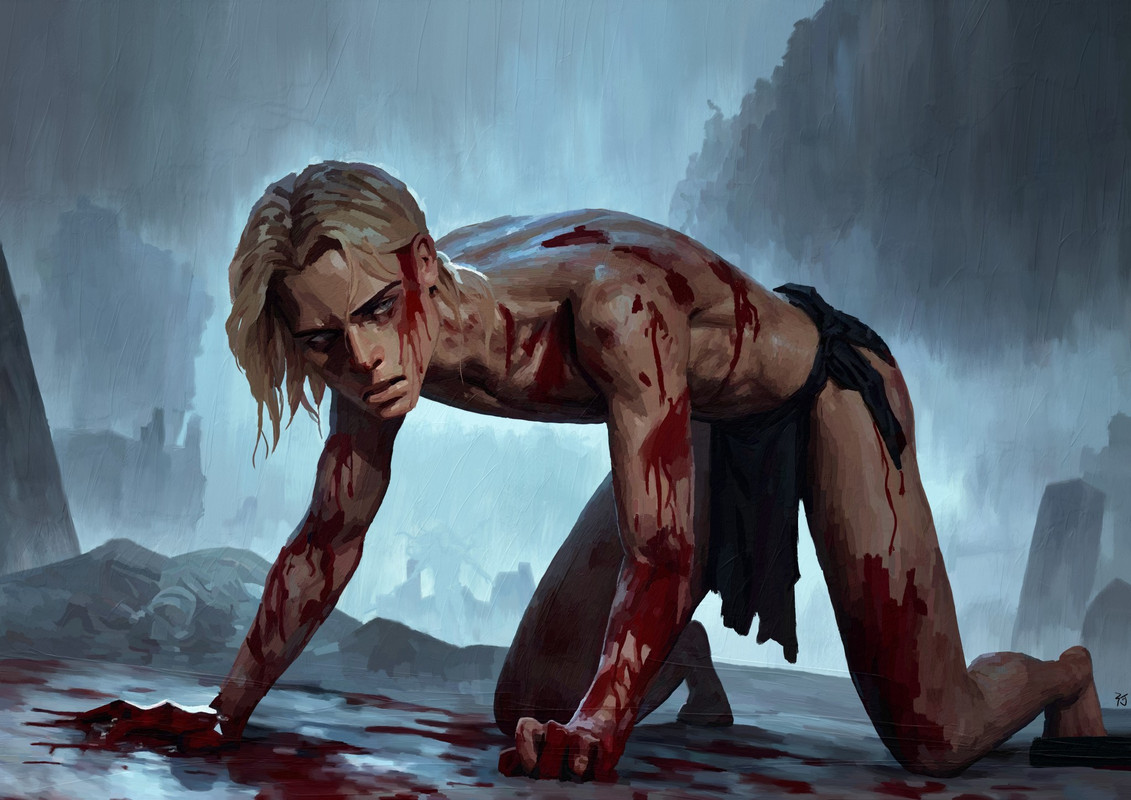
The tapestry shifts, just a little bit. At one time doomed to die here, in the dark and among the wolves, Finrod instead is saved. Young, brave, desperate enough to try the impossible, they pull his spirit back from the brink, and his breath steadies in his chest.
The ride back to Nargothrond is a blur.
Finduilas is aware of the earth speeding below her, the jingle of metal and leather of the soldiers surrounding her. Cool night air and smoke filling her lungs.
They don’t stop, pushing with all haste, riding through the night. The enemy has abandoned Tol-in-Gaurhoth, and all his followers behind. The only enemy they now fight is time.
Luthien sings over his limp form, grounding his spirit back to his body, and Celebrimbor binds his wounds. Finduilas prays, sends her words out the Valar, singing to the wind and the earth and the spirits of the air.
When they reach Nargathond, Finrod is whisked away, stitched up and cleaned. Word is sent to Galadriel, to Thingol, to Fingon, and all the others.
Finrod has been gravely injured, but will live.
And so, the tapestry begins to change. Threads unweave, unravel, are carefully pulled from fabric and rewoven, remade.
It is not easy.
Faced with the difficulties and tragedies of life, it is easy to say to oneself: if only this had happened, or this thing had not happened, or if I made a different choice here, or they had said something different there, everything would be different. Everything that is awful now would be fixed, and everyone would be happy, life would be simple.
But faced with the true reality of a chance at change, it is often just as difficult as before—only in a different direction.
Hiking up a steep hill, one may complain of the strain and exertion, and look forward to the return journey. ‘ This path is not so bad,’ one may say, ‘ if only we were going downhill instead.’ Upon reaching the summit and beginning the descent, one finds that the downward angle makes it much easier to trip on the loose stones, and the strain of legs bracing against gravity makes muscles ache.
Finrod wakes slowly, emerging from the deep, suffocating fog of unconsciousness like a man crawling from the depths of a grave. His body aches, a dull throb in every muscle, every bone. The pain is there, beneath the surface, a reminder of the battle that had nearly taken his life. The fight with the werewolf had left him more broken than he dared admit, and though he had survived, it had cost him dearly. His hands—once so nimble, so skilled—are now bandaged and shattered. His fingers, some of them gone, twitch uselessly against the sheets.
He remembers the moment when Beren and Luthien left, coming to his bedside one morning as the sun streamed through the window. Finrod remembers it in the haze of a dream, still recovering and not quite fully awake. Luthien had held his hand, and Beren had pressed a kiss to his forehead. They spoke of thanks and loyalty, and then they had gone, continuing on their quest.
Finrod is glad Beren is alive, glad he could protect him. If he woke up in that cursed pit again, with the wolf and the chain and Beren, helpless —Finrod would do it again, in an instant.
But that small, bright piece of joy is buried beneath a mountain of bitterness and pain. He doesn't regret what he did, but that doesn't make it easier. Every day he lies in bed, staring at the ceiling, and wonders if he will ever feel whole again.
His hair is still short, unevenly chopped and jagged. He hates it. He hates looking in the mirror and seeing the rough, uneven lengths of what was once his golden crown. He hates the way it makes him feel small, diminished. Worse than that, he hates the way he hates everything. This anger gnaws at him, bitter and consuming, and yet he cannot stop it. He has always been calm, collected, the great king of Nargothrond, the leader his people needed. But now, he feels like a shadow of that man, angry and bitter and broken. His people had forsaken him when he had been at his best, golden and fearless and joyous. Now, he was so much less. What cause had they to stay?
The visitors come in waves, the doors to his chambers opening and closing, but Finrod barely acknowledges them. Apologies, well-wishes, reassurances—they all blur together into meaningless noise. He pushes the letters off his bedside table in frustration, lets the parchments scatter across the floor, and when his healers come to check his wounds, he speaks to them only in gruff, monosyllabic responses. The weight of their expectations—of everyone’s expectations—weighs on him, suffocating.
He should be grateful to be alive. He knows this. But it is hard.
And so he retreats, curling into himself like a wounded animal, refusing to see anyone, refusing to speak. He stays in his room, avoiding the sunlight that spills in through the narrow windows, choosing instead to sit in the shadows, lost in the dark labyrinth of his thoughts. He turns even from Finduilas, though it does not stop her from coming. She sits quietly with him, drawing sometimes, or reading (though now, she reads of war tactics rather than embroidery patterns) like so many afternoons they had spent together before.
He still does not speak, and on the worst of days he sends even Finduilas away.
It is on one of these days—one of the worst—that the door to his chambers bursts open with an unceremonious thud. Finrod doesn’t turn his head, doesn’t even flinch. He knows who it is before she speaks. A part of him wants to jump up, wants to dance. He has missed her so very much. But the larger part of him can't manage the will to move.
“Finrod,” Galadriel’s voice rings through the room, clear and firm. She strides inside, radiating light, as though the very air bends to her will. Her presence fills the space, bright and undeniable. “I’m not leaving until you look at me.”
Finrod doesn’t move, his eyes fixed on the far wall. He hears her footsteps approach, feels her standing beside his bed, but still, he remains silent. He can sense her eyes on him, sharp and assessing. He waits for her to scold him, to chastise him for sulking like a child. But Galadriel does none of those things.
Instead, she sits down beside him. “You know, you’re making it very hard for me to be nice to you,” she says, her tone light but edged with steel.
Finrod sighs, turning his head just enough to glance at her. “I’m not in the mood for visitors.”
Galadriel narrows her eyes. “Clearly.” She leans closer, and before he can react, she tugs at a loose strand of his uneven hair. “But I’m not just any visitor, am I?”
Finrod feels the faintest flicker of something—annoyance, perhaps—but it’s not enough to spark any real reaction. “Go away, Galadriel.”
“Not a chance,” she replies, her voice unyielding. “Look at you. You’re sitting here, wallowing in self-pity, when you should be standing tall, alive. You survived, Finrod. That’s no small thing.”
“I know that.” His voice is sharp, a flash of irritation breaking through. “I know I survived. But that doesn’t change anything. Look at me.” He raises his bandaged hands, the mangled remnants of his fingers barely visible beneath the linen wrappings. “I can’t play. I can’t—”
“You can’t what?” Galadriel interrupts, her tone cutting through his words like a blade. “You can’t be the man you were before? Of course not. None of us can. But you’re still here, Finrod. And that means something.”
Her words hang in the air between them, heavy with truth. For the first time in days, Finrod feels the weight of his own bitterness begin to crack, just slightly.
Galadriel watches him for a moment, her eyes softening, and then she reaches out, her fingers brushing gently through his hair. “Your hair,” she says quietly, “it’s a mess.”
Finrod almost laughs, though the sound catches in his throat. “I know.”
“Well,” Galadriel says, standing up with a determined glint in her eyes, “we’ll fix that.” She walks across the room, retrieving a small pair of scissors from her bag. “Sit up.”
He doesn’t argue. Slowly, painfully, Finrod pushes himself into a sitting position, wincing as his stiff muscles protest the movement. Galadriel stands behind him, her fingers deftly combing through his hair, trimming the uneven edges with a practiced hand. Each snip of the scissors feels like a weight being lifted from him, a small, tangible act of renewal.
“There,” she says after a few moments, stepping back to admire her work. “Now you look more like yourself.”
But she isn’t done. Galadriel picks up a small box from the table, opening it to reveal delicate strands of gold and silver, intricately wrought jewels that catch the light. She begins weaving them into his hair, her fingers gentle and precise. As the cool metal brushes against his skin, Finrod closes his eyes, the tension in his shoulders easing just a little.
When she’s finished, she steps back again, a satisfied smile on her face. “Now, look at yourself.”
Finrod hesitates, but slowly, he turns to the mirror. For the first time in many days, he looks—not just at his reflection, but really looks. His hair, once ragged and uneven, now falls smoothly around his face, gleaming with the jewels Galadriel has woven into it. His eyes are still tired, his skin still pale, but something in his expression has changed. He looks more like Finrod Felagund—the king he once was, and perhaps, the king he can still be.
He takes a deep breath, and for the first time in what feels like forever, it doesn’t hurt.
“Thank you,” he whispers, his voice rough with emotion.
Galadriel smiles softly, her hand resting lightly on his shoulder. “I’m glad you’re still with us, brother.”
Finrod had begun to accept visitors again, his chambers filling each day with friends, advisors, and well-wishers. It was exhausting, but it was also necessary, a reminder that he was still needed, that he still had a place among his people. Slowly, as the days passed, his mind healed along with his body. The bitterness that had once consumed him began to loosen its grip, replaced by a quiet resolve to rebuild what had been broken.
But there was one face he has yet to see—Orodreth.
As the ruler in Finrod’s absence, Orodreth had taken control of Nargothrond after Celegorm and Curufin’s coup, and Finrod knows well the weight of that responsibility. The younger elf’s silence, however, spoke volumes. Guilt clings to him like a shadow, and though Finrod understands it, the absence stings. There hasbeen no word, no explanation, nothing from Orodreth since Finrod’s return, and the emptiness it leaves in Finrod’s heart is hard to ignore.
Days turn into weeks, and still Orodreth does not come.
Then, one night, when even the crickets and night birds had fallen silent and the moon hung dark and heavy in the sky, Finrod awakes to a strange sensation. The air feels thick, as if it holds a secret in its grip, and though the room is quiet, Finrod knows someone was there. Slowly, carefully, he turns over, the weight of his movements heavier than they had been in the days before. His breath comes out in a soft exhale.
It is silent, except for the sound of someone’s ragged breathing. Someone trying very hard not to cry.
“Orodreth,” Finrod says softly, his voice hoarse from sleep.
No answer comes, but the silence that follows is telling. The presence lingers, hesitant, as if waiting for permission.
Finrod forces himself to sit up, wincing at the tightness in his muscles. The stars outside his window cast faint patterns of silver light across the room, and in that dim glow, he can make out the figure standing near the doorway—Orodreth, his posture slumped, his face hidden in shadow.
“Orodreth?” Finrod calls again, more gently this time, his heart aching at the sight.
“I am sorry, Uncle,” comes the faltering reply. Orodreth’s voice is thick with emotion, barely a whisper. “I didn’t—I wasn’t strong enough. I should have stopped them sooner. I should have—”
“Come here,” Finrod interrupts softly.
Orodreth hesitates, but after a long pause, he steps forward. His movements are slow, weighed down by a grief he had not yet allowed himself to feel. When he reaches the bed, he stands there for a moment, unsure, his hands trembling at his sides.
Finrod reaches out, placing a hand on Orodreth’s arm. “Sit with me.”
Orodreth obeys, lowering himself onto the edge of the bed like a child afraid of disturbing something fragile. But he was not a child anymore. He was a grown man, with a daughter of his own, and yet Finrod could still see the boy he had once been—the boy who had looked up to him with wide, trusting eyes, the son of his brother who had followed him with eager steps wherever he went, almost like a son of his own.
Both of them had lost so much in the Dagor Bragollach. But while Finrod had begun to heal, Orodreth had not yet truely grieved. Not for his home, his wife, his father and uncle. The loss and the fear had rooted itself in him, watered by the words of Curufin. Finrod knows well the way cold fear freezes the mind, the bones. He does not blame Orodreth for faltering.
“I failed you,” Orodreth whispers, his voice barely audible. “I failed everyone.”
Finrod sighs, a deep, weary sound, and shakes his head. “No, Orodreth. You did what you could in an impossible situation. None of us could have predicted what would happen. I don’t blame you.”
“But I should have spoken out,” Orodreth says, his voice breaking. “I should have cast them out the moment they arrived. I should have—”
“There is no ‘should have’ anymore,” Finrod interrupts gently. “What’s done is done. All we can do now is move forward. Together.”
Orodreth’s shoulders shake, and for the first time, he allows himself to break. Tears stream down his face, silent but unrelenting. Finrod pulls him close, wrapping his arms around his nephew and holding him as tightly as his strength would allow. Orodreth clings to him, burying his face in Finrod’s shoulder, and for a long time, neither of them speak. The only sound in the room was the quiet, broken sobs of a man who had carried too much for too long.
Finrod rests his chin atop Orodreth’s head, his own heart heavy with the weight of everything they had both endured. The pain of their losses, the scars—both physical and emotional—ran deep. But they were still here, still together, and that was something.
Orodreth nodded against him, his tears slowly subsiding. He pulls back slightly, wiping his face with the back of his hand, though his eyes are still red and puffy.
“I’m glad you’re here,” Orodreth whispers, his voice raw. “I thought… I thought I’d lost you.”
Finrod smiles faintly, his hand resting on Orodreth’s shoulder. “You didn’t lose me. I’m still here. And so are you."
For the first time in what felt like a long, long time, Orodreth meets Finrod’s gaze, and in that moment, something passed between them—a silent understanding, a bond that had not been broken, even by the trials they had faced.
They had both suffered, both stumbled in the darkness of their own minds, but here, in the quiet of the night, they found each other again. Finrod gives Orodreth’s shoulder a gentle squeeze, and he feels another small spark of hope stir within him.
Perhaps, in time, they would both heal.
The power of Morgoth grows everyday, while the elves claw and bite at each other, like rats in a trap. A snake eating its own tail, devouring itself while the enemy watches and laughs.
Finrod stands at his window, a small thing lodged deep into the walls of Nargothrond. One of the last strongholds of Beleriand, his home, his pride and joy. Now the halls he has walked so many times send shivers down his spine, and when enclosed by his rooms of elaborately carved stone his head spins and his breath catches unpleasantly.
Nargothrond and Tol Sirion, both lost to the enemy in different ways but lost nonetheless.
His hands, still bandaged, lay on the windowsill.
Hooves clatter outside, the noise of voices and metal and horses fill the air. Finrod does not crane his neck to look, does not summon a servant to ask. He knows who it is, knows it was only a matter of time before they came, following in the wake of their brothers’ destruction.
Once, as children, Celegorm had broken Finrod’s flute. It was a childish thing, but it had tiny carved birds along the side and had been Finrod’s prized possession. He carried it everywhere, piping high songs and trilling notes wherever he went.
Celegorm—annoyed, jealous, bored or a dangerous combination of all three— had taken it from Finrod one day and let his hunting dogs use it as a toy. They had torn it to shreds, and Finrod had run sobbing to his father.
A toy flute, a broken crown. Shattered, broken to the floor, tossed by careless hands.
Later, Maedhros had come to their house, and had made several very pretty apologies. Celegorm—not too much older still than Finrod—was still learning, was very sorry and wouldn’t do it again. Celegorm, noticeably, stood by and said none of these words himself. Finrod, prompted by his father, had accepted the apology and in a few weeks, they were friends again.
Years later, the tensions between the families rose to become threats at sword point and arguments with harsh words escalated to fists. The cousins condensed, pulling back into family groups and circling each other like rival packs of wolves. Maedhros stopped apologizing for his brothers, and started joining them instead. This time when Finrod tangled with his Feanorian cousins, Maedhros had given Finrod not an apology, but a black eye in return.
Finrod watches Maedhros dismount below and wonders which it will be this time.
He breathes in, lets the fresh air and sunlight fill him, and carries its memory with him as he descends down into the halls of Nargothrond.
Pain still lances through him with every movement, but he stands tall and steady, looking down upon his cousins. The times of riding through Beleriand on hunts, full of life and wonder seem far away, the sunlit childhood of Valinor even further.
He knows Maedhros and Maglor, respects them. They are cousins, after all.
(Celegorm and Curufin had been his cousins, as well. Once upon a time, he had counted them as friends.)
Finrod knows that the scars of Tol-in-Gaurhoth still mar his body. His hair hangs chopped short, the front strands pinned up with a few jeweled clips borrowed from Galadriel.
A harsh line slices through the side of his face, starting from just under his eye and curving around his cheek up to disappear in his hairline.
Maglor’s gaze comes to rest on his hands. Bandaged, broken, and shattered, Finrod’s hands will never be able to play the harp as he once did.
Maglor looks away, but Maedhros meets his gaze.
“Celegorm and Curufin have told us what happened,” Maedhros says.
Finrod looks back at him, raises an eyebrow. “Have they indeed?”
The candles burn low. Shadows from far above slant across the floor. It has been hours.
Finrod is seated, guards behind him. Maedhros and Maglor have remained standing, alone in the center of the hall.
“What would you have me give?” Maedhros says, eyes glinting, challenging. “Their lives?
“Perhaps,” says Finrod. “It would be within my rights. It would be no less than they deserve, not the least for Luthien.”
Maglor shifts, puts his sword hand closer to his hilt. The soldiers behind Finrod shuffle, the quiet clanks of their armor drowned out by the sheer volume of tension in the room.
Finrod holds up a hand. “But.” He says. “I do not ask this.” He meets Orodreth’s eyes across the room. The two of them had spoken long into the night, taking counsel from one another, and Finrod lays out his judgement without hesitation.
In the end, Celegorm and Curufin are stripped of their lands and titles. Disinherited, not quite disowned, Maedhros sends them far to the east, tracking rogue bands of Orcs.
It is a compromise, which means that absolutely no-one ends up happy.
Finrod convinces Maedhros and Maglor with some trouble, the other brothers with a little more effort, and their followers will fall in line eventually. He does not speak to Celgorm and Curufin, not now and maybe not for the next decade.
He does not hate them, he thinks, nor would he be happy to see them dead. He simply does not wish to see them at all.
Thingol is less pleased with the solution, wishing in anger to slay them for their crimes, but Finrod, still a little bitter about how Thingol had treated Beren in the first place, has no hesitation in visiting Thingol, traveling into Doriath limping and still covered in scars. Finrod brings Celebrimbor, who had rescued Luthien, rescued him. Beren and Luthien come back to Doriath as well, and they stand before Thingol together.
He pleads for peace and cooperation between all elves and men, putting aside the past to look to the future danger, and Thingol listens.
Finrod pens a letter to Fingon as soon as they leave Thingol’s court, and then he sleeps for a week.
He wakes up, eats breakfast, and then he makes a list.
Finrod visits the Noldor, the Sindar, the Teleri. He visits the men, the Edain as well as the Easterlings, walking through the camps of Maedhros’ men. He speaks with the dwarves and makes alliances between anyone and anything he can find.
He crosses Beleriand many times over, switching out more horses than he can keep track of.
He often brings Finduilas and Celebrimbor with him. Finduilas, who is finding her voice, Celebrimbor who is trying to find his heart. The two of them have become fast friends, these two young elves, forging a deep friendship despite their family’s history.
Finrod is beginning to think that Maedhros’ plan might just work.
“Absolutely not,” Finrod says. “No.”
Maedhros scowls down at the letter half composed on his desk, his scarred face twisting and burning like a mirage in the flickering candlelight. He looks fearsome, deadly. A demon in the night, a true son of Feanor.
“I thought it sounded polite,” Maedhros protests, sounding nothing more than a sulky elfling.
Finrod stares at him, eye twitching. A one time high king of the Noldor, oldest son of Feanor. Politician, peacekeeper, vastly intelligent in matters of state and warfare both.
Many otherwise insufferable parties in Valinor had passed in the company of Maedhros, watching him produce smooth words to obnoxious courtiers with a quirk of the eyebrow traded in between them the only clue to his true feelings.
Finrod has often regarded him as one his most sensible cousins on the Feanorian side.
Cold wind rushes in through the open window, and the pages of parchment rustle against the table, incriminating words marching across the surface in black ink boldly proclaiming their message to all the world.
Finrod very politely does not say out loud what he is very loudly thinking, and instead shoves the whole sheaf of letters into the flames without comment.
Maedhros blankly stares at the flames quickly devouring the pages, the words going up in smoke. He’s wearing the same robes he has been wearing for the last week. His hair slumps onto his shoulders limp and greasy, unbraided, and the dark circles under his eyes are so deep that one could see them from Valinor.
Finrod doesn’t think he’s seen Maedhros sleep since Finrod had arrived weeks ago.
“Go take a nap,” Finrod sighs, pinching the bridge of his nose. “Then try again. And this time maybe leave out the part about the Silmarils.”
Maedhros’s next draft to Thingol contains much fewer threats of violence and of being forsworn enemies and the wrath of the sons of Feanor raining down upon Doriath like fire from the heavens.
It’s a start.
In time, it comes.
The Union of Maedhros, they call it. (Once, somewhere, they called it the Nirnaeth Arnoediad.)
The story remains as written. The elves come together, the Finwineans and the Feanorians. The Men, Edain and the Easterlings, the Naugrim and the host of Turgon, coming unlooked for from the mountains of Gondolin.
But this time, things are different. Just slightly, a whisper here, a new thread there. Gwindor comes not as head of a small company, but of a large and worthy host, the elves of Nargothrond led by Orodreth himself--brave, fearless. Thingol sends scores of elves from Doriath, the line of communication between him and Maedhros open and empty of any scorn. The Easterlings working with Maedhros and Caranthir are loyal and true, more and more every day.
The battle rages, smoke and blood and the smell of death everywhere, inescapable.
Gwindor is held back by Orodreth, the army does not attack early. When Morgoth bids his treacherous men to attack, the armies of men split--then split again. Treachery against treachery, confusion against confusion.
The sons of Bor take down Ulfast and Ulwarth but amongst the shouts and smoke and confusion Uldor is killed by men among his own guard, who have become loyal to the elves. These men who Finrod has spent so much time with, bringing Edain and Easterlings together, introducing them to elven traditions and enjoying learning theirs.
They reject Morgoth’s treachery at the last minute, leading swaths of men back towards the host of Maedhros. Assailed by three sides, it wavers, pulls apart, reforms. The host of men rengage, bringing new fury and valor onto the battlefield. The sons of Feanor have no need to escape this time, and the host does not scatter. Instead it grows, more and more men joining as they sweep across the field of battle.
High on a hill stands Fingon alone, separated from Turgon and facing Gothmog alone as his guards fall one by one. Fire leaps around him as another Balrog comes up behind, fire whip slashing down—only to be caught by Maedhros. Maedhros, whose host had not scattered, who had not had to escape the battlefield. Maedhros, with his spirit of fire standing back to back with the High King as they drive back the Balrogs, leading their armies further in, pushing back the enemies to the very gates of Angband itself.
And yet, victory is not assured.
Behind them, the battle still rages. Turgon, and his hosts press forward, but the enemy is relentless. Orcs swarm like ants, new foul creatures spill from the depths of Angband, and still Morgoth holds his malice in reserve. Finrod’s eyes flicker to the horizon, where the skies above Angband remain black, as if waiting for a final blow that has yet to fall.
He glances across the battlefield at Maedhros, whose face is set in grim determination, but there is something unspoken in his cousin’s eyes—a fear, a knowledge that not even the combined might of elves and men may be enough to quell the darkness that looms. The enemy has yet to show its full hand.
In the distance, he sees Orodreth leading the forces of Nargothrond with bold courage, Finduilas at his side, her banner streaming behind her like a ribbon of gold. She has grown in these months—no longer the quiet maiden of Nargothrond, but a leader, fierce and determined, her voice calling above the din of battle, drawing her people forward with unyielding resolve.
But Finrod’s heart remains uneasy. Morgoth remains, hidden, his malice lurking like a shadow just beyond sight. The sense of doom hangs in the air, heavy and unrelenting. The threads of fate are tangled, the tapestry unwoven. Has his fate passed him by, or does it yet lie in wait?
Yet amidst the chaos, there is a glimmer. It flickers like the last light before nightfall, an ember in the ashes. For every alliance formed, every hand extended in friendship, there is a chance—a chance that this time, things might end differently.
Finrod stands tall on the field of battle, his golden hair glinting in the dying light of the sun, the roar of battle in his ears like a distant echo. He feels it—a change in the wind, a subtle shift in the threads of fate.
Perhaps this is the moment, he thinks. Perhaps this is the moment when the tide finally turns.
But as his eyes trace the horizon, the dark clouds over Angband still loom, unmoving, waiting.
And Finrod, for all his wisdom, cannot say what lies ahead.
Only that the fight is not yet over. And hope, fragile as it is, still lingers.
For now.