Chapter Text

The Piltover Academy auditorium was not the temple of quiet lectures and theory it usually was. Gone were the tiered seats where professors once pontificated beneath stained-glass oculi; the space had been gutted and reimagined in brass and linen.
What now sprawled was a great and haphazard bazaar of invention. Long rows of demonstration tables jostled for attention on the marbled floor, each bearing strange apparatuses like altars to rival gods. Arc-lamps, strung from wrought-iron gantries above, hissed and flickered, casting long shadows over polished gears and oiled levers. The scent in the air was thick: scorched copper, varnished mahogany, the faint sweetness of ozone.
This was the Distinguished Innovator’s Competition—an annual tempest of ambition and vision, where Piltover Academy’s finest, or at least its most desperate, unveiled the inner machinations of their minds to the city’s elite. The auditorium was a throbbing cacophony: a din of overlapping demonstrations, raised voices, hydraulics, and the occasional alarming hiss from a pressurized pipe.
A mechanical arm attempted to knit a sock and promptly strangled itself with yarn. A self-boiling kettle shrieked like a banshee and spat steam in the face of its inventor, who bowed anyway. An atmospheric condenser quietly turned fog into ice within the glass lungs of a humming cube, prompting the rare song of applause.
The judges floated through this chaos in clusters of three and four—academy staff in pressed uniform, trade lords with silver-topped canes, and venture financiers with toothy smiles. They murmured, took notes, and occasionally raised a brow to devastating effect. Some candidates blanched as they approached; others straightened spines and grinned too wide.
For those gathered here, it was not merely a contest. It was a stage upon which a single brilliant moment might secure a lifetime of funding, patronage, and renown—or else consign an idea to obscurity and student debt.
This was Piltover’s true theater, and the curtain was already rising.
Jayce stood at his table, posture straight as a rifle barrel, but his fingers betrayed him—twitching at his sides, drumming anxious patterns along the seam of his coat. He’d polished his boots twice that morning. Now they scuffed restlessly against the gleaming tile, unable to keep still. The judges were one table away.
He glanced sidelong toward the neighboring exhibit and immediately regretted it.
Dmitri. Of course.
Dmitri and his stupid ponytail already grinning in his direction. The man beamed and raised both thumbs in an encouraging gesture that practically radiated good will.
Top of the class. Preternaturally polite. Unfailingly kind. And always, always looked at Jayce like he'd hung the moon in the sky. Jayce loathed him with every fiber of his being.
Jayce scowled and turned sharply back to his own table.
His exhibition lay at the center like a reliquary in a chapel. It rested atop black velvet, arranged with ecclesiastical care: a gilded cradle of finework brass and filigree. It resembled some celestial device—an orrery or diviner’s scope more than any earthly thing. And yet at its heart nestled the true marvel: a gemstone, glistening blue, teardrop-shaped, held in golden teeth no wider than a compass needle.
Wires spilled from the contraption’s flank like viscera, snaking toward a tall mechanical limb to its right—elbow-jointed and claw-tipped, folded like a mantis in patient wait.
Jayce stirred at the movement in his peripheral. The judges had begun to bleed away from the neighboring display, and his heart climbed into his throat like a stowaway. He adjusted his stance, smoothed a wrinkle from his lapel, gave his curled moustache a twist, and composed himself.
They approached his table in a cluster.
A vastaya in pince-nez and brocade, fur combed sleek as gunmetal. A chirean of considerable height, nails lacquered and spats spotless. A man with a breathing apparatus of wet, hissing filters—the scent of brine and antiseptic trailed him like perfume.
And last, the Dean of the Academy himself: Professor Cecil B. Heimerdinger, who had not missed a single competition in sixty-three years. The yordle's snowy mustache was a sculptural wonder that Jayce often envied.
Jayce inclined his head. “Good afternoon, honored gentlefolk,” he said, enunciating each word with theatrical clarity, though his pulse thundered in his ears. “I am Jayce Talis, son of the late Caetano Talis—explorer, inventor, and the first man to chart the skies beyond the Shadow Isles in search of the legendary Camavor.”
There were a few mutterings of recognition and approval. Everyone knew of Caetano Talis. His name held a weight that Jayce had every intention to exploit.
Jayce reached to the core of his device and delicately unseated the gem from its cradle. It caught the lamplight and held it like breath in a bottle.
“On one such expedition, my father unearthed a most curious mineral—what he called a hexstone. Though it may appear unassuming, this is no ordinary gem. Within it pulses a force that defies steam, coal, or even combustion. Colleagues, this stone may offer what the engines of progress have long cried out for: clean, inexhaustible energy.”
There was a rustle among the onlookers. Heimerdinger’s eyebrows gave a subtle twitch. Nearby students—fellow inventors and visitors both, began to collect in a small crowd.
Jayce returned the stone to its golden housing and flipped a switch.
There was a moment’s silence—then the machine stirred.
Light welled up inside the hexstone like a sunrise in deep ocean. It crackled—delicate arcs of lightning leapt along its cage. The arm beside it unfurled like a serpent stretching after sleep. Servos whined. The claw rotated, then lowered with ritual gravity toward the metal block on the table.
A beat.
Then: a searing beam of blue lanced forth from the core of the claw. The table glowed with it. The metal block sizzled. Half the observers flinched.
Jayce kept his hand outstretched like a showman before a curtain drop.
“Laser cutters, as you know,” he said, “require immense power to operate—usually fed by great quantities of fuel. And yet, this cutter is powered by a single hexstone.”
The beam sliced cleanly across the block, leaving a line of molten silver.
The judges stirred like deepwater fish sensing heat. There were sharp murmurs and the fevered scratchings of fountain pens.
Jayce cast his gaze over the crowd.
His eyes locked with another’s: a young man in the Piltover Academy uniform, leaning on a cane, a year his senior from the color of his cravat. His face was sharp, arresting, his expression one of quiet intrigue. Amber eyes held Jayce’s gaze with disarming steadiness.
Jayce faltered, momentarily thrown off course.
Then he gave a quick shake of his head, cleared his throat, and turned back to the judges, recovering his rhythm quickly.
“Alas,” he went on, “this is the only hexstone presently known to exist.”
A pause. Just long enough for the drama to curdle.
“My father left no coordinates, no records of the site where he found it. That is why I ask for your support. Your patronage, sponsoring an expedition of discovery. With it, I will retrace my father’s steps across Runeterra to find the source of the hexstones. To bring back more, and change the—”
A sudden noise interrupted him.
Wet and sparking, like a metal lung collapsing.
The generator hiccupped. Then rattled. The golden cradle hissed as veins of lightning began to crawl across its arms like restless centipedes. The gemstone's light shifted—brilliant, flickering, too-bright.
Jayce’s smile died.
“No—no no no, not now—”
The machine shrieked. The cutter arm twitched, spasmed, then swung violently to the left.
A student’s project—an elegant clockwork aviary—was reduced to burning feathers and melted brass in a blink.
The cutter jerked again. A nobleman’s hat halved neatly by the beam. Its owner screamed, clutching his scalp and dignity alike.
Jayce lunged for the controls, but the machine was not yet finished in its path of destruction.
The arm rose—higher, higher—then slashed upward in an arc of glorious light.
Right through the gantry.
There was a sizzle as the beam kissed iron. The structure groaned. Weld-points glowed red-hot. A shout echoed across the hall.
“Clear the floor!”
Panic moved like gas through a breached hull.
Innovators scattered, skirts catching, boots slipping on tiles gone slick with spilled oil and tea. The judges fled, coats flaring behind them. The gantry gave a final metallic shriek—then fell.
Arc-lamps burst like supernovae. Wires lashed. Sparks rained.
Flame found silk. A row of tables blossomed fire. Black smoke rose thick and cloying. Screams followed.
And at the center of it all, framed in the infernal glow of a dying dream, Jayce stood in shock.
Still, mouth ajar, like a statue carved in the moment of tragedy.
Professor Heimerdinger stepped through the ruin with the quiet dignity of someone who had weathered worse. It wasn’t the first Distinguished Innovators catastrophe—not by far. His waistcoat ends were scorched. His whiskers stood on end with residual static.
He stopped before Jayce, who glumly lowered his gaze.
“I am sorry, my boy,” Heimerdinger said, not unkindly. “It is a grand dream. But I fear the technology of our time is not yet ready to house such wonders.”
He touched Jayce’s hand—a ghost of reassurance—and turned to follow the tide of scholars, sponsors, and engineers streaming toward the exits beneath the alarm-bells.
Jayce remained a moment longer.
He moved then, stepping back to the smoldering remnants of his table. Amid scorched velvet and crushed metal, the hexstone lay still—dull and dormant. He lifted it from the debris, cradling it in his palms.
He turned to go, casting his miserable gaze to the smoke rising toward the fractured oculi far above, carrying his dreams away with it.
Jayce sat on the Academy steps with the slack posture of the thoroughly defeated. His coat was singed at the hem, and soot had settled in the folds of his collar. In his hands, the hexstone glimmered faintly.
Behind him, the world carried on: fire-brigades doused the auditorium with hissing foam. Students clustered on the lawn, their voices low, scandal-bent. A few spared glares for the man on the steps. Some pointed accusatorily. One threw a crumpled flyer.
Jayce ignored them. He turned the stone over in his palm, as if a new angle might reveal something salvageable. It did not.
“Sorry, Papa,” he murmured to the stone. “I suppose I’ve fucked everything up again.”
There was a clap on his shoulder, startling him out of his melancholy.
“You’ll get it next year, mate,” chirped a voice like sunshine in a bottle.
Jayce didn’t have to look to know it was Dmitri: stupid ponytail bouncing, optimism radiating from every pore. “You were brilliant right up until the bit where everything exploded. And I’m sure you’ll get that part sorted. Just needs a bit of tinkering!”
Jayce said nothing. He didn’t even scowl.
Dmitri gave his shoulder a squeeze, then bounded off to go join their fellow students.
Jayce sighed. He reached for his coat pocket—and froze.
He patted it. Then the other side. Then rummaged through his satchel. Panic prickled.
“Shit,” he breathed.
His notebook was missing.
Years of equations, test notes, frantic breakdowns, errant sketches scrawled in midnight ink. Obsessions, revisions, half-formed revelations. His life’s work—every fevered inch of it. The thought that it all might’ve gone up in smoke filled his gut with a cold, rising horror—
“Looking for this?” said a voice, each syllable rolling with a thick accent.
Jayce turned—and startled.
It was the man from the crowd. The one with the cane and the amber irises.
Jayce found himself eye-level with his leg, around which was wrapped a heavy brace—an intricate construct of brass, canvas, and leather.
He stood a step above Jayce, idly flipping through a familiar leather-bound book. “I must say, Mr. Talis; I’ve never met anyone who signs every single page of their notes. A little egotistical, don’t you think?”
“Give me that!” Jayce scrambled upright, indignantly lunging for the book. He was a full head taller, but the man was quick and unconcerned. He pivoted with a deft flick of his cane, holding the notebook just out of reach like a matador taunting a bull.
“They were impressive pyrotechnics,” the man said, still leafing through. “But this ‘HexTech’ theory of yours—I’m far more interested in that.”
Jayce faltered mid-grab. “I—pardon?”
The man raised an eyebrow. “It worked, did it not?”
“I… suppose so,” Jayce muttered, rubbing the back of his neck. “But I can’t stabilize the output. It always hits a runaway threshold and overfeeds the system.”
“Have you tried increasing the frequency?”
Jayce blinked. “I’ve always focused on dampening the oscillations.”
The man stopped at a page. “Ah, and therein lies your issue.” He drew a pencil from his vest pocket and scribbled a few marks. “Here—see this? You are thinking in terms of suppression, but the stone will only stabilize at high frequency.”
Jayce leaned in. His eyes widened.
He took the notebook from the man's hands. Fingers tightening on the edges, he stared. The numbers clicked—one by one, like tumblers in a lock. Wonder bloomed in his chest. Circuits re-routed, formulas realigned. The whole mad tangle of his generator shifted around this single correction, and for the first time, it all fit.
“So… I have to crank it,” he breathed.
The man blinked. Then gave a soft laugh. “Yes. You have to, eh, crank it.”
“It certainly works on paper, but...” Jayce mumbled. “I must test this immediately.”
“A tad troublesome with a melted generator,” the man noted.
“I have another at my workshop,” Jayce replied. “A prototype. Not as refined, but it’ll do what we need it to do.”
“We?”
Jayce smiled—wide and sincere—then reached out to clap a hand on the man’s narrow shoulder, who raised a curious eyebrow at the contact.
“You solved the issue,” Jayce said. “You ought to see it through with me.”
The man regarded him. Then, with a shrug, “Lead on, then.”
Jayce turned, eagerly bounding down the steps with renewed purpose—then paused, glancing back.
“I realize I don’t even know your name.”
The man gazed at him for a moment, a slow smile crossing his face.
“It’s Reveck. Viktor Reveck.”
Jayce’s workshop was nestled in the higher tiers of Piltover’s steel-clad spires, its tall windows half-blinded with soot and the pale grease of citylight. It was a generous space, by skyloft standards—larger than most flats, warmer than most laboratories—but still little more than a single open chamber, subdivided by purpose rather than walls.
The air carried the scent of hot brass and machine-oil, undercut faintly by burnt toast and chemical cleaner. The heart of the room was a labyrinth of scarred worktables thick with clutter: coils of copper wire, screwdrivers with polished wooden handles, half-dismantled engines, cracked plates, and the carcass of a gear-driven armature. Shelves lined the walls from floor to ceiling, groaning under the weight of metal scraps, tins of solder, and a great many glass jars labeled in unreadable scrawl.
A blackboard dominated one wall, covered edge-to-edge in equations: careful loops of chalk interwoven with furious bursts of notation. Arrows, question marks, corrections on top of corrections. A cup of old tea had fossilized beneath it.
Pipes ran along the ceiling like the arteries of the place, rumbling softly in a soothing intone. Steam hissed gently from a pressure valve in the corner, casting the room in a steady thermal breath—warmth that pooled in corners and made the dust dance.
There was, ostensibly, a living space—tucked behind a freestanding shelf of servo-motors and leather forgewear. A narrow cot, slightly sagging. A chipped mirror hung above the workshop sink, perpetually smudged with soot. A battered skillet sat on a hot plate beside a shelf of food stocks—a sack of cornmeal, a half-empty breadbox, a butter bell, a sliced-into wheel of cheese that was beginning to mold.
Jayce winced the moment he stepped inside. The mess hit him like a wrench to the temple. Gods preserve him—his undergarments still lay on the floor by the cot.
He darted across the room in a desperate lurch and toed them under the bed, trying to make it look like part of his natural stride.
Viktor stepped in behind him, gaze flicking about with an unreadable air. Jayce cleared his throat and attempted to straighten both his spine and what was left of his dignity and manners.
“Can I take your coat? Or get you a cup of—”
“Is this a schematic for a hexstone-powered airship engine?” Viktor interrupted, already drifting toward the chalkboard, his cane tapping softly against the copper-gridded floor.
“Oh!” Jayce hurried after him, clasping his hands behind his back. “Yes—well, it’ll need adjusting now, of course, with your correction. But yes. I’ve long believed that, in sufficient quantity, hexstones could provide enough energy for sustained flight. Even for something as massive as an airship.”
“Fascinating,” Viktor murmured, plucking up a piece of chalk. Without hesitation, he began annotating the margin of Jayce’s equations. “The lattice array is clever. Of course, you will need to compensate for the feedback loop inherent in high frequency stimulation.”
Jayce’s hand twitched at the sight of someone else marking up his board. But then the shapes began to take form—lines arcing into elegant solutions, numbers balancing like weights on a scale. He seized another piece of chalk and joined him, excitement eclipsing discomfort.
“If we brace this channel,” Jayce said, sketching in stabilizers along the conduits, “we might be able to contain the cascade.”
“Indeed,” Viktor nodded, lips quirking faintly. “Imagine it—a world where the range and cost of airship travel are no longer fettered by fuel reserves.”
“I’ve imagined that my entire life,” Jayce replied, voice soft. He raised his hand, gaze catching on the leather bracelet at his wrist. Nestled in its brass socket, held fast by tiny teeth, glinted the hexstone.
Viktor’s eyes flicked to it, then drifted toward the nearby workbench, where the generator prototype squatted like a steel beetle. It was a crude thing: all raw edges and utilitarian rivets, worlds apart from Jayce’s brass display model. That one had shimmered with careful filigree and persuasive charm. It had to—Piltover judged progress as much by polish as by proof. Appearances mattered. Theatrics mattered.
Jayce was good at that sort of thing. He had, after all, once wanted to be a magician. The kind with white-gloved prestige and fog machines. In a way, he had simply followed the illusory down a different path.
Viktor stepped to the workbench and leaned his cane against the side. Long fingers splayed on the surface, studying the device.
“Hm. We should reinforce the housing before the frequency test. Reroute the circuit.” His brow furrowed. “Do you have additional resistors?”
Jayce turned to a shelf, running a finger along the neatly labeled crates until he found the right one. With a grunt, he pulled it down and carried it to the bench, setting it down with a thud. Delicate metal parts glinted within.
He then reached for a basket shoved into the corner, pulling out a set of parchment diagrams and unrolled them across the table. They fanned out like a tapestry of ordered chaos: blue ink, grease smudges, coffee stains, careful notations and crossed-out miscalculations.
Viktor leaned in, and they both stood over the paper, adjusting the lines together—recalculating, drawing arrows, making tiny marks in mirrored handwriting. They moved like dual clock hands: circling, crossing, never quite touching.
Jayce found his gaze drifting to the man beside him.
It was strange. He had always worked alone. Preferred it, in truth. Solitude gave him clarity, let him tinker without friction or compromise. But this—this quiet collaboration with Viktor—was unlike anything he’d ever known.
There was a rhythm to it. An undeniable synchrony. Like two gears slotting into place, rolling along with perfect calibration. They filled in each other’s thoughts without speaking, passed utensils without asking. Viktor corrected an equation just as Jayce was about to reach for it.
It sent a strange little thrill through him.
He looked back down at the paper, a small smile tugging at the corner of his mouth.
When at last their revisions felt sturdy enough to summon reality from theory, Viktor moved to another bench for the soldering tools. Jayce gathered the final parts, clearing away what wasn’t needed. The light outside had grown soft, gilded—the hour when the aerial trams above began to hum like tuning forks across the sky, heralding Piltover’s descent into the wakeful evening.
Viktor rolled up his sleeves, revealing pale forearms smattered with moles. Then, with a sidelong glance at Jayce, said, “I’ll take that cup of whatever you were offering earlier. I have a feeling we’re going to need it.”
Jayce grinned, already heading toward the kettle.
It was well into the early hours of the morning, and both were on their fifth cup of coffee by the time they stood side by side, gazing at the adjusted generator.
It resembled some lab-born monstrosity, cannibalized from the corpses of half a dozen other machines. Tubes wound like entrails. The housing bulged. Ugly, in all senses. But it followed the schematics as required.
“I suppose,” Viktor said, glancing over, “it is time to crank it.”
Jayce exhaled, stepped forward, and fitted the hexstone into its cradle. It slid into place with a satisfying click.
His hand hovered over the ignition switch.
And suddenly, the events of the previous day surged back—the memory of heat, the shriek of rending metal. Smoke clawing at the ceiling. The wistful look in Heimerdinger’s eyes. The ash that had once been his reputation.
The sound of a throat clearing startled him out of his spiral. He looked up.
Viktor’s expression was calm. Thoughtful. His eyes were steady pools of polished amber.
“This HexTech theory of yours has the potential to make the world a better place, Mr. Talis,” he said gently. “Have faith in that dream.” Then, a dry, lopsided smile: “Even if it means setting a few rooms ablaze in the process.”
Jayce held his gaze for a long moment. Then, slowly, returned the smile. He turned back to the console—and flipped the switch.
The generator gave a groaning hum. The hexstone, nestled within its cradle, flickered dimly at first—like a candle struggling to catch. Then the resonator engaged. A low-frequency whir grew in pitch as Jayce adjusted the dial, coaxing the machine toward the frequency Viktor had theorized. The stone brightened, deepening to that familiar otherworldly blue.
Along the workbench, the array of test bulbs flared to life—one by one—bathing the workshop in soft, clean light.
But the joy was short-lived.
The machine began to protest. The hum became a snarl. Energy arced across the coil array with a furious snap. The lightbulbs flickered, surged. Sparks flew from the housing. Blue lightning crackled around the exposed wiring.
Jayce’s eyes flew wide. “I don’t think it’s going to hold! Look at the buildup—!”
He lunged for the cutoff switch—but Viktor’s voice stopped him in his tracks.
“The resonance will stabilize it!” Viktor shouted over the rising din; his voice laced with conviction. “Trust me!”
A beat later, the machine screamed—a final, blinding surge of light bursting from the hexstone. Both men staggered back, Jayce reaching instinctively to steady Viktor, his hand gripping his arm just before he might’ve gone down.
Then—silence.
The light settled.
The arcs faded.
The generator purred like a satisfied beast. The hexstone glowed, steady and sublime. The bulbs along the bench now shone with unbroken, unwavering light.
Jayce stared, dumbfounded. Then exhaled, breath trembling.
“My gods,” he murmured, half in awe, half in disbelief. “It worked.”
Viktor, still catching his breath, regarded the machine quietly, face bathed in ethereal blue. Then he turned to Jayce, eyes sharp with new interest.
“Tell me more about this expedition of yours.”
The journals of Caetano Talis were legion.
Bound in weathered, oil-dark leather, they bore the scent of exhaust, ozone, and distant shores. Their pages were ragged and well-travelled—creases worn into the parchment like old scars, stained with tea, mud, and ink spilled in haste. Some entries were written with academic precision, others with jagged urgency. There were sketches of impossible beasts, portraits of people, maps whose edges curled like withered petals. Margins teemed with notes and counter-notes, some in Caetano’s faded hand, others newer—Jayce’s corrections and questions scrawled in fresher ink.
Jayce had laid the lot of them out across the floor—the only remaining surface untouched by parts or debris. Jayce sat cross-legged amidst the sprawl, while Viktor reclined with one leg tucked beneath the other, his braced limb stretched stiffly forward. He nibbled, distractedly, at a stale tea biscuit Jayce had unearthed from a tin at the man's request for something sweet.
“When my father passed, all of this came to me,” Jayce said softly, lifting one worn volume in both hands. “His maps. His logs. Every word he ever wrote about his expeditions.”
He flipped through a journal, pages whispering as they turned. “As I mentioned during the presentation, there’s nothing here about the hexstone. Not a word. Not where he found it. Not what it is. He never wrote of it.”
He glanced across the room, to where the crystal pulsed with steady blue light in its housing. “He mailed it to me on my birthday,” he added, voice dry. “He was on expedition at the time. Communication wasn’t exactly his strong suit.”
He slid a folded map toward Viktor, who reached out, tracing the winding red path inked over its surface—like the flight of a drunk wasp.
“Still,” Jayce continued, “I think I’ve figured out his trail. I’ve spent years comparing his travel notes to shipping logs, scribbled itineraries, even postmarks on old letters. If I follow his steps, I believe I can find the source.”
Viktor studied the map in silence, then said, “That could be a very long journey. Worst case, it takes you across the entirety of Runeterra with nothing to show for it. Two years, maybe more.”
Jayce only shrugged. “What’s two years,” he murmured, “compared to the future of clean energy?”
Viktor merely nodded.
Jayce sighed wearily, elbows braced on his knees. “Not that it matters now. After that disaster at the showcase, the investors won’t come near me. I doubt I could even get in the room.”
Viktor considered this, chewing slowly.
“Hm,” he said. “I may be able to help in that matter.”
With a grunt, he leaned forward, gripping his cane, and pulled himself stiffly to his feet. He looked down at Jayce with unreadable eyes.
“Tell me something, Mr. Talis.”
Jayce looked up.
“Is this truly what you want to do?”
“What do you mean?”
“If someone gave you the means—passage, funding, time—would you really go? Tomorrow, next week, for two years or ten? Would you leave everything behind for something you may never find?” A pause. “Or is it all just a grand dream?”
Jayce blinked. Then slowly, solemnly, rose to his feet as well.
“I’d leave tonight if I could,” he said. “I’d leave everything—my studies, my home, my family. My father was a remarkable man. He chased the impossible and never looked back.” His gaze drifted to the maps again, to the chaos of paper and ink and legacy. “I want to be a man he would’ve been proud of. I want to change the world. And I’ll do whatever it takes.”
He smiled, small yet certain.
“I’ve already given my life to this. What’s the rest of it?”
Viktor studied him a moment longer. Then, apparently satisfied, he reached for his coat and shrugged it on.
“Meet me in Zaun,” he said. “Vertigris Station, gate seven. Tomorrow. Two o’clock.” He paused at the door, amber eyes glinting under the flicker of the lamps. “Bring the hexstone. And the generator schematic.”
A beat.
“Do not be late.”
-={ ⚙ }=-
As the clean, orderly avenues of Piltover gave way to the crooked teeth of the Undercity’s maw, the air itself seemed to shift. Marble façades and gleaming brass gave way to soot-streaked stone and oxidized copper. The descent into Zaun was not gradual—it was a plunge. The tram clattered into the great fissure that sundered the earth, swallowed whole by the shadow of the chasm.
Zaun was a city built downward, not outward. It clung to the vertical walls of the canyon like a stubborn fungus, buildings stacked atop one another in impossible tiers, stitched together with steel walkways and bolted scaffolds. The sky—what little of it could be seen—was obscured by the dense canopy of metal and stone overhead, choked further by ribbons of thick smoke and steam that rose from vents and smelters below.
The air was thick with smog and chemicals. Breathing it felt like swallowing iron filings. Jayce’s eyes burned, watering against the acrid sting. He tried not to look too closely at the slick green runoff pooling in the gutters.
Trams rattled along cables overhead, their riveted hulls crusted with grime and welded repairs. They groaned as they passed, hissing like angry beasts, ferrying passengers through winding arteries. Tracks crisscrossed the buildings at odd angles—some horizontal, others vertical. Jayce watched one tram pause mid-air, suspended on its track like an insect caught in a web, before shuddering into motion again.
Vertigris Station was nestled into the side of one such overpass, bolted into the rock like a barnacle. The lettering of its sign was flaking and corroded, barely legible. The platform was narrow and crowded, flanked by reinforced girders and venting pipes that spat clouds of steam at irregular intervals. The walls were rust-streaked and covered in old flybills: job postings, missing persons, offers for augmetics and blackmarket serum. Somewhere nearby, a whistle blew, and a blast of pressurized air screamed through the tunnels below.
Jayce stepped off the tram with one hand on his satchel, the other clutching his coat against the press of the crowd. The floor underfoot vibrated faintly with each passing car. He kept moving, boots echoing on grating, eyes scanning the smoke-fogged platform of gate seven.
“Afternoon, Mr. Talis.”
Jayce startled and spun on his heel.
Viktor stood behind him, composed and incongruously elegant amidst the gloom—both hands resting atop the head of his cane like a dapper statue carved out of finer stone than the city around him.
Jayce straightened, clearing his throat. “Mr. Reveck.”
Viktor glanced at the silver timepiece he drew from his coat. “You’re early. Excellent. Follow me.”
He turned without waiting, descending deeper into the station’s interior.
Jayce hesitated, then scrambled after him, boots skidding slightly on the damp metal grating. “Are you, uh… are you from here?”
“I am a Zaunite, yes,” Viktor said, not looking back.
“Oh. But you study at Piltover Academy?”
Viktor cast him a sidelong glance, the corner of his mouth curling upward. “One can achieve many things with sufficient will. Even a poor cripple from the Undercity.”
Jayce flushed. “That’s not what I—”
“I know, Mr. Talis.” Viktor’s voice was amused and not unkind. “Come. Stay close. And do keep a hand on your belongings—pickpockets here are quite deft.”
Jayce winced and clutched the strap more tightly, trailing after him through the crowds.
“Where are we going?” Jayce asked as they stepped from the station into the winding arteries of Zaun proper.
The streets outside were alive with motion and noise—boots clattering on steel walkways, hawkers shouting in rough dialects, steam hissing like the breath of some slumbering beast. The buildings pressed close on either side, an architectural mishmash of rusted girders, weather-stained bricks, and bolted-on extensions. The road sloped steadily downward, carrying them deeper into the Lanes, into the dark marrow of the city.
“To meet your potential investor,” Viktor replied evenly. “I do hope you are prepared to plead your case.”
“O-of course. Who are we meeting?”
“Silco.”
Jayce nearly tripped over his own feet. “Lord Silco?!”
“Indeed. Problem?”
“N-no, I just…” Jayce looked down at his clothes, though proper, felt rather plain for meeting a lord. “I would have worn a better coat.”
“Unlike your Piltie venture capitalists, Silco is not a man impressed by gift wrapping so much as contents.”
Jayce frowned, unconvinced. Even if that were true, he dearly wished he had known he’d be meeting the steward of Zaun himself. He’d heard stories—everyone had. A revolutionary turned autocrat. They said he’d seized control after ousting the so-called “King of the Lanes,” Vander, and controlled the corrupt chem-barons by giving them each a sector to bleed dry through predatory ventures like drugs and the sex trade.
“What if I say the wrong thing?” Jayce asked, voice an octave higher.
“Then I’m afraid you’ll be going home with a few less fingers.”
Jayce stopped in his tracks, horrified. Viktor merely kept walking, the faintest smirk tugging at his mouth. “Better be right, then.”
They descended further, the world tightening around them. Overhead, the last threads of sky vanished entirely, swallowed by pipes and overhangs. A distant tram rumbled by on overhead rails, sparks raining in its wake. The air thickened with oil and ozone. Faces in the crowd grew harder, warier. Jayce kept close behind Viktor like a shadow clinging to light.
They came to a building set apart from the grime around it—not grand, but maintained. The brick was intact, the sign welded in crisp copper letters: Administrative Hall. Two guards flanked the entrance. One look at Viktor, and they stepped aside without a word.
Jayce swallowed hard as they stepped through.
Inside, the floorboards creaked beneath their steps. The walls sweated with rust. A wheezing elevator carried them up through the bones of the building, each floor shot by like lost final chances. A flickering green bulb lit the hallway ahead in sputtering pulses, casting everything in a sickly pallor. Jayce’s nerves were sparking like exposed wire. His palms were damp. His heart a hammer in his chest.
They stopped before a large door. Iron-braced wood. Bolted hinges. Jayce braced himself—there would be a throne, surely. Or chains. Bloodstains, maybe. Viktor reached for the handle.
And opened it into—
A simple office.
No throne. No torture devices. Just a modest room with wooden furniture and book-laden shelves. A filing cabinet in the corner, a ticking wall clock, and a coat hung on a peg.
A slender man sat at the desk, leaning over paperwork. He looked up casually as they entered. One side of his face was badly scarred, and his right eye was mechanical, flickering faintly. But his expression was calm, almost fond.
“Afternoon, Viktor,” he said, flipping a page. “You do know you don’t need an appointment to see your own father, yes?”
Jayce’s eyes widened. He snapped his head to Viktor in shock.
Father?
Now that he stared, he could almost see it—in the bone structure, mostly.
“The appointment is not for me,” Viktor said evenly, gesturing toward Jayce. “My colleague has a proposition for you.”
“Oh?” Silco leaned back in his chair, folding his hands as he fixed Jayce with a gaze that was more curious than cold—but still sharp enough to cut. “And what is it, exactly, that’s managed to capture my dear Viktor’s interest? That’s no small feat.”
Jayce hesitated, feeling himself wither just slightly beneath that stare. Then he straightened his spine and cleared his throat, brushing down the front of his coat as if to smooth out the nerves along with it, and offered a polite bow.
“Lord Silco. My name is Jayce Talis. I’m the son of—”
“He’s invented clean energy,” Viktor interjected. “And he’s here seeking investment.”
The air whooshed out of Jayce's lungs all at once, along with the tidy presentation he’d rehearsed. He cast a quick look at Viktor, who gave no sign of mischief—just efficiency.
Silco’s brows lifted further, his interest visibly sharpening. He glanced between the two men before resting his chin lightly on one hand.
“Go on, then.”
Jayce took a breath, reaching to his wrist and unclasping the hexstone from the bracelet. He held it up between them. In the dim light of the office, the gem glinted a deep blue.
“It’s called a hexstone,” he said. “When exposed to certain resonant frequencies, it produces vast, sustained energy. One stone can power a high-drain mechanism. It’s efficient, renewable, and—most importantly—emission-free. No coal. No waste.”
He glanced out the window, where Zaun’s sky lay blanketed in heavy smog. “HexTech could render fossil fuels obsolete.”
Silence settled over the room like dust.
Viktor held out his hand, and Jayce passed the stone to him without a word.
“Unfortunately,” Viktor said, turning the gem between his fingers, “this is the only known specimen. Mr. Talis intends to lead an extensive expedition to trace its origin.”
Silco rubbed at his jaw, eyes narrowing in thought. “And you’re looking for someone to sponsor this expedition, I take it?”
“Yes,” Jayce said, standing a little taller. “I’ll handle the logistics. I just need the means. A ship. A crew. Supplies. Enough to sustain a long-range journey.”
“And in return,” Viktor added, his gaze steady on Jayce, “when the origin is found and HexTech begins implementation, Zaun benefits first.”
Jayce met his eyes—and in that moment, he saw it.
He saw past Viktor’s measured tone and neutral expression. Saw the purpose burning beneath, fierce and simmering. A son of Zaun who had not forgotten the choking haze, the children with blackened lungs, the families who lived their whole lives under a sky that never cleared.
Viktor wanted to clean the air. Wanted to heal his home.
And that—Jayce realized with a sudden swelling warmth—was exactly what he’d always wanted too. To change the world. To make life better for the people who needed it most.
For the first time, the mission felt tangible. Purposeful.
Jayce opened his mouth, about to agree—when the door suddenly slammed open with enough force to shake the hinges.
“Silco!”
A high-pitched, lisping voice rang out, and before Jayce could so much as turn, a flash of electric-blue hair whipped past him.
A girl of maybe nine barreled into the room, boots stomping on the wooden floor. Her goggles were crooked on her forehead, and she was breathless with excitement as she skidded to a stop in front of Silco’s desk.
“I need cogs!” she blurted, practically vibrating. “The Crawling Wagon just set up down by the Oilridge tramline and they’ve got a genuine atmospheric pressure cannon! It’s a limited run and it’s got chrome inlays and a smoke emitter and—!”
“Powder, darling,” Silco sighed. “I’m in the middle of a meeting.”
The girl blinked, finally seeming to notice the room was not empty. Her gaze bounced from Jayce to Viktor—then lit up like fireworks.
“Viktor!”
Before Jayce could react, she launched herself across the office and collided with Viktor in a hug, nearly knocking him off balance.
“I thought you weren’t coming home 'til next weekend!” she exclaimed, beaming up at him.
“Just visiting,” Viktor managed, steadying himself with a soft grunt.
“Ooh—what’s that?” Her attention snapped instantly to the hexstone in his hand, eyes widening, reaching for it.
Jayce instinctively took a step forward, unsure whether to intervene, but Viktor calmly lifted the stone higher, out of her reach.
“It’s not a toy,” he said sternly.
“I just wanna look!” she insisted, bouncing on her toes and making increasingly wild grabs for it.
“You’ll pocket it and vanish before I’ve blinked,” Viktor accused, holding the gem firmly aloft.
Powder grinned mischievously. “Your arms will get tired before mine do. You always get tired—”
Before she could finish, a new hand slipped into view—pale, spindly, long-fingered—and Viktor wordlessly dropped the stone into it.
“Hey!” Powder cried, indignant.
Jayce blinked in surprise. A tall man had silently stepped between them, wrapped in a long coat with one eye milky-white and half his face obscured by a dark gaiter. He examined the hexstone with a low, rasping grunt.
“Curious,” the man muttered, turning it in his fingers.
“Afternoon, Corin,” Silco said dryly. “I assume you were eavesdropping.”
“Naturally.” Corin’s voice was hoarse and gravelly, like gears grinding under pressure. His gaze flicked to Jayce, piercing. “Did you bring data to support your claims, boy?”
Jayce’s brain stuttered for a beat before he coughed and fumbled for his satchel. “Uh—yes, I—uh—”
He pulled out his leather-bound notebook and flipped to a page of schematics, handing it over.
Corin took it, already scanning it as Silco leaned back in his chair, allowing Powder to clamber into his lap with an exaggerated pout. The image made Jayce's head spin with cognitive dissonance—the tyrant lord whose name is whispered in fear back in Piltover, with a little child hanging off his arm.
“Can it work?” Silco asked.
“Perhaps,” Corin muttered, eyes still on the page.
Viktor stepped closer to Jayce and murmured, “This is my mentor. Dr. Corin Reveck.”
Jayce startled, looking between Viktor and the man, the names suddenly clicking into place. He was quite confused as to why Viktor bore this man’s surname if Silco was his father—but that wasn’t the part that truly alarmed him. “Wait... that Corin Reveck? The one who was—”
“—removed from the Academy for illegal practice,” Viktor finished. “Yes.”
Corin didn’t look up. “A matter of philosophical disagreement.”
Jayce wisely kept his mouth shut, resisting the urge to say anything that might result in lost fingers.
Corin handed both the notebook and the hexstone back to Jayce. “The theory appears solid,” he said, folding his hands behind his back and turning to Viktor. “You trust it, then?”
“I have seen the generator function exactly as described,” Viktor replied evenly.
“It was Viktor’s refinement that made it work,” Jayce added quickly, glancing between Corin and Silco. “I couldn’t have stabilized the mechanism without him. But with further tuning—and a steady source of hexstones—I’m confident I can provide you with viable clean energy generators.”
Both men nodded, clearly intrigued.
Powder, meanwhile, was half-sprawled on the desk, flipping a letter opener between her fingers.
“Does it explode?” she asked, hopefully.
Jayce winced. “Uh… not anymore.”
“Hmm. Boring.”
Silco sighed and nudged her off his lap. “Go find your sister.”
“But the Wagon—!”
“Ask your other father.”
With a theatrical groan, she slouched toward the door. But before she left, she threw her arms around Viktor again, squeezing tight. “Will you go to the river with me soon?”
“Tomorrow,” he promised gently, smoothing a hand over her hair.
That seemed to satisfy her. She released him, stuck her tongue out for good measure, and scampered out—slamming the door behind her.
Silco laced his fingers together atop the desk.
“I’m willing to finance this endeavor,” he said slowly. “But with this year’s infrastructure repairs, I fear the funding may be… less generous than you were expecting.”
Jayce’s heart leapt into his throat. His hands clenched at his sides, trying to contain the surge of hope rising in his chest. “O-of course! That’s no problem at all.”
“We’ll draw up the details in writing,” Silco said, reaching into a drawer and flipping over a small business card. “Lawyer to lawyer. I’ll provide the base means—funds for the expedition, materials for fabrication—and in exchange, you’ll bring these... HexTech generators to Zaun.”
“Agreed—” Jayce started eagerly.
“I have another condition,” Viktor interrupted.
Silco looked up. Jayce turned, brows raised in question.
Viktor’s fingers tapped once against his cane, then stilled. He held Jayce’s gaze, and there was something measured in it, like the first careful movement across thin ice.
“I go with you.”
Jayce blinked. “Y-you… want to go on the expedition?”
Silco sounded even more taken aback. “Viktor. Your studies—”
“It is common for students of my year to pause their coursework for a Grand Tour,” Viktor stated. “A ridiculous coming-of-age tradition where the privileged go abroad, spend their parents’ money, and return with stories of wild beasts and dinner parties. The Academy makes concessions for it. This expedition seems… infinitely more productive.”
Silco frowned, chewing on his inner cheek thoughtfully. “It’ll be dangerous, boy. Is this endeavor truly worth the risk to you?”
Viktor didn’t respond immediately. He turned away, moving toward the window. He stood there a moment, quiet, then looked up—up past the haze, toward a sky long hidden from view.
“If I can help bring clean air to Zaun,” he said softly, “bring the stars back?” He turned, eyes luminous. “That’s worth every risk to me.”
Jayce could only look at him, struck dumb by the earnestness in his voice, the passion in those eyes. A long moment passed before Jayce finally managed, “Well… I’d be honored to have you along. I really would.”
Viktor dipped his head, and Jayce caught the faint, almost childlike excitement flickering in his gaze. It kindled something in Jayce too, and he felt the fire erupting in his core.
Silco sat back slowly, studying Viktor with an unreadable expression. “Then it’s settled, I suppose,” he said. “We’ll work out the details. I’ll charter a vessel and allocate a budget for supplies. You’ll be ready to depart… by next month.”
Next month.
Jayce’s thoughts reeled. His pulse thundered. After years of dreaming—it was finally happening next month. A real expedition. A real chance to change the world.
He turned to Viktor again, and a wide, bright grin overtook his face.
And he wasn’t doing it alone.
As they stepped out of the administration building, Jayce felt like his thoughts were floating a few feet above him—dizzy with excitement, disoriented by all that had just happened. And yet, even amid the thrill, he couldn’t help glancing at the man beside him and blurting out, “So… Silco’s your father?”
Viktor gave a small, amused smile. “Adopted. He and Vander took me in when my parents died.”
Jayce blinked, nearly tripping over a crack in the uneven cobblestone. “Wha—Vander? The Vander?”
“Oh yes,” Viktor replied casually. “His husband. Happily retired from politics. He tends to his subterranean gardens and occasionally lectures children on minerology.”
Jayce could only gawk. He’d grown up in a world where history was taught in moral binaries—Silco the revolutionary tyrant, Vander the fallen idealist. Not lovers. Not… parents.
Viktor gazed at Jayce knowingly.
“Piltover likes to make bogeymen of issues they prefer not to address.”
Jayce closed his mouth, letting the revelation settle like dust in his lungs. He glanced down at the oil-slicked cobblestones beneath his boots, the iridescent sheen catching dully in the artificial, amber light. Piltover’s polished version of history suddenly felt paper-thin and flammable.
How many other “truths” had he swallowed without question?
“So… why Reveck?” he asked after a pause.
“Corin is my mentor,” Viktor said. “In Zaun, where many go without names, it’s tradition for a mentor to pass theirs down, if they have one.” He looked up—past the pipes and scaffoldwork, through the filtered haze—to the shimmering outline of Piltover’s towers high above. “His name still carries weight in certain circles. And in Piltover?” A humorless smile tugged at his mouth. “Even a disgraced name is better than none.”
Jayce hummed, thoughtful. His father had carried the Talis name from Ixtal, built it into something meaningful with his own two hands. Caetano had bestowed on him more than blood—he’d handed him momentum. Jayce had never stopped to consider what it might mean to have no such privilege. To start from dust.
“You didn’t mention to Silco that the Academy sometimes expels students who go on Grand Tours,” he said. “Why would you risk something so important? For this expedition?”
Viktor gave a short huff. “You think it’s my life’s ambition to become a cog in Piltover’s machine? An Academy education will take me places, yes,” he allowed. “But I’m an opportunist first.” He cast Jayce a sideways glance. “And when I flipped through your notebook... I had a vision.”
“A vision?”
“Of the future.”
Once again, those amber eyes burned with passion.
“A world powered by your HexTech dream. Not just clean energy—not just a replacement for coal. Think of it—technology without energy bottlenecks. Limitless, scalable. Devices you can hold in your palm. Powered prosthetics. Machines that think. Cities that breathe.” A pause. “We could give power to people who’ve never had it.”
Jayce stood beside him in the road, stunned into silence by the vision as it unfolded. He could see it now—like a veil had lifted. And once again, as he stared at the man in front of him, he experienced something he never had before.
A spark in the lonely dark. Someone to share this lofty goal of his, to validate it and drive it forward. Companionship.
He smiled, slow and certain, and reached out—resting a hand on Viktor’s shoulder.
“And we’ll make that a reality,” he said. “Our HexTech dream, partner.”
Jayce lay on his cot beneath the mezzanine rafters, the glow of a half-spent candle flickering across the ceiling. The heater vents hissed steadily behind the wall, a soft breath of warmth threading through the cold metal bones of the room. Outside the sealed window, Piltover slept beneath a haze of electric light.
He lay with his father’s journal open on his chest, one arm crooked behind his head. The page was dated—nearly twenty years ago—and chronicled a minor disaster somewhere in the Shuriman wastes, where a supply cart had toppled during a storm and the crew had spent the night in a half-collapsed ruin, passing around a tin flask and playing cards until dawn. His father had written about it like a treasured joke, noting every squabble and quip with a fondness that made Jayce’s chest ache.
A smile curled across his lips as he read it again.
That would be him soon. That would be his life.
A real expedition. A real ship. A real crew. Days filled with chart plotting and course adjustments. Nights with laughter and stupid jokes and blistered hands. It wouldn’t be easy—but he didn’t want easy.
He exhaled a dreamy sigh and let the journal fall to his stomach, head tilted against the pillow.
He could see it already. Standing at the deck rail under the stars, a breeze tugging at his sleeves. Behind him, the low rumble of the engine, boots scuffing the deck, someone shouting over laughter. A raunchy story halfway through, punctuated by the clink of tin mugs and a round of howling over midnight ale.
And there—in the soft arc of lamplight across the deck—
A figure, half-curled against the chill, coat drawn snug around narrow shoulders. Cane wedged securely between crates, tucked safe from a sudden tilt of the ship. Amber eyes caught the glow like molten gold as they met his gaze. A faint upturn ghosted lips.
Jayce blinked—and the ceiling of his workshop swam back into view.
He smiled, the image still warm behind his eyes.
-={ ⚙ }=-
The airship dock hung suspended between the steep stone cradle of Zaun and the towering heights of Piltover, a gleaming brass spine straddling the divide. Colloquially known as the Gate, the dock was a neutral ground raised high on cables and struts. Suspended like a cathedral of industry, it was held aloft by faith in physics and the cooperation of two cities that benefitted from the rare agreement. The scent of ozone and coalfire hung in the air, crisp and stinging, while wind-whipped flags snapped from gantries and pylons.
Steam hissed beneath the walkways. Dockhands in leather aprons shouted over the shriek of turning machines. Somewhere, a whistle blew—a sonorous, mechanical trill—and an entire deck shivered as a behemoth-class freighter disengaged its moorings.
Jayce stepped onto the main platform, his boots clanking against iron grating slick with condensation. The cold bite of altitude pinched his cheeks as he inhaled deeply. For a moment, he was still—just breathing it in, the smell of iron and mist, of soot and sun-bleached sailcloth.
And then he looked up.
The sky above was alive with movement. Airships of every make and philosophy drifted through the haze—some like glass-winged beetles, others like hulking krakens of riveted steel. There were vessels strung with wind sails of canvas embroidered in family crests, and clunkers layered in patchwork plating and piping. There were couriers shaped like birds of prey, gilded pleasure yachts, and merchant schooners with rotating turbine-fans.
Jayce’s grin spread. He turned slowly, swept his gaze across it all.
That’s when he heard it—the quiet, precise staccato that was becoming familiar.
Click.
Click.
Click.
Jayce glanced to his right, and there he was: Viktor, emerging from the shadow of a cargo crane. Wind caught the edge of his coat, whipping it like a ship’s flag. His hair was swept by the altitude, and his eyes were narrowed slightly against the breeze.
“Good afternoon, Mr. Reveck,” Jayce said brightly, offering a smile and a slight tip of his head.
“Indeed, Mr. Talis.” Viktor stepped up beside him, gaze sweeping across the rows of docked ships. “Ready to get acquainted with your vessel?”
“Of course!” Jayce beamed, practically vibrating with anticipation. “I presume you’ve already seen it?”
“Not in person. Silco showed me the blueprints.” He tapped his cane lightly against the dock’s railing, then turned on his heel. “Come along, then.”
Jayce followed at once, matching pace with him as they strolled down the long, creaking dock.
They passed vessel after vessel, each more stunning than the last—sleek hulls of lacquered steel, finely tuned engines humming, rigging lined in woven shimmer-thread. Jayce’s heart thudded in his chest as his eyes danced over polished brass, suspended walkways, and bold house flags snapping in the wind. Every step sent a fresh thrill through him.
Which one was theirs? The Leviathan-class frigate gleaming with golden inlays? The wide-winged galleon with triple turbines? That intimidating, barbed ship with etched plating like armor?
“Ah. Here we are.”
Viktor stopped, and Jayce’s eyes jumped ahead—and promptly went wide.
Before them towered a ship straight from an adventurer’s wet dream. Elegant, enormous, multi-tiered—its hull gleamed with burnished brass and dark iron filigree, every edge etched with runic embellishments that caught the light. Its balloon canopy arched above it like a cathedral dome, deep crimson stitched with gold thread. Crew moved along the gangplank, laughing and shouting as they loaded crates. Lanterns glinted off the deck like starlight. Jayce’s chest swelled.
How many adventures would be born on those wings? Firefights with sky pirates, the fallen hulks of voidborn leviathans strung across the hull like trophies. Maybe some of the crew played instruments—they’d make up their own shanties as they sailed. Jayce could bring his mandolin. He wasn’t any good, but with all the time ahead, he’d learn. What stories would be told, leaning over that railing beneath the stars—
“Ah, not that one,” Viktor said dryly, a snort curling out of him as he tilted his head.
Jayce blinked, confused—then followed the gesture.
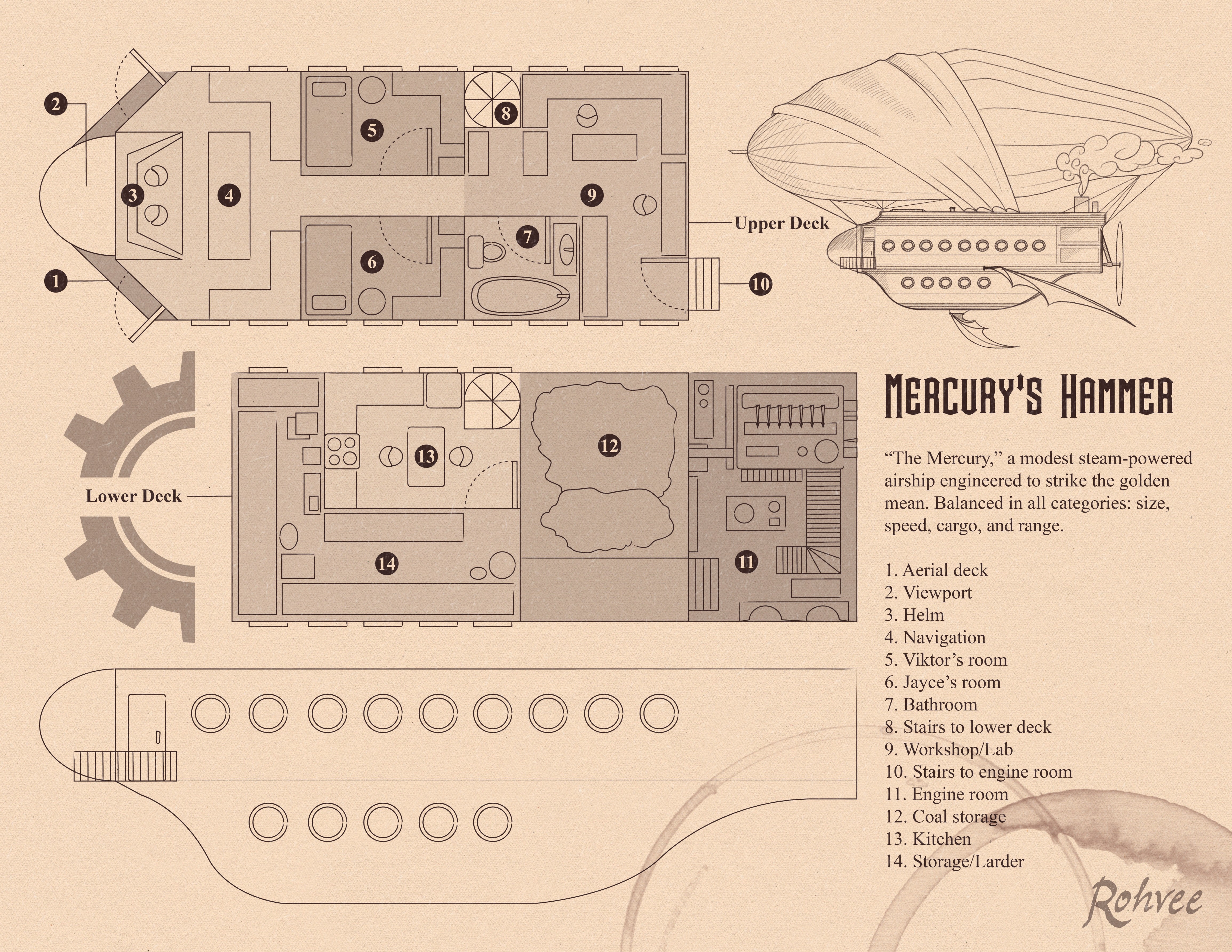
Next to the grand vessel floated a far smaller ship, low-slung and unimpressive. Its frame was blunt, almost wedge-shaped—like the head of a hammer. The hull was a dull, riveted gunmetal. Two modest wings jutted stiffly from its sides, and its blimp hung heavy above it like a bloated fruit. It bobbed slightly against the ropes keeping it tethered to the dock.
“Mercury’s Hammer,” Viktor introduced, voice wry as he gestured with a little theatrical sweep. “Your ship, Mr. Talis.”
Jayce stared.
His heart plummeted.
“Oh,” was all he managed.
Viktor chuckled under his breath, already setting off toward the gangplank. “Now, now. She may not be much to look at, but she’s a fine vessel. Let’s see, how did the blueprints phrase it... ah. ‘Engineered to strike the golden mean’,” he said, the corner of his mouth tugging upward. “Balanced in size, speed, cargo, and range.”
Jayce followed, trying to match Viktor’s pace as they crossed the grated walkway to the aerial deck. It crunched underfoot, metal crusted with salt. More of a walkway than a deck, really: a cramped strip barely wide enough for two to pass abreast, certainly no room for evening tales and drinks among the entire crew.
Jayce swallowed down the tight knot in his throat, trying not to let the gloom take root.
It was still a ship. Still a vessel built to fly, to carry them across the world.
Wasn’t it?
Viktor pulled a brass key from his coat, corroded with worn teeth, and slipped it into the lock. It jammed halfway. He frowned, jiggled it, muttered something in what Jayce assumed was Zaunite under his breath—and at last the mechanism clicked. He gave the hatch a sharp tug.
It opened with a shrieking groan, rust grinding against rust, the sound so sharp it made Jayce wince.
Inside, the air was stale with dust and old oil. Viktor reached to the side and flipped a switch; the lights buzzed to reluctant life, stuttering once before filling the compartment with a warm amber glow.
“The helm and navigation room,” Viktor said, stepping in, cane clicking against the metal floor.
The helm dipped down into a recess before the wide viewport, framed by twin steps leading to a pair of well-worn leather seats. Their seams were cracked, but the padding looked thick. The control console—brass and polished wood—bristled with dials and levers, a double yoke seated in the middle. Gauges twitched to life. Lights blinked.
Behind the cockpit, a broad oaken table dominated the space, its surface already scattered with charts, maps, and compasses. Shelves lined the walls, filled with navigation books, metal instruments, and bound logs.
That flicker of anticipation returned like a match struck in the dark. Jayce brightened, shoulders squaring as he drifted toward the navigation table. He brushed dust from the surface, unfolded one of the brittle-edged charts, and leaned over it, the shabby disappointment falling away for the moment.
“Have you settled on a trajectory yet?” came Viktor’s voice behind him. He lit a lantern with a click of its striker, the flame coughing to life in a glass belly, and set it down beside the map.
Jayce chuckled. “I decided that years ago.”
He plucked a red wax pencil from the mug of rattling tools, tapping it once against the wood. “By my estimate, my father was in Demacia when he sent me the hexstone. That doesn’t necessarily mean he found it there, but it’s a good place to start.”
He began to draw a dotted crimson trail from Piltover’s spires westward, the line winding along jagged mountain ranges toward Demacia’s heart. “From there, we trace his steps in reverse—Freljord, Noxus, and up into Ionia.”
He circled the continent’s edge like an augury in ink, then swept the pencil down in a wide arc. Viktor leaned closer, his gaze following the motion.
“By then it’ll be edging into the cold season. We'll head back southwest, overwinter back home.” A pause, then Jayce went on, “If we haven’t found the source of the hexstone by that point, we push onward in spring—” He tapped the edge of the map, “Bilgewater, the Shadow Isles, then the Shuriman continent.”
Viktor hummed. “Quite the waggle dance,” he said. “By the time we return, we’ll be rather cosmopolitan.”
Jayce grinned at that. The hexstone and the future it promised remained the heart of their journey, but he couldn’t help the flutter of anticipation that stirred in his chest. At the idea of the whole world opening to him. To walk the sun-bleached streets of distant cities, to meet people from every corner of the map, to witness how they lived, how they worked, taste what they ate. He looked forward to smoky market stalls and unfamiliar spices, to the warmth of shared meals and laughter in foreign tongues. The road ahead was uncertain, but it brimmed with stories waiting to be lived.
“Shall we continue our tour?” Viktor asked, and Jayce nodded, feeling reinvigorated.
They moved through the back door of the navigation room into a narrow corridor, walls of patinaed metal, the floor creaking faintly under their steps. Viktor ran his hand along the wall, fingertips brushing rivets and seams, counting them perhaps. He paused at one of the doors, unlatching it with a soft click.
“Two cabins,” he said simply, and swung it open.
Jayce leaned in. A small cot, neatly tucked into the wall like a drawer. Shelves above and beside, enough space for tools and books. A simple tiered desk with a fixed lamp. Three portholes let in the watery afternoon light. The whole room could be crossed in a few steps—but it was private. A place to relax and work.
“This one’s yours,” Viktor added. “Mine is opposite.”
They moved on. The next door opened with a gentle shove.
“Lavatory,” Viktor announced, “complete with proper plumbing and—because I told my father I would not go anywhere without it—a bathtub.”
Jayce’s brows rose.
Sure enough, tucked under a round window was a gleaming copper tub, comically large in proportion. The room was as cramped as the rest—barely enough space to turn around—but the presence of that tub made it feel even smaller. A ridiculous indulgence when space was an unaffordable luxury, really.
But, if Viktor had insisted on the amenity, Jayce figured he had no right to argue. Truthfully, he wasn’t about to turn it down. After a long day elbows-deep in machinery, muscles sore and salt crusting his skin, the thought of sinking into warm water sounded downright divine.
The corridor opened into a larger chamber lined with tables and shelves. A blackboard stretched along one wall, half-smeared with chalk from some long-ago scrawl. A few tools already hung on a pegboard—clamps, a welder, spools of copper wire. The room smelled of old oil and chemicals.
“The workshop,” Viktor said, sweeping a hand out as he turned in place. “I imagine we’ll spend most of our time here. The equipment budget has been allocated, of course. It’ll be stocked before departure.”
Jayce drifted in, fingers dragging along the thick wooden edge of a workbench. A few stools sat tucked beneath it, one left off to the side like it had just been used. He could already imagine himself hunched over some project, sweat at his temples, calling out for a tool—Viktor’s voice behind him, a chair scraping, the handle of a wrench pressed into his palm.
“There’s the engine access,” Viktor pointed to a metal bulkhead door on the far wall. “Coal stores, maintenance space. And here—” he turned to a spiral staircase in the corner. “That’ll take you down to the galley and cargo hold. And that's the extent of it.”
Jayce leaned over the stairwell, peering down into the shadows below. He imagined noise—clanging pots, someone bickering over the last wedge of cheese, the scent of sizzling onions and metal mugs passed around in celebration. He imagined standing at the stove, trying to make one of his mother’s authentic Ixtali recipes for a homesick crew.
On that thought, he paused.
He blinked.
Frowned.
“Wait,” he said slowly. “Where are the crew quarters?”
Viktor bit his lip. His expression shifted faintly—something sheepish curling at the corners.
“Ah,” he said. “Did no one tell you?”
Jayce straightened.
“There is no crew, Mr. Talis,” Viktor said, tone light yet wary. “It’s just you and I.”
Jayce stared. The words clanged around in his skull, louder than they should have.
Just the two of them.
The imagined clamor vanished. No midnight stories, no grumbling over dish duty, no laughter bouncing down the halls. No strangers turned companions. No camaraderie carved out of sweat and shared danger.
He felt something in his chest pitch sideways.
“I’m terribly sorry to disappoint,” Viktor added softly, glancing away. “I’m sure you’d prefer better company.”
Jayce’s head snapped up.
“No!” he said, sharp with sincerity. He crossed the space without hesitation and laid a hand on Viktor’s shoulder. “No, not at all. I...” He hesitated. “I had imagined something different, yes. I’ve been reading my father’s journals for years—he made it sound like... like the crew was half the adventure. But if I only get one person to go on this journey with me, I’m glad it’s you.”
Viktor looked at him, startled. His eyes flicked down to the hand on his shoulder, and his ears—Jayce noticed—had gone the faintest shade of pink.
“Hm,” Viktor hummed. “You must not have very many friends, then.”
A genuine laugh ripped from Jayce’s chest. “Well, you’re not wrong.” The only person he could really call a close friend was Caitlyn, who was basically his sister, and nine years his younger. Which was rather pathetic, admittedly.
“But really,” Jayce added, softer now. “You’re a remarkable man, Mr. Reveck. I have a feeling we’re going to work wonders together here in this workshop.”
Viktor smiled, just a little. “The future of an energy-rich world, born in a flying tin can.”
“Hey,” Jayce grinned. “All the best things come from humble beginnings.”
Viktor dipped his head slightly in deferment.
And truly, Jayce wasn’t just saying this to soothe him. He’d had a taste of what they could do together, and it was already stuck fast in his blood. That energy between them—that synchronicity. The absence of it left a hollow, like coming down hard off something he hadn’t realized he’d gotten hooked on.
He found himself wondering how much of that spark would persist beyond the confines of the workshop. What it would be like to share space so intimately with the man. Of course they’d grow close—how could they not? Proximity, survival, a singular purpose. It would breed a bond unlike anything he’d known. Jayce really hadn’t had many friends at any point in his life, certainly none as close as what this was promising to become. He found himself looking forward to it.
He smiled faintly as the images came: the two of them bickering over navigation charts. Tuning the engines shoulder-to-shoulder. Taking turns burning dinner. He imagined himself waking groggy, coffee in hand, to shuffle into the helm in his sleepclothes and find Viktor already at the yoke—
He blinked. A sudden thought struck.
“So... you know how to fly an airship?”
Viktor hesitated.
“Ehm... no,” he admitted sheepishly, then glanced at the calendar on the wall. “But these things practically fly themselves, and we have two weeks to learn.”
Jayce stared for a beat. “Ah.”
-={ ⚙ }=-
Viktor sat perched atop the leatherbound luggage chest, cane resting against his knee as he watched the chaos unfold. Dockhands wrestled crates and canvas-wrapped bundles up the gangplank and into the Mercury’s underbelly, grunting and cursing as they went. Every few minutes came a muffled thump or inventive curse as someone smacked their head against a low beam or lost their footing on the cramped spiral stair.
He turned the ring on his middle finger in a slow, meditative spin. It was large, reaching nearly to his second knuckle, the gold band inlaid with sapphires—squares and triangles tessellated into what looked almost like the exploded view of a puzzle cube, flattened and gleaming.
“Nervous?”
He looked up. A familiar mop of pink hair approached through the morning haze, Vi lugging a heavy bag over each shoulder like they weighed nothing. Fifteen and already solid as steel—broad-shouldered, callused, perpetually scuffed from one scrap or another. She was everything he hadn’t been at that age, and twice as bull-headed.
“For what?” he asked dryly. “Leaving behind my home, my family, the only life I’ve ever known to sail off into the perilous unknown where I’ll likely freeze, crash, get eaten or shot?”
He offered her a wry smile.
“Not in the slightest.”
Vi dropped the bags with a grunt. She gave the ship a wistful once-over, then slumped down beside him on the luggage chest with an unceremonious thud.
“No Powder, I take it?” Viktor asked, though he knew the answer.
“Locked herself in her room. She'll regret not coming to say goodbye in a few days, but... well, you know how she gets.”
Viktor nodded, lips tight. “She spent a good hour last night trying to convince me to take her with us. I’m honestly shocked she hasn’t crammed herself into one of these crates.”
Vi huffed a laugh. “Not for lack of trying. I caught her halfway in before she could wedge the lid shut.” She bumped her shoulder lightly against his. “We’re all gonna miss you, big brother.”
A small smile tugged at his mouth, but the ache behind his eyes throbbed. Her words stung as reality set in for the first time. Even if he’d kept some distance since starting at Piltover Academy, he’d still made it home every month. Back to that loud, cobbled-together family of theirs. A patchwork of grief and grit, stitched close by shared pain and stubborn love. He’d needed them just as much as they’d needed him—and now he was leaving. Kicking out the wedge from the door.
His mind flicked to Powder, who always looked at him like he'd hung the stars—curled up and crying in her room. Guilt wracked his ribs.
“I… I’ll miss all of you dearly,” Viktor murmured, biting down on the quiver in his voice.
“You sure about this?” Vi asked softly—not for the first time. “You don’t have to go, you know. This... Talis guy? He’ll be fine. He can figure it out on his own.”
For a second, the tug almost reached him. Her voice frayed the edge of his emotional mind. The image of turning around and crawling back into bed called to him like a balm.
Maybe Jayce could do it without him. He was smart. Capable. The son of a legend.
But would he have made it even this far alone?
Viktor tilted his head up, gazing at the stretch of sky above the Gate. Cloudy, shifting—but there, beneath it all, a sharp blue horizon. And something in his chest calmed.
“I’ve been given a chance to change things,” Viktor said, quiet but steady. “To herald in an era of a clean, new Zaun. To give you and Powder a better life.” He looked back at her. “I know it sounds foolish, but… I have to try.”
Vi held his gaze for a long while, then sighed and smiled—just barely. It curved tired and proud at once, as she leaned in and rested her head on his shoulder.
“If anyone’s gonna do it, it’s you, Vik.”
Viktor slipped his arm around her shoulders and pulled her in tight. Closing his eyes, he held onto the embrace, just a little longer.
“Am I interrupting?”
Viktor blinked his eyes open to find Jayce approaching, a soft smile tugging at his lips beneath that ridiculous curly mustache.
The man was clad in a heavy aviator’s coat, its fur-lined collar flared out like wings, exaggerating his already broad shoulders. The hem swept long, flaring dramatically in the wind. A well-worn pair of goggles hung loose at his throat, and his boots were laced to the knee. He looked every inch the daring explorer, plucked from the pages of an old penny novel. Viktor glanced down at his modest vest and plain frock and couldn’t help but feel underdressed—like a librarian swept up into someone else’s adventure.
Viktor gently pulled away from Vi and reached for his cane, pushing himself to his feet. He gestured between them. “Mr. Talis—my sister, Violet.”
Jayce extended a hand. “Pleasure to meet you, Violet. Come to see us off?”
Vi shook his hand firmly. “Mm-hm. Just don’t go dragging my brother into any pits of ancient horrors, alright? We kind of need him back in one piece.”
Jayce laughed. “Wouldn’t dream of it.” He shot Viktor a bright look. “I’m sure we’ll take good care of each other.”
A peculiar flutter stirred in Viktor's stomach—one he pretended not to notice.
“Now then, Mr. Reveck,” Jayce turned, eyes lifted toward the Mercury. Whatever disappointment the man had felt about her modesty seemed to have melted away; his expression was alight again with wonder, and Viktor felt it catch in his own chest as he stepped forward to stand beside him.
Jayce glanced sidelong at him with a smile of barely contained excitement, which Viktor matched in turn.
“Adventure awaits!”