
Chapter Text
Realms:
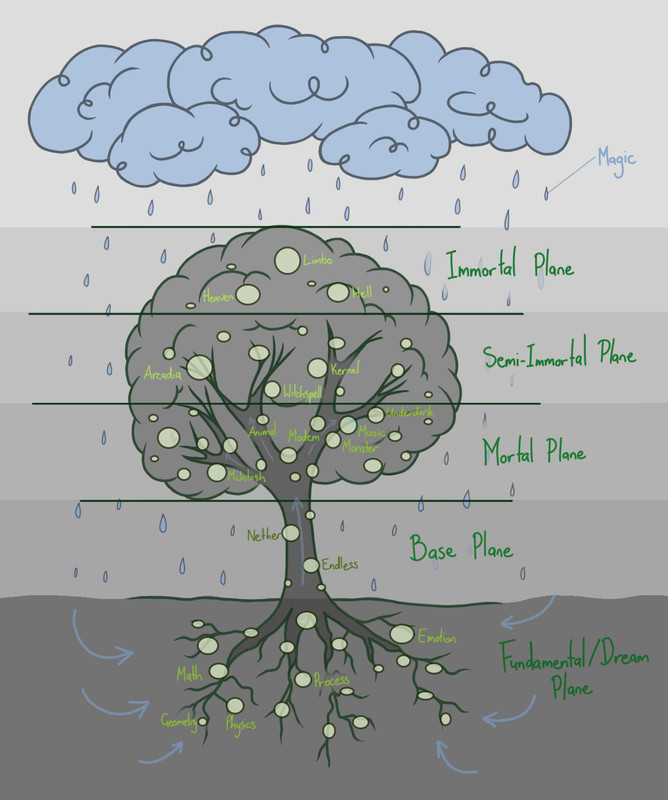
As this series takes place in a modern-fantasy setting, much of the world-building is completely new. In this au, fantasy races and magic abound and the known world consists of a vast collection of realms, collectively known as the Realm Tree. Though only a working model of the system, the Realm Tree is the glue that holds all of the known realms together and connects these vastly different worlds to one another.
Planes:
The Realm Tree can then be further broken down into what's known as the Realm Planar Structure, which groups the realms together into a collection of planes stacked loosely on top of each other. This is probably the most important distinction of a world as, depending on which plane you’re on, will dictate a large majority of the magical rules of that dimension.
From bottom to top, the planes are as follows:
- The Fundamental Plane (also known as the Dream, Bottom or First Plane) – the realms here make up the fundamental mechanics of the planes above and is generally considered only reachable through a person’s subconscious. Realms in this plane tend to come in clusters (also known as portal nexuses), with neighbouring realms often sharing similar concepts (e.g. Math, Geometry, etc.)
- The Base Plane (also known as the Second Plane) – a very small collection of (known) worlds that provide a solid base for the rest of the realms to rest upon. Given how difficult it is to travel down through the planes, no one is quite sure how many realms exist in this plane, with only a handful documented.
- The Mortal Plane (also known as the Middle or Third plane) – the most populated plane. There are numerous realms that make up this plane, all with wildly varying sizes, appearances, magical landscapes, populous etc. Similar to the Fundamental Plane, these realms also tend to come in portal nexus clusters. However, other than proximity, this tends to have very little effect on the makeup of the realm other than ease of travel between them. The people in these realms are generally considered mortals, as they often have limited lifespans and lower tolerances to injuries. They are also the most diverse in terms of cross-realm relationships, with many holding a positive view of inter-planar travel and the biggest trade-alliances.
- The Semi-Immortal Plane (also known as the Fourth Plane) – this plane is quite similar to the mortal plane but with more baseline magic and less total realms. They are more spread apart and magical in nature but can be difficult to tell apart from your average mortal realm. The easiest tell is generally the people. Races from this plane are more likely to have inherent magic, longer (and in some cases speculated infinite) lifespans and tend to keep to themselves.
- The Immortal Plane (also known as the Top or Fifth Plane) – this plane has three major realms (Heaven, Hell and Limbo) as well as a handful of much smaller realms. Unlike our world, these are not worlds of the afterlife but do borrow somewhat from real-life connotations (aka, Hell is known as a place of suffering, Heaven of enlightenment/rest and Limbo for the lost/the searching). They are home to the Celestial, immortal beings of high magical potential. As these realms are rarely visited, most knowledge about them is vague or passed down through stories. Making it difficult to know what is and isn't true.
Magic:
So how does magic work in this realm structure? Well, if the wider system can be thought of as a Realm Tree, then the magic acts similar to the rain. This magic pours continuously down from above the tree onto the dimensions below. Which means, the higher up the ‘tree’ you are, the more likely your realm is to be drenched in excess magic and the more likely the native denizens of that realm are to have their own inherent magic. However, this doesn't mean there is no magic in the lower realms. As all of the Rain Magic that didn't hit a realm will instead sink into the 'ground' to be absorbed up through the root system (the fundamental realms) to feed the rest of the tree’s internals. Meaning that all of the realms will have some form of magic baked into the very essence of the world.
Portals:
Physical travel between worlds is almost always done through some form of portal (although there are certainly other ways to project messages/your consciousness cross-dimensionally), all with varying levels of strength, stability and restrictions. These different portal types can be broken down into the following categories:
- Warped trees/Nether portals – the most common and stable way to travel cross-dimension. Since the Nether is a generally hostile and barren place to live, some of the trees there tapped into the planar magic to feed on the nutrients of other realms. However, a byproduct of this process was the formation of naturally occurring portals grown into the planes above them. Most of these portals pop up in the mortal realms, with a few portals ending up in the semi-immortal plane and occasionally all the way up into the immortal plane. However, because of their nature, a restriction of the tree is that they can’t grow portals downwards. Which means you can’t get to the fundamental realms or any other base realms through them (this is also why it’s considered a bad idea to grow Nether portals anywhere but the Nether). Most Warped trees grow in close proximity to each other in an environment called a Warped Forest. However, they can technically grow anywhere in the Nether. Likewise, Warped trees in close proximity to each other will most likely to grow into the same Nexus cluster.
- Created portals – Celestials, powerful magic users, potent artefacts and spells all have the ability to create portals. These will vary in terms of stability, accuracy and longevity, but generally the more efficient and potent the source and the less distance you’re bridging, the better the portal will be. Still, the resources needed to maintain a portal this way is generally not considered feasible. And thus, these days, it is mostly used by the higher plane realms and places with excess magic.
- Dream plane portals – due to its nature, the fundamental plane is itself quite different travel wise from the only planes. Realms in the fundamental plane are naturally connected, making it much easier to jump between them. However, the plane itself is incredibly difficult to get to other than through subconscious/projection magic (hence the more colloquial name of the Dream Plane).
- Glitches – the last type of portal is an unknown and spontaneous type of portal formed through means not understood. They can appear anywhere, for any length of time, and can connect any two worlds together. Thought to be created by the Icons or the Realm Tree itself, these portals are super unstable and risky to use as it is unknown how long they will last for or where they will take you.
So how common is cross-dimensional travel? Well, for most of the realms, isn’t exactly extraordinary but it’s also not super common. This is both due to the inherent rarity of the different portal types as well as the dangers many of them can pose. I would best describe it as similar to cross-continental travel here back in the 1700-1800’s. A big undertaking and your average person likely has never done so, but still enough for plenty of good and services to be exchanged. Certain realms, however, can have stricter regulations on portal use (requiring extensive documentation and monitoring to use/create them) or might ban them outright, depending on the place.