
Chapter Text
Plain Text Transcript
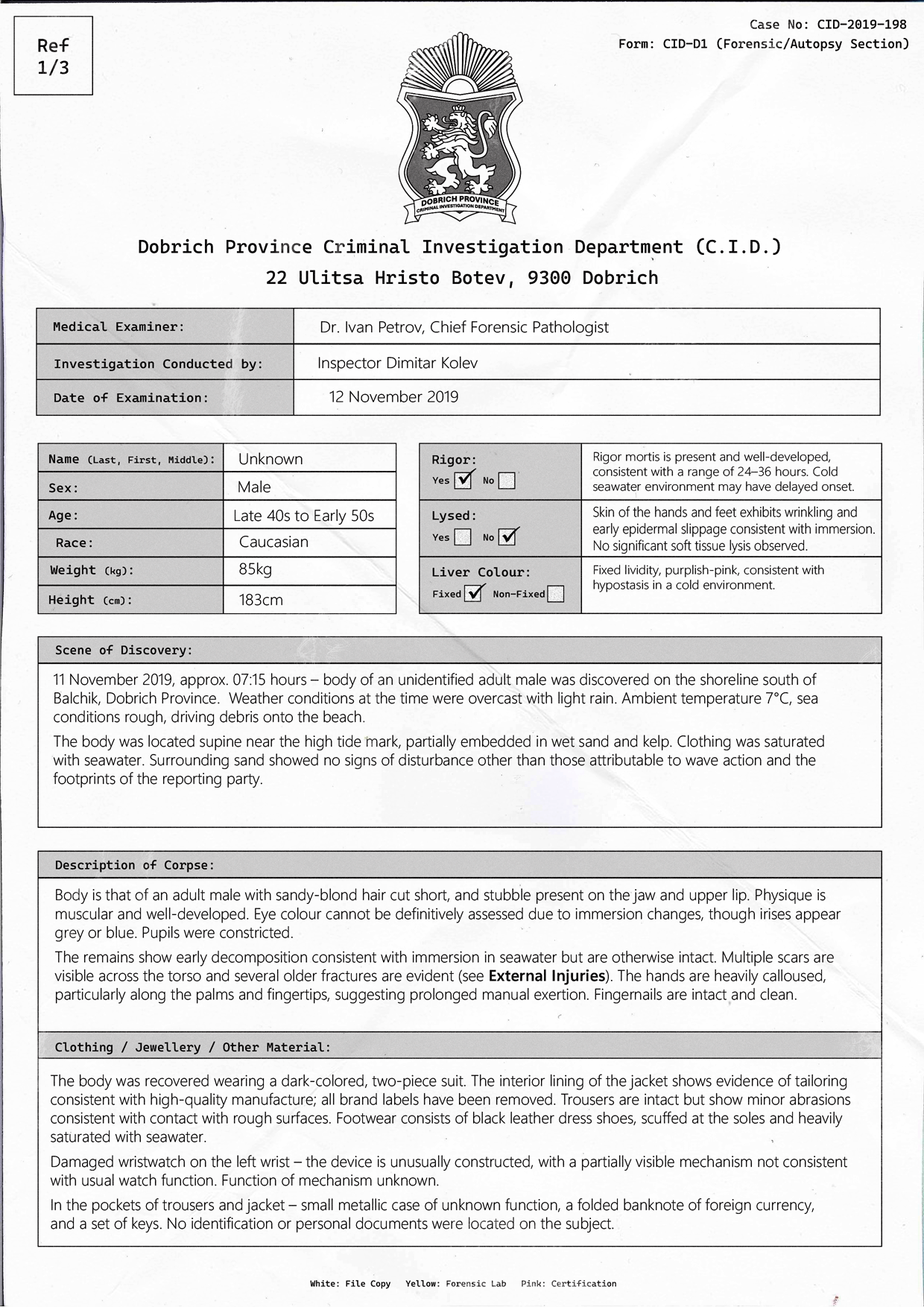
Case No: CID-2019-198
Form: CID-D1 (Forensic/Autopsy Section)
Dobrich Province Criminal Investigation Department (C.I.D.)
22 Ulitsa Hristo Botev, 9300 Dobrich
Medical Examiner: Dr. Ivan Petrov, Chief Forensic Pathologist
Investigation Conducted by: Inspector Dimitar Kolev
Date of Examination: 12 November 2019
Name (Last, First, Middle): Unknown
Sex: Male
Age: Late 40s to Early 50s
Race: Caucasian
Weight (kg): 85kg
Height (cm): 183cm
Rigor: Rigor mortis is present and well-developed, consistent with a range of 24–36 hours. Cold seawater environment may have delayed onset.
Lysed: Skin of the hands and feet exhibits wrinkling and early epidermal slippage consistent with immersion. No significant soft tissue lysis observed.
Liver Colour: Fixed lividity, purplish-pink, consistent with hypostasis in a cold environment.
Scene of Discovery:
11 November 2019, approx. 07:15 hours – body of an unidentified adult male was discovered on the shoreline south of Balchik, Dobrich Province. Weather conditions at the time were overcast with light rain. Ambient temperature 7°C, sea conditions rough, driving debris onto the beach.
The body was located supine near the high tide mark, partially embedded in wet sand and kelp. Clothing was saturated with seawater. Surrounding sand showed no signs of disturbance other than those attributable to wave action and the footprints of the reporting party.
Description of Corpse:
Body is that of an adult male with sandy-blond hair cut short, and stubble present on the jaw and upper lip. Physique is muscular and well-developed. Eye colour cannot be definitively assessed due to immersion changes, though irises appear grey or blue. Pupils were constricted.
The remains show early decomposition consistent with immersion in seawater but are otherwise intact. Multiple scars are visible across the torso and several older fractures are evident (see External Injuries). The hands are heavily calloused, particularly along the palms and fingertips, suggesting prolonged manual exertion. Fingernails are intact and clean.
Clothing / Jewellery / Other Material:
The body was recovered wearing a dark-colored, two-piece suit. The interior lining of the jacket shows evidence of tailoring consistent with high-quality manufacture; all brand labels have been removed. Trousers are intact but show minor abrasions consistent with contact with rough surfaces. Footwear consists of black leather dress shoes, scuffed at the soles and heavily saturated with seawater.
Damaged wristwatch on the left wrist – the device is unusually constructed, with a partially visible mechanism not consistent with usual watch function. Function of mechanism unknown.
In the pockets of trousers and jacket – small metallic case of unknown function, a folded banknote of foreign currency, and a set of keys. No identification or personal documents were located on the subject.
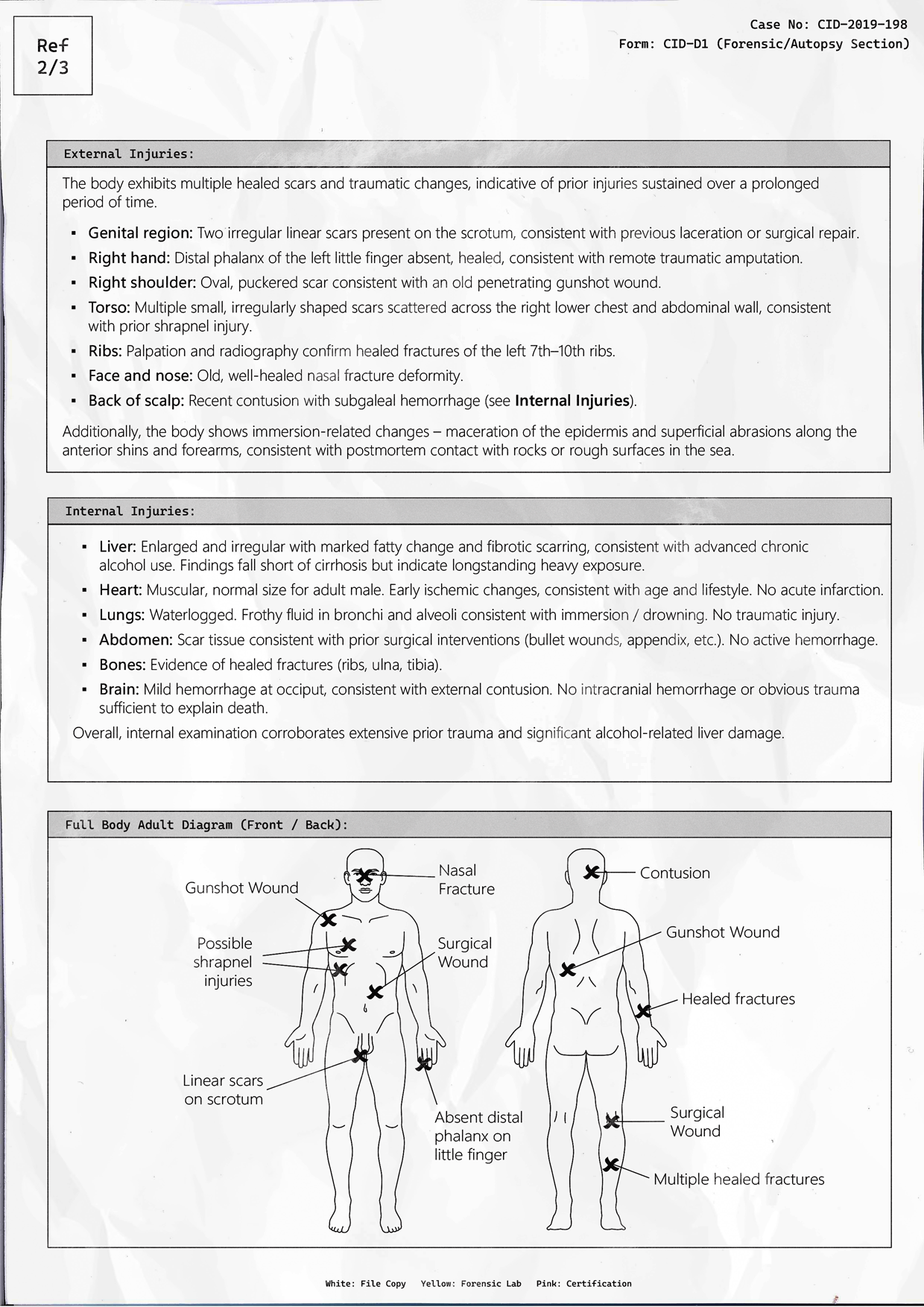
External Injuries:
The body exhibits multiple healed scars and traumatic changes, indicative of prior injuries sustained over a prolonged period of time.
• Genital region: Two irregular linear scars present on the scrotum, consistent with previous laceration or surgical repair.
• Right hand: Distal phalanx of the left little finger absent, healed, consistent with remote traumatic amputation.
• Right shoulder: Oval, puckered scar consistent with an old penetrating gunshot wound.
• Torso: Multiple small, irregularly shaped scars scattered across the right lower chest and abdominal wall, consistent with prior shrapnel injury.
• Ribs: Palpation and radiography confirm healed fractures of the left 7th–10th ribs.
• Face and nose: Old, well-healed nasal fracture deformity.
• Back of scalp: Recent contusion with subgaleal hemorrhage (see Internal Injuries).
Additionally, the body shows immersion-related changes – maceration of the epidermis and superficial abrasions along the anterior shins and forearms, consistent with postmortem contact with rocks or rough surfaces in the sea.
Internal Injuries:
• Liver: Enlarged and irregular with marked fatty change and fibrotic scarring, consistent with advanced chronic alcohol use. Findings fall short of cirrhosis but indicate longstanding heavy exposure.
• Heart: Muscular, normal size for adult male. Early ischemic changes, consistent with age and lifestyle. No acute infarction.
• Lungs: Waterlogged. Frothy fluid in bronchi and alveoli consistent with immersion / drowning. No traumatic injury.
• Abdomen: Scar tissue consistent with prior surgical interventions (bullet wounds, appendix, etc.). No active hemorrhage.
• Bones: Evidence of healed fractures (ribs, ulna, tibia).
• Brain: Mild hemorrhage at occiput, consistent with external contusion. No intracranial hemorrhage or obvious trauma sufficient to explain death.
Overall, internal examination corroborates extensive prior trauma and significant alcohol-related liver damage.
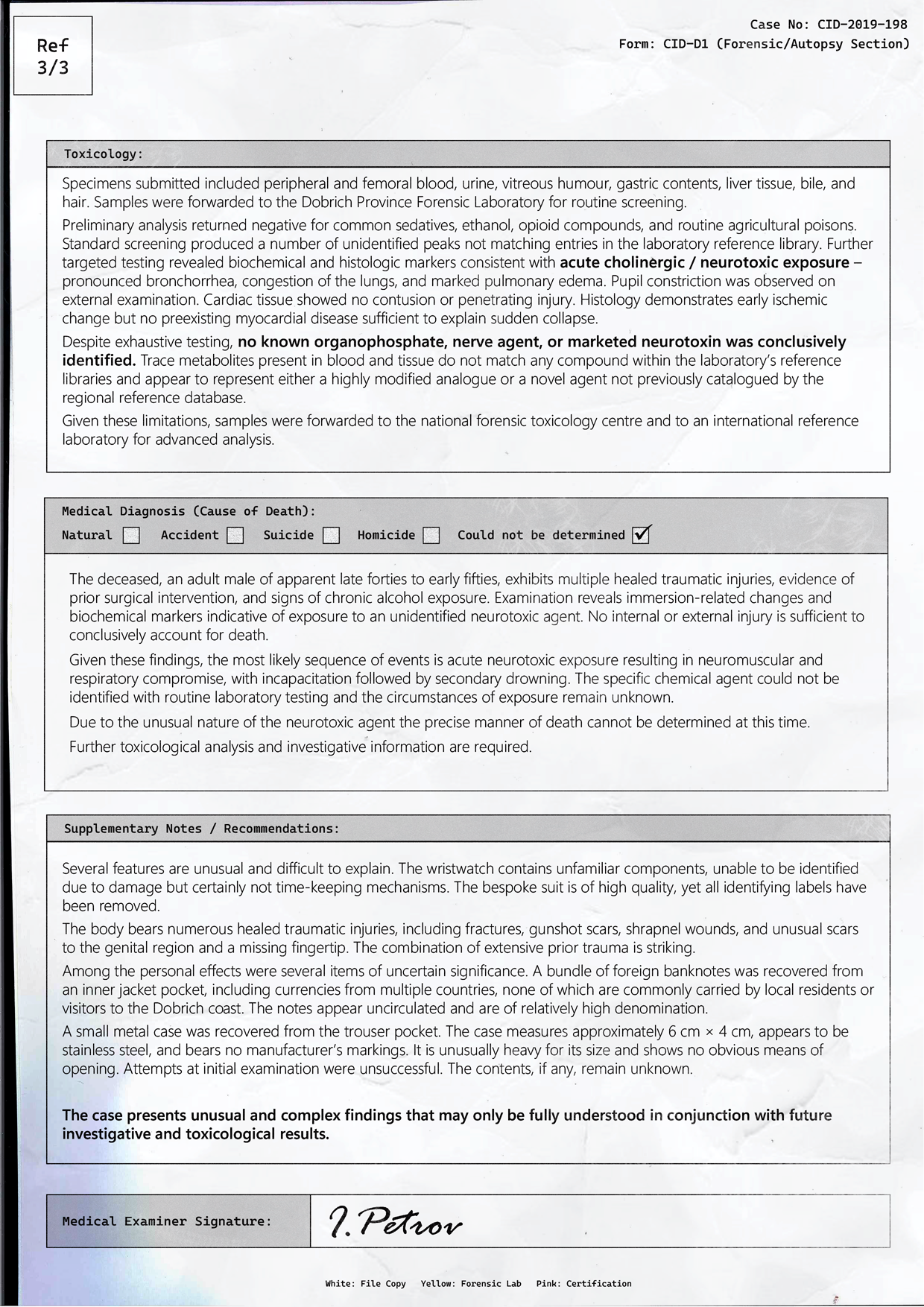
Toxicology:
Specimens submitted included peripheral and femoral blood, urine, vitreous humour, gastric contents, liver tissue, bile, and hair. Samples were forwarded to the Dobrich Province Forensic Laboratory for routine screening.
Preliminary analysis returned negative for common sedatives, ethanol, opioid compounds, and routine agricultural poisons. Standard screening produced a number of unidentified peaks not matching entries in the laboratory reference library. Further targeted testing revealed biochemical and histologic markers consistent with acute cholinergic / neurotoxic exposure – pronounced bronchorrhea, congestion of the lungs, and marked pulmonary edema. Pupil constriction was observed on external examination. Cardiac tissue showed no contusion or penetrating injury. Histology demonstrates early ischemic change but no preexisting myocardial disease sufficient to explain sudden collapse.
Despite exhaustive testing, no known organophosphate, nerve agent, or marketed neurotoxin was conclusively identified. Trace metabolites present in blood and tissue do not match any compound within the laboratory’s reference libraries and appear to represent either a highly modified analogue or a novel agent not previously catalogued by the regional reference database.
Given these limitations, samples were forwarded to the national forensic toxicology centre and to an international reference laboratory for advanced analysis.
Medical Diagnosis (Cause of Death):
Could not be determined.
The deceased, an adult male of apparent late forties to early fifties, exhibits multiple healed traumatic injuries, evidence of prior surgical intervention, and signs of chronic alcohol exposure. Examination reveals immersion-related changes and biochemical markers indicative of exposure to an unidentified neurotoxic agent. No internal or external injury is sufficient to conclusively account for death.
Given these findings, the most likely sequence of events is acute neurotoxic exposure resulting in neuromuscular and respiratory compromise, with incapacitation followed by secondary drowning. The specific chemical agent could not be identified with routine laboratory testing and the circumstances of exposure remain unknown.
Due to the unusual nature of the neurotoxic agent the precise manner of death cannot be determined at this time.
Further toxicological analysis and investigative information are required.
Supplementary Notes / Recommendations:
Several features are unusual and difficult to explain. The wristwatch contains unfamiliar components, unable to be identified due to damage but certainly not time-keeping mechanisms. The bespoke suit is of high quality, yet all identifying labels have been removed.
The body bears numerous healed traumatic injuries, including fractures, gunshot scars, shrapnel wounds, and unusual scars to the genital region and a missing fingertip. The combination of extensive prior trauma is striking.
Among the personal effects were several items of uncertain significance. A bundle of foreign banknotes was recovered from an inner jacket pocket, including currencies from multiple countries, none of which are commonly carried by local residents or visitors to the Dobrich coast. The notes appear uncirculated and are of relatively high denomination.
A small metal case was recovered from the trouser pocket. The case measures approximately 6 cm × 4 cm, appears to be stainless steel, and bears no manufacturer’s markings. It is unusually heavy for its size and shows no obvious means of opening. Attempts at initial examination were unsuccessful. The contents, if any, remain unknown.
The case presents unusual and complex findings that may only be fully understood in conjunction with future investigative and toxicological results.