
Chapter Text
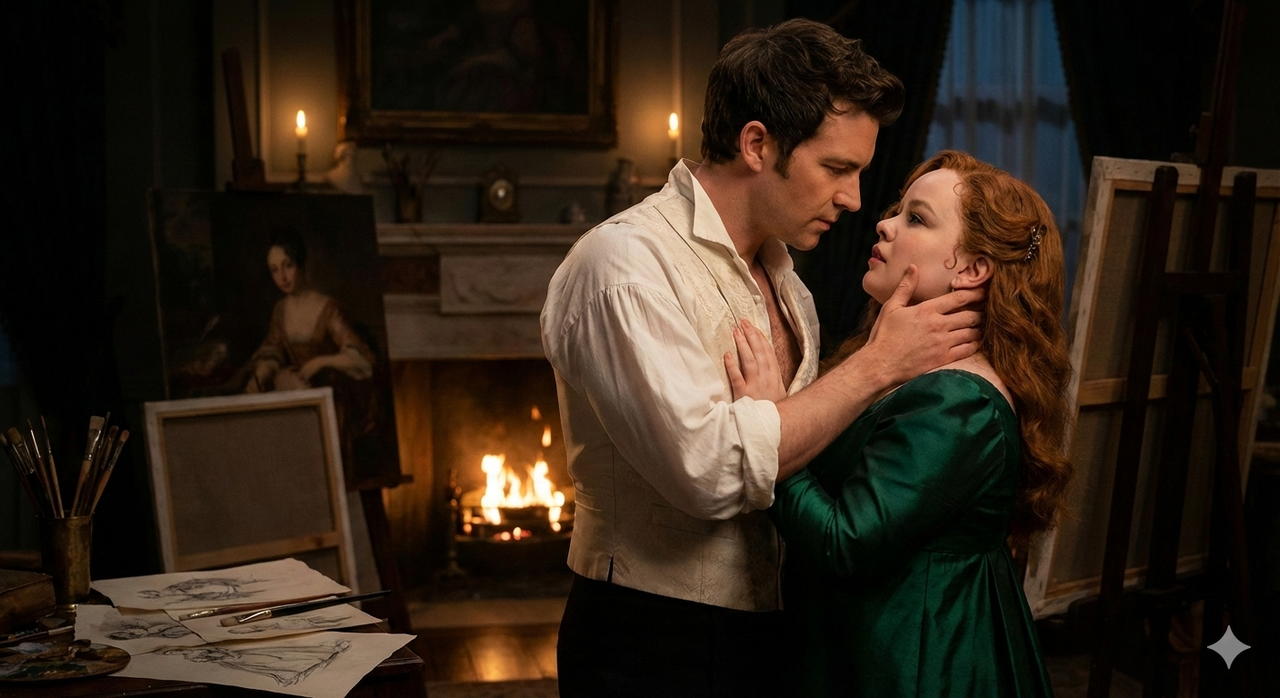
The ballroom of Bridgerton House exhaled the heat of a thousand candles and the heady scent of lilies, which, by the mid-point of the evening, had become positively stifling. Somewhere ahead, the music thundered—bright, frivolous, and utterly out of step with the dull thrumming Penelope Featherington felt in her very fingertips.
She stood pressed against the wall, seeking sanctuary within the heavy folds of the velvet portieres. Her gown was a muted shade of mint—a marked improvement over her usual citrus hues—yet in the eyes of the ton, she remained mere background for the more radiant debutantes. Despite her resolve, her gaze drifted repeatedly toward Colin. He was laughing, leaning in toward Miss Edwina Sharma, whom Kate Bridgerton had once more brought to London to display upon the marriage mart. In the eyes of the celebrated traveler, there resided nothing but light, effortless flirtation.
Watching them, Penelope felt more than mere sadness; it was a physical exhaustion born of the nightly necessity to don the mask of the ever-amiable friend.
"If you continue to look at him so, Penelope, you shall either incinerate him on the spot or vanish into thin air from sheer longing."
Penelope started. Leaning almost imperceptibly against a window embrasure stood Benedict. His cravat was knotted with a touch less precision than etiquette demanded, and he idly turned an empty crystal glass in his hands. There was a certain detachment in his posture that mirrored her own.
"I haven't the slightest notion what you mean, Mr. Bridgerton," she replied softly, keeping her eyes averted.
"Oh, come now. We are at an age, and in a state of mind, where lying requires far too much exertion." Benedict took a step closer, shielding her from the prying eyes of passing matrons. "I have watched you this past half-hour. You look upon my brother as if he were the only source of light in this room, while he conducts himself like a common moth."
Penelope finally raised her eyes to his. There was no shame in them, only a profound, weathered honesty.
"And what of you?" she countered. "You look at every masked woman or every lady with a silver ornament in her hair as if hoping she might be her. You are hunting a ghost in a crowd of living souls. Is that any easier?"
Benedict froze. His ironic half-smile vanished, replaced by an expression of strange relief. He had finally been "unmasked," and the revelation brought a curious peace.
"No," he confessed, his voice dropping to a whisper. "It is not easier. It is like trying to hold river water in a sieve. She was here; I felt her hand in mine, I danced with her, I saw her laughter... and now I live in a world that feels like a sketch by an amateur artist. The colors are wrong. The faces are wrong."
They fell silent. A flock of giggling girls swept past, a whirlwind of powder and youth. To Penelope and Benedict, the noise seemed to drift from the far bank of a distant river.
"Colin told me today that I am his most 'faithful friend,'" Penelope said, her voice trembling ever so slightly. "That word... 'friend.' It sounds like a sentence. As if he has drawn a line in the dust and said, 'You may go no further than this.'"
"The worst of it is," Benedict picked up the thread, "that they do not do it out of malice. They simply do not see. To them, we are constants. You are the 'loyal Penelope'; I am the 'ever-ironic Benedict.' They have no inkling that beneath these roles are people who... simply wish to be chosen. Not for merit or virtue. But simply because, without us, their world would be incomplete."
Outside, the rain intensified, its rhythmic drumming against the glass echoing the cadence of the quadrille. Benedict extended his hand—not for a dance, but as an anchor.
"Come to the gallery, Penelope. It is dark, it is cold, and there isn't a single happy soul in sight. It is the perfect place for the two of us tonight."
She placed her hand in his. His palm was warm and steady. They moved through the hall—two invisible actors choosing to abandon the stage for one evening. In the gallery, amidst the portraits of ancestors whose passions had long since turned to dust, they stopped by the window.
"Do you know what is strangest of all?" Penelope asked, watching her reflection in the dark pane. "Sometimes I hate myself for continuing to hope. Every time he smiles at me, I build castles of sand, knowing the first tide will wash them away."
"The dictates of reason are always routed by the dictates of the heart," Benedict said, leaning his forehead against the cool glass. "My reason tells me she could have been anyone—a married woman, an actress, a passing guest I shall never meet again. But the heart... it is too foolish. It compels me to attend every ball in the hope of a miracle."
He turned to her, his gaze piercing in the gallery’s gloom.
"Penelope, promise me something."
"What is it?"
"If ever—be it in a year or ten—we wake to find we no longer feel this ache... let us not try to summon it back. Let us simply allow ourselves to be free."
Penelope offered a faint smile—her first genuine one of the night.
"I promise. Though I fear, Mr. Bridgerton, that we are the sort of people who guard our sorrows as faithfully as others guard their treasures."
They stood in the silence, listening to the rain. That night in London, there were many happy couples, many intrigues, and much splendor. But the deepest connection was forged here, in the shadows, between two people who had finally given each other permission not to be happy. They had no need for pretense. And in that bittersweet acknowledgment of shared grief, they found something more than mere comfort—they found a witness to their own existence.