Work Text:
Lisbon was uncompromising in its summer heat and steep hills, the perfect contrast to Venice's murky, horizontal damp. Bill loved the sun here: the feel of it burrowing into his skin, brutal and impersonal and perfect. It felt as if the heat was burning Venice and its memories away: the confusion, and the fear, and the shame, all of it being scorched from his body by a sun that cared not for his pain and self pity. He dumped his old, musty clothes and bought white t-shirts and a pair of jeans, and wandered the city in a daze, letting the sun have its way with him and losing himself in the streets, and the noise, and the magnificent blue of the high, high sky.
The longer Bill spent in Lisbon, the more easy he got with the man he had been since Sandra's truth had proved him to be incompetent, cowardly, and useless; a waste of skin and bone that didn't deserve to live, but which hadn't earned the right to die. Lisbon and its imperious sun didn't care about Bill, and that felt just right: to be insignificant, and ignored, and swallowed up by this cynical, old city that neither noticed he was there, nor would take note if he left.
He rented a small apartment, high on a hill in a working class neighborhood. It was cheap and austere and impersonal, with a tiny window through which could just see the blinding glint of the Tagus, way down below. He had one room. In it, there was a double bed, a small desk with uneven legs, a washbasin, and a simple chair; the bathroom was down the hall. It was perfect, the kind of colorless, anonymous place where a man could live and die without ever attracting any attention.
Within a few days, Bill had developed a routine. He'd rise around noon, splash water on his face, shave (or, more often, not), and head out to feed his hangover, finding a space in one of two cafes on the hill. At midday, both were packed with men on their lunch breaks: rough, loud men who ate the cheap, hearty plate of the day, and shouted at one another about football and women, filling the cramped rooms with their confidence and ease. Bill would take any open chair, nodding at the strangers with whom he was sharing a table, and keep to himself, head down, making his way methodically through whatever was placed before him. It was another entirely anonymous space, one in which he was hardly seen, let alone remembered; forgotten as he hoped one day to forget himself.
He'd drink an espresso and big pitcher of cheap, unpleasant house wine at lunch, and then take a walk, soaking in the rays of that disdainful, beloved sun as he made his way to the past: either by the face of the church and up to the old castle or, when he felt the need to wear himself out, over to the Discoveries Monument, where he felt small and comical in the face of the bravery and brilliance of the men celebrated in that blindingly white marble.
The walk dulled the buzz of the wine, and killed enough time for Bill to dive into the darkness of the bars once he returned to his neighborhood. He always started in the dark hole at the bottom of the hill, relishing the seedy nature of the place, and the way it made him feel at home as he drank his first double of the night. From there, he'd wander, challenging himself to find a new place each night: neon-infused tourist trap or local dive, they all had liquor, which was all Bill needed. He'd drink until closing and, if he could, make his way home, his body on autopilot as it scaled the hill and returned him to his little room where he'd fall into bed, head dull with loss and drink. The next day, as the sun began to bake the walls, he'd start again, greeting each morning a little more sure of his disdain for himself, and a little more determined to die here.
+++
One day, after he'd been in Lisbon for about two weeks, Bill had lunch next to a man with blazing blue eyes. He noticed them when the man nudged him and pointed to the salt; Bill never looked at up again, after handing him the shaker. He felt the man next to him, though: the warmth of his thigh and shoulder, so close to Bill; the smell of sweat and engines and aftershave on him, all so miserably, terrifyingly tempting. Bill tamped his desire down with instinctive speed and turned his body toward the television, trying to ignore the presence that screamed at his senses from less than a foot away.
Two days later, the man was there again, taking the open seat next to Bill as he ate. Even when the tables were full, the local men typically avoided sitting next to Bill if they could; whether it was because they wanted to be next to friends, or because they sensed his prickly malaise he didn't know, but once that space emptied, it was rarely filled again. But the man took it and looked at him, demanding Bill's eyes with his own and nodding in greeting, his face assessing. Bill swallowed hard and got up to leave, but not quickly enough to escape the man's distinctive scent, which seemed to follow him as he rushed to the cash register, creating as much space as possible between them. That night, he slept by the fountain in the Rossio, the hill to his apartment too much to navigate when the earth was tilting and his head was spinning.
For three days after that, Bill ate anonymously among the working me, left to his routine in peace. He was relieved by the man's disappearance, but there was a sharp pain in his chest, too, which he did his best to ignore. Bill didn't deserve anyone, and no one deserved to bear the burden that any kind of relationship with Bill represented — even friendship inevitably ended up one way, with Bill walking away, emptier than ever, and another former friend, bleeding out on the ground.
(He thought he saw the man's eyes, just once, in the noisy crowd at the Praça do Comércio as he walked his usual path toward the monument in Belém. He was searching the crowd before he'd ever registered what had happened, but the man wasn't there. Bill told himself he was glad.)
The day after the Praça do Comércio, the man was back, as if he'd never vanished. This time, he stood at the bar and waited until the space next to Bill opened up, in so doing passing up at least three chances to sit down. When Bill, panicked, got up to leave as the man with the eyes sat down, he felt a hand on his shoulder, and heard, in unaccented English, two words: "Please. Stay." Bill froze, then let the hand ease him back down. His stomach roiled with newly awakened butterflies, and he thought for a moment that he was going to vomit in his untouched espresso.
The man left his hand on Bill's shoulder for only a moment, but it was hours before its heat faded. Bill watched him, knowing he should leave but unable to do so, utterly hypnotized by the man's proximity and the way in which he'd so easily changed Bill's own direction. He had been so determinedly alone for so long that this sudden, assertive attention made Bill feel as if, in that moment, the man could tell him to do anything and he'd obey, a feeling which both thrilled and repulsed him.
He had dark, curly hair and olive skin, with smile lines around his eyes and an outfit to match Bill's own; as he sat down, Bill noticed the jeans the man wore were worn on the thighs and fit him so well it was difficult to tear his eyes away. There was a certain weariness to the man, but a sense of ease, too, as he'd come through whatever had threatened to drain him with a certainty that Bill couldn't imagine.
He didn't know how long the man had been looking at him, but there was a smile tugging at the corner of his mouth, and his eyes were sharply curious. He put out a hand. "I'm Steven."
Bill was so undone by the simple attention (any honest attention) that the hand he awkwardly offered across his body was trembling. "Bill."
Steven didn't talk much, and Bill was unable to do so. They sat in a silence that was neither companionable nor tense; it was angular and edgy and full of potential for disaster, with maybe the slightest undercurrent of possibility for something better. Bill drank his espresso and then another; Steven ate his lunch efficiently but as if he enjoyed it. Bill hadn't tasted a meal he'd eaten since he arrived in Lisbon — for him food was fuel and routine, nothing more.
When Steven finished his meal, he nudged Bill with his shoulder, jerked his head toward the door, and picked up the check. Watching him walk away, Bill knew what he should do: either stay there, or get up and leave Steven behind for good, nipping the temptation that was burning through him in the bud, and saving Steven from the ways in which Bill would harm him.
What Bill did instead was walk to the door, sliding close enough to Steven on his way out to feel the heat coming off of his broad, solid back, and step outside. And then, he waited. Bill felt like he was jumping off a cliff simply simply by deciding to stand there, sure that he was doomed but almost breathless with the unfamiliar thrill of curiosity — of wanting to discover things about another person for the first time since before everything blew up with Sandra. It was terrifying and dangerous and felt like a betrayal of himself and the vows he'd taken to fade away in quiet anonymity, but here he was, heartbeat thudding in his ears, exhilarated to have no idea what was next.
+++
Steven led Bill down the hill and across the Rossio, his pace easy and relaxed; by his side, Bill fell into step, finding his own body relaxing simply from mirroring Steven's.
"I want to show you something," was all Steven offered by way of explanation, but Bill would have followed him anywhere at this point. He'd decided to jump and he was going to keep falling until he hit the bottom, however messy the impact.
Weaving his way through the window-shopping crowds and tourists in the Baixia, Steven led Bill to a church at the top of the hill opposite the one on which he lived. Steven paid for them to enter but, rather than taking Bill into the museum the church housed, he turned right into a dark passage, then they stepped out into the light.
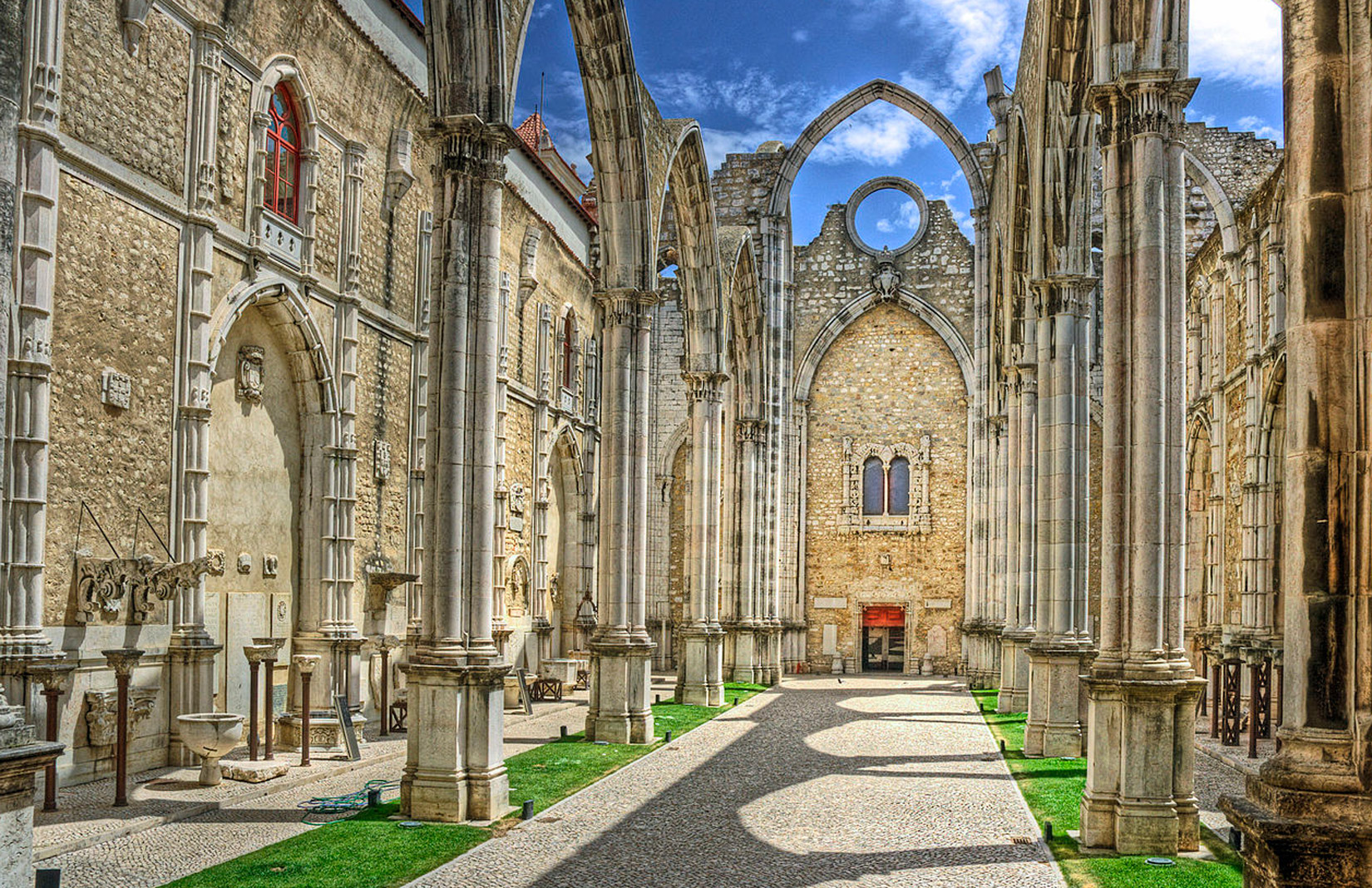
Bill was awestruck. Looking up, he saw the remains of what must once have been a gothic cathedral, all stone walls and grand arches, reaching to the heavens. The roof, however, was gone, so the arches stood brave and delicate against the brilliant sky, solid and resolute in the face of nature, man, and time. At his feet was the bright green of grass, something he realized he'd not seen since coming to Europe: not in Venice, and not anywhere else in Lisbon. They were completely alone.
He could hear the grin in Steven's voice when he spoke. "Listen," he urged Bill.
Bill listened, and he heard ... nothing. It was as if the city and its lives and cars had simply vanished, or like the secret ruin had spirited them away to another place and time. The peace and quiet were astonishing.
Something hard and sharp and in Bill's chest broke apart then, and he could breathe without hesitation or obstruction. He'd been so constricted for so long he'd forgotten what it felt like to breathe without thinking about it; to be able to simply exist without pain.
He turned to Steven, roughness in his voice. "Thank you," he rasped out, unable to say anything more.
Steven's eyes on Bill's were serious and oddly gentle, as if he feared even looking at Bill too harshly might shatter him. Rather than respond, Steven walked out on the grass and lowered himself to the ground at the base of one of the columns reaching dizzyingly up, up, up. He lay back with his hands under his head, and closed his eyes.
"Whenever I'm in Lisbon," he murmured, his voice so low Bill had to move closer to hear him, "I come here. It makes me feel small, but in a good way. Calms me down."
Squinting against the sun, he looked up at Bill and patted the grass next to him. "Sit. Lie down. Sleep. Whatever you need to do."
+++
Bill slept for what felt like hours. The air was cooler when he started awake, and he was in shadow, the sunlight now illuminating just the far corner of the crumbling floor. Disoriented, he raised himself on his elbows and looked around in a panic; Steven was there, still lying next to him. His eyes were open now, and he looked content.
"Feeling better?"
Bill stretched and thought about it. He did feel better — more relaxed than he had in months, and rested, or at least moving toward it. He took a deep breath, just to feel the sensation of his lungs swelling, and the nearly forgotten freedom of movement it entailed.
"Much better." He paused, lying back again, mirroring Steven's pose. His left elbow lay atop Steven's right one; neither of them moved to change things. Unable to articulate all of the questions pinballing around in his brain, Bill chose the simplest one: "How did you know?"
Bill felt the elbow under his shift as Steven moved in something like a shrug. "You were alone, and angry and scared." There was a pause, "I don't know. So, so tense and bound up. I felt like you might fly apart, just sitting there, eating lunch. And," he added, his voice changing as he leaned up on his right elbow and rolled toward Bill, "I didn't want that to happen, not before I got to talk to you."
This close to Steven, Bill realized he was older, maybe forty to Bill's thirty-five, something which made Steven's presence all the more reassuring to Bill's raw nerves (and mind and heart). Bill breathed again, and made himself look Steven in the eyes. "Thank you. For bringing me here. For bothering to care." He blinked hard, ashamed of the unexpected tears that were threatening to escape. "It's a ridiculous thing to say and I don't think you can understand, but you might have saved me."
Steven returned Bill's look, as steady as the thump-thump of Bill's heart. "So tell me. Teach me to understand." There was a beat, and then Steven closed the distance between them, his lips firm but sweet on Bill's. "I have three days, and they're all yours."
+++
Over the next three days and three nights, Bill found out that Steven was from Chicago, that he wanted to travel so he worked as a seaman on freighters, and that his hands were rough with callouses which caught on Bill's skin in excruciatingly wonderful ways. He found out that Steven was a breathtakingly thorough kisser, that his body made Bill feel small and vulnerable, but that he wanted to die with how perfect it was.
(Bill also found out that giving a blowjob was like riding a bike, and that Steven could make him beg for what felt like hours, with his month on Bill and his hands like a vise on Bill's restless hips.)
While they lay, tangled together under Bill's little window, in the furious Lisbon heat, Bill told Steven everything. About Sandra, and all of the girls and boys before, and when his life fell apart, and about Rosie and that terrible fear, and all of the blood on his hands. Bill talked and raged and cried sometimes, and Steven held him through all of it, offering his solid, imperfect body as a bulwark against the world and the memories of which Bill was purging himself. Steven never told Bill it would be OK, nor did he reassure him — but he never pulled away, not once. And Bill would fall asleep with his head on Steven's chest, exhausted, body and soul, but a little more himself than he'd been an hour earlier.
+++
They said goodbye at the busy port as Steven boarded his ship, headed back to Norway, where it was registered. He said he'd call when he was next in the States, and Bill told him he would send a postcard to the PO Box in Oslo.
As Bill turned to go, he was sad but his heart was light. It was time for Bill Fenner to live again. It was time to go home.