
Chapter Text
art drawn by me

♕ Behind the Voices
By #xanticheese
"Throw a little love their way and you'll bring out their best..."
☀ Zachary_Levi (Eugene) ☀
"There are many messages to take from the film. Flynn's kind of journey of being true to himself, and knowing that you don't need to create this facade; that it's okay to be you and own who you are and love who you are. And at the end of the day - at the end of the film - you get this incredible message of self-sacrifice and love, and that's huge; (...) to offer that to someone else."
❅ Idina_Menzel (Elsa) ❅
"She compromises herself for a very long time, until (...) she at least finally becomes her truest self and owns who she is."
✢ Interviewer: "What would you say you're most scared of in life?"
"I guess in relation to Elsa, it's the idea of really letting go and showing all of who I am to the world - and I think especially women - you know, when we're powerful and strong women - we wrestle with the fact of letting that be and still being loved."
Parallelism
 Their life messages focus on self-image and negative freedom (escapism) versus positive freedom (being one's true self). Within this morality tale, love, acceptance, reformation, and second chances grant the deuteragonists redemption without introjection [definition: "the unconscious adoption of the ideas or attitudes of others"], overcompensation, or feelings of childhood inferiority dictating the adult choices that they make. For example:
- The facade that is Flynn Rider is an imitation of a storybook swashbuckler to hide the character flaws, childhood agonies, and insecurities inside Eugene (as he, himself, calls his childhood a tragedy where no one accepted "Eugene Fitzherbert").
- The facade that is Queen Elsa is an imitation of her father's expectations to hide the character flaws, childhood anxieties, and insecurities inside Elsa.
- Somehow we got this: while polishing himself into the "perfect" swashbuckler (while she had once polished herself into the "perfect girl" for her parents), he felt he had to overcompensate for his flaws - the real him - as did she. How our deuteragonists really felt: (Less Than) Perfect by Pink.

"They like the idea of me. They don't actually know me."
"...That sounds lonely."
"Their so-called artificial costume was in fact wrought from the very fabric of any sense of inferiority they felt, such bells and whistles meant to distract others, and indeed themselves, from any real pain they might be feeling beneath their artifice."

- She lacked receiving validation from a healthy family environment (you could even say it added to disowning herself emotionally, as upbringing plays a part in a child's self-image).
- He lacked receiving validation from a healthy family environment (you could even say being disowned [or never owned] added to disowning himself emotionally, as upbringing plays a part in a child's self-image, especially those sequestered in poverty or unwanted children homes. He echoes as much by emphasizing the "nothing" he had).


Conceal | Don't Feel

They responded to whatever baggage and faults they had by concealing them and not feeling them. They also "put on a show," though Eugene does so by trying to live on the lighter side of life. Unfortunately, trying to live in the light only created that much more of a shadow.
☀ "I'll spare you the sob story of poor orphan Eugene Fitzherbert..."
Going inwards and facing those darker corners was too degrading (albeit for fear of different results that rang the same chime we're all familiar with IRL: exposing cracks in one's reflection and facing them)
Rapport
What some may create as a rapport between the deuteragonists is the psychology that led to escapism and facades.
More than simply "grieving" family, both deuteragonists are skewed by their absence.
♕ Stuck behind the window of an orphanage and a castle, these guys missed out on family life (or in this case, family warmth) in their impressionable years, so they were forced to grow up fast.
♕ His only role model, which in a way "parented" him, was a fictional character, while little and "grown" Elsa relied on the model of queenliness to guide and ground her emotionally. Both later learn that depending on such cardboard images kept them from true maturation.

♕ The inevitable loss of role models, familial protection, and parents also deprived them of the emotional support that was needed to prepare them for adulthood and society.
♕ Upon facing this womanhood/manhood (and society) alone, they made misguided choices as a result, which were caused by staying insecure over their true selves.
♕ Thanks to this issue with self-image and feeling held down by their old lifestyles, the characters left those deemed their younger siblings (Eugene's bio calls him "something of an older brother to the younger orphans" in his Flynnigan Rider era) by running away from 'home' and the sob story plotline to rewrite it with one that allowed them to make their own lives and rules.
♕ The comfort that a new life provided was their idea of a "fixer-upper" for everything that ailed them deep down.
♕ They thought their issues were so completely physical (rather than internal) that if they "abandoned" one environment and created a new one, everything would be solved. They would then not only be "fixed" and no longer "broken" adults from "broken" childhoods in their POVs, but free from the humiliation of that being exploited and exposed.
♕ The shared thought: by making a new life, the old life can't hold me down or define me anymore. I'll have comfort and freedom; I'll be rested and alone."
♕ Refusing to be hemmed in by society any longer, they leave (or believe they have left) that damaged child part of themselves behind. This action was their definition of growing up and transitioning into adulthood.
"I know I left a life behind, but I'm too relieved to grieve..." ~ Let It Go (Demi Lovato)
Though one could say both submitted to decline ("I can't rise above my obstacles, so I have to find a burrow") by hijacking the belief that being escapists paved new opportunities, because he found no way to deal with his drastic circumstances other than to steal from nobility, while she found no way to deal with her drastic circumstances other than to abandon nobility.
The Juxtaposition
Eugene refused to accept or angst over detriment.
Despite his less-than-ideal environment, he takes the initiative in his situation by trying to find "a better way" rather than depending on someone else to do it for him. "The grass is always greener on the other side" is his motto.

The redeeming side of this ambitious nature urged Rapunzel to embody all that she imagined herself to be. "We needn't necessarily accept the broken situation into which we're born; we may make our own choices and decide to be self-made." There is no "What do I do now?" in his doctrine. When life makes you sad over a seemingly dead-end existence, you go out and find a new dream to head-in-the-clouds Eugene.

Featured: #FrozenxFairytale
Elsa embraced the detriment and angst associated with her less-than-ideal environment.
Unlike Eugene, who "believed he had nothing to lose by becoming as extraordinary a character as he thought he could be," she suppressed her need for automony and extraordinaire, "exchanging personal will for obedience and service."
"It's here where the seeds of resentment planted themselves," making her shadow bend towards his pathway when she actually does end up "sacrificing her humility along with the strict responsibility she imposed on herself in youth."

This gave us a peasant who became an individualist + outlawed runaway and a queen who surrendered to both levels of that same path to transform (as she soon must share his outlawed life).
:origin()/pre06/cc78/th/pre/i/2014/324/3/7/snowy_night__flynn___elsa__by_frozenxfairytale-d86zbmf.jpg)
"I changed my name because I didn't want to remember who I used to be: weak, sensitive, and damaged," Flynn explained. "I wanted to be strong, fearless, and untouchable." ~ StunningSnowflakes (Warmth on a Cold Day)
Elsa chases this same transition in "Let It Go."
♕ When they find where their potential could be expressed, both went on to operate from where they were most comfortable, which was out of range and miles away, where the natural "take charge" drive prevalent in both their characters could serve as their own beacons, (something many of us gleaned from Elsa ourselves).
☀ And we're pretty sure Eugene sang lines in "Let It Go" when he broke away from his past:
"It's funny how some distance makes everything seem small. I'm never going back; the past is in the past. I don't care what they're going to say. That perfect () is gone. No right, no wrong - no rules for me; I'm free. Turn away and slam the door. You can't find me; the past is so behind me."
☀ While he'd still be able to repeat Idina's quote the way Menzel and Frozen's audience could:
"I guess in relation to Elsa, it's the idea of really letting go and showing all of who I am to the world...() we wrestle with the fact of letting that be and still being loved."♕ Though unlike Eugene, she was her own passionate, sassy, larger-than-life individualist who had it in her all along. She didn't need to depend on something -- or someone -- else to be extraordinary; no Flynnigan Rider. She just was.
...Shining in the starlight?

To him, that might be a strength in character he feels she doesn't give herself credit for. And unlike Flynnigan Rider, who he could never emotionally relate to, he can relate to her story's general metaphor like a true reader, just like us. Eugene, IMO, is the target audience Elsa is aimed at.
Isolation vs. Independence

But by remaining solitary and chasing isolated pieces of land to be alone, our deuteragonists mistook being isolated for being independent. As we saw, neither acquired true self-confidence through escapism. Their turning points required love and experiencing some example of familyhood.
(I.E. Eugene's melting smile when Rapunzel's parents not only hug her, but welcome him; it was one main fulfillment he wanted and needed as a child and adult)
On being given no benefit of the doubt/second chances

♕ They are sentenced to death after being blackmailed. They face the gallows with the agony of possibly never seeing the only people who loved them (for who they really were) again.
♕ They tried to embrace their true colors prior to their death sentences, but their mistakes wouldn't let them get away without a noose. To the black and white world that objectified them, they were shades of grey - a most intolerable obscurity.
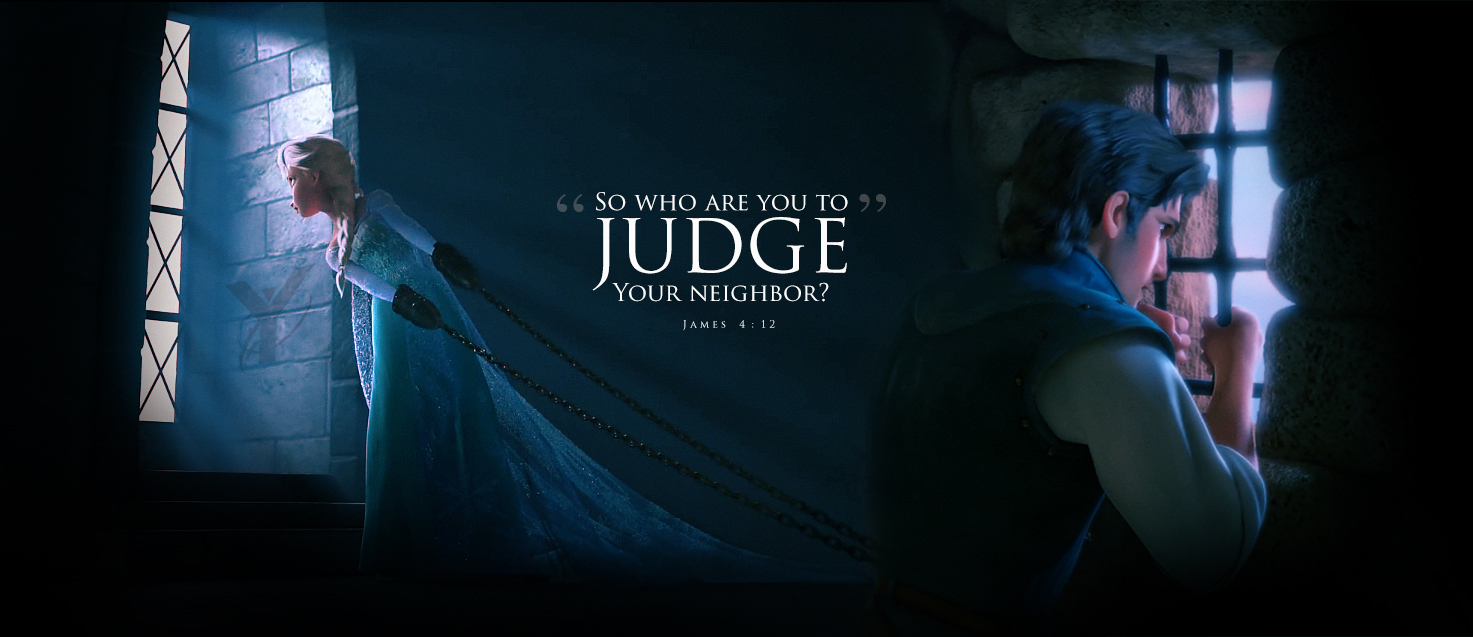
♕ Eugene brought it on himself directly. Elsa brought it on herself indirectly, though because of a similar cause and effect: not dealing with the darker parts of life as they had it. For if they'd loved themselves in whole and not in parts right from the start, and had not been invalidated as children, he wouldn't have succumbed to thieving, and she wouldn't have fled or succumbed to the anger in her heart.
Idina Menzel: "It's a reminder to us that we need to always be searching and not settling for the outside, that you always need to seek a deeper truth in people, because there's always two sides to the story."
Happily Ever After
Both end up accepting their flaws and strengths, no longer letting labels trouble them, and find the meaning of love in self-love, as well as reconciliation with love, which results in finally #Letting_It_Go.
This is the real definition of taking charge of your own life (positive freedom).
"What do you see in me?"
"I believe it's the same thing you see in me: a second chance."

Featured: #xanticheese
"It's funny how we can become a slave to freedom by the simple act of seeking freedom. One can only be free by being transformed from the inside. Being free ironically means belonging to a truth that elevates your consciousness. To keep in relationship to that is the way to overcome the world and the world system and transcend into who we are meant to be, every day."
~DreamWeaver