Work Text:
The lights hum like a headache waiting to happen.
The chair is molded weird, like it was cast for a body Eiji doesn’t have, and his back keeps scraping the upper ridge every time he tries to relax. The TV in the corner is on mute. In the middle of the room, a man in a suit paces with his phone pressed to his ear, his mouth opening and closing like a fish. A toddler is licking the seat of another chair and his mother looks too tired to stop him.
Everything is cold and blue. The tiling, the chairs, the muted TV news, the people. The small window doesn’t even offer comfort; it’s just a dark blue mirror covered in droplets. Eiji can’t hear the rain under the chatting and the hum of the lights. When did it start raining? The sky had been so clear.
More than anything, the floor is too cold for the thin socks he pulled on in a hurry before coming here. The chill climbs his legs, settles in his spine and makes friends with his anxiety.
It’s hard to picture that this morning, today was still a normal day.
“You’re doing the penguin hunch,” Ash says.
“The… what?”
Ash tilts his head, studying him. “You know. When you’re cold and you fold in like you’re trying to become a smaller bird.”
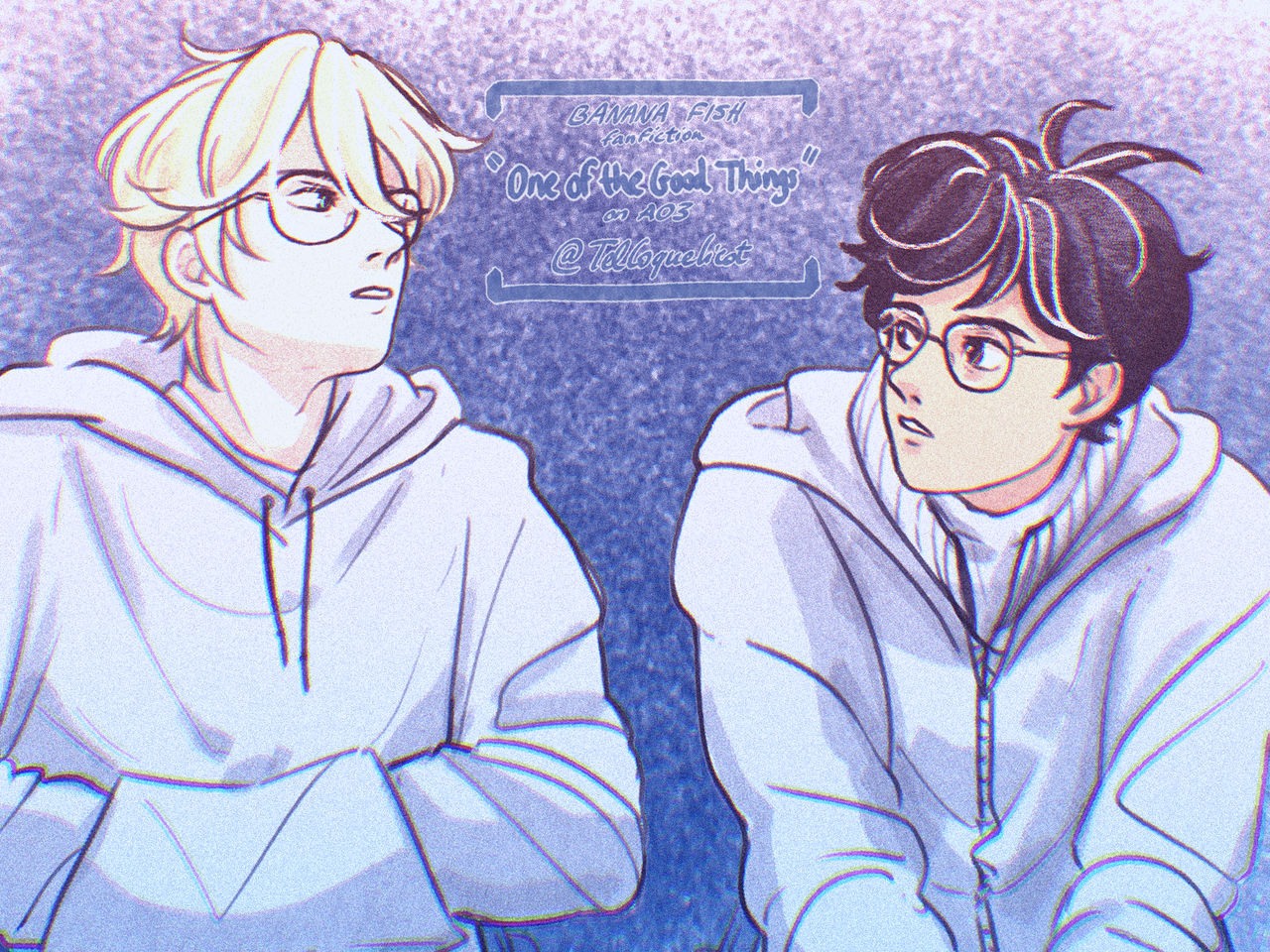
Eiji lets out a tiny sound that’s more sigh than laugh. The image fits.
“I’m not a bird,” he mutters, but straightens anyway. The plastic seat creaks. Across the room, someone coughs; the TV flashes a commercial full of bright teeth.
Ash sighs and stands. “I’m getting you something hot from that machine. Bitter tea, watery coffee—hot chocolate if you’re lucky.”
“You don’t have to—”
“I know.” His hands disappear into his pockets, shoulders hunched against the same cold. “That’s the fun part.”
It’s good Ash is here. Waiting alone is tough, especially when Eiji’s guarding the last eight percent of his phone battery like it’s his soul. Ash is great company, even if he doesn’t realize it. Eiji hopes he’s good company too.
He watches Ash go. The fluorescent light turns his blond hair pale at the edges. Eiji wants to take his picture—he could sacrifice one or two percent—and show it to him and point out how even in this light, he looks like an angel. But that would be an odd thing to do. Saying it out loud would be worse. But it’s true that Ash looks like an angel, and in a moment like this, where everything is unplanned and unpredictable, true things feel good.
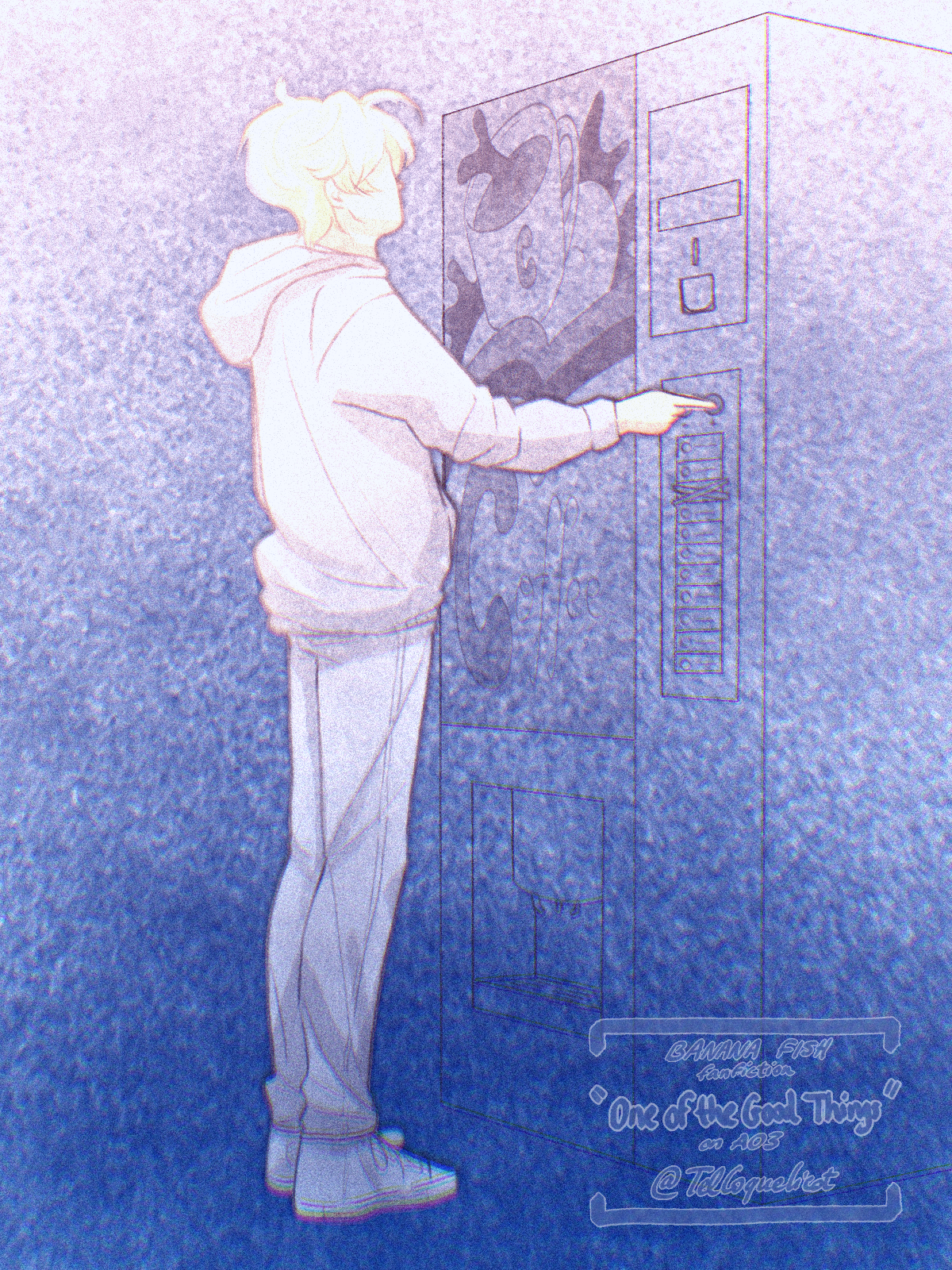
“Here you go—looks like you’re lucky.” Ash reappears next to Eiji, holding out a cardboard cup like a prize. There’s a second one in his other hand.
Eiji’s hand sneaks out of his pocket to grab it. It smells like chocolate, and hopefully tastes like it too, but it doesn’t really matter. It’s warm, and it’s from Ash.
I am very lucky.
His gaze lifts. The numbers on the wall keep changing, but never in a way that makes sense. Red digits blink from 38 to 42 to 15 to C109, accompanied by a half-hearted beep that sounds like the machine has given up trying.
Ash nudges his elbow. “You’re doing it again.”
“Doing what?”
“Frowning at the screen like you’re trying to decode it. It’s random. Give up.”
Eiji hadn’t realized he was frowning. “Maybe there’s a pattern.”
“Yeah. The pattern is ‘you’ll be here forever.’” Ash slouches lower, doing his own version of the penguin thing. “Okay. Hit me. Top three worst places you’ve ever had to wait.”
Eiji takes a careful sip of the steaming hot chocolaty drink. It almost burns his tongue.
“Immigration office,” he says. “Four hours. No Wi-Fi.”
Ash grimaces. “Brutal. Next?”
Eiji thinks, sifting through the unpleasant archives. “Shorter’s radio studio. He said five minutes. It was forty-five.”
Ash snorts. “Okay, fair. Still not as bad as this.”
Eiji smiles. It hadn’t actually been that bad. Ash had been there too, leaning against the wall, making rude gestures toward Shorter on air until Eiji’s shoulders shook. Eiji had tried to stifle his laugh, until he couldn’t. He’s pretty sure Shorter’s listeners heard him squeak live.
“Oh—and the day I arrived in America. The very first time.” The memory unlocks itself. “My flight landed in the morning, and I wasn’t getting the keys to my studio for a couple of days, so I booked an Airbnb. But I couldn’t check in before three p.m., so I waited on a bench in the middle of a small park because I didn’t know where I could go with my suitcase, and it was so hot, and I was so jet-lagged—and I—I think I passed out a few times.”
“Damn,” Ash says, lifting his cup. “Bet some vulture started circling you.”
“And the Airbnb was terrible, but at least it had AC and a bed. One more hour and I probably would’ve died.”
“Good thing you made it,” Ash says. “You would’ve missed out on life without Shorter’s radio show.”
Eiji chuckles, warmth spreading inside him, pushing back the blue. “I would’ve missed out on a lot of good things.”
He doesn’t say which ones he’s thinking of. You, obviously. Then the friends he’s somehow collected. Even Shorter’s ridiculous radio show probably makes the list.
“Yeah. We wouldn’t have met.” Ash says it like it’s just a fact, but his gaze drifts away and he bites his lower lip. Eiji’s heartbeat stutters, then races, his cheeks go hot. If he had said it first, he probably would’ve phrased it the same way. And maybe added, I’m glad we did.
He doesn’t say any of this. Coward.
“Look where it got you,” he says instead. “Waiting in a cold waiting room with me, filling out all the paperwork because I can’t understand it. Did I even say thank you?”
“Not as much as you said sorry,” Ash teases, gentle. “I don’t mind being here. I don’t want you dealing with it alone—or even worse, not dealing with it at all.”
Eiji shrugs, trying for casual and landing somewhere around guilty. “It’s really not that bad. I could’ve just walked with the club crutches for a week. I’m sure it’s nothing.”
“Your coach said you should get it checked in case it’s broken.”
I should have kept this part to myself.
“It’s not broken,” Eiji says. He tries to make it sound light. “I’m very sturdy.”
Ash doesn’t budge. “You don’t know that.”
“You’re missing work because of me.”
“No one cares.”
“Well, I’m sorry.” The word feels small and useless, but it’s the one he knows best.
“I know—I know.” Ash scrubs a hand over his face, then drops it, his voice softening around the edges. “But there’s nothing to be sorry about. Let me do this for you, okay? Let yourself be taken care of. I—” He swallows, eyes flicking to Eiji’s ankle and back. “I probably suck at taking care of people, but I want to. I really don’t want to be anywhere else but here right now.”
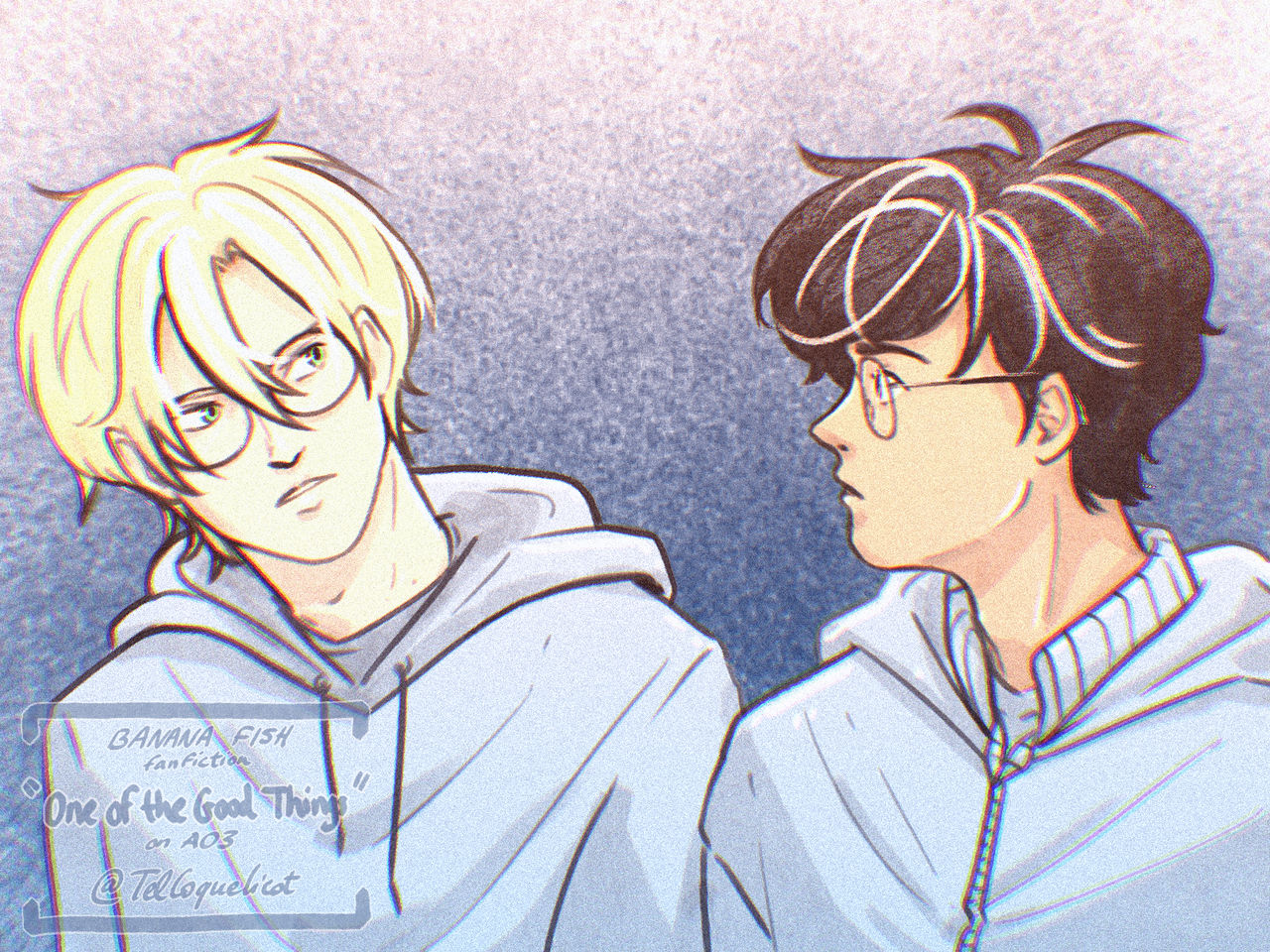
The words hit Eiji in two places at once. One is all stubborn pride that bristles at being taken care of, because letting it happen sounds dangerously close to admitting he needs it. The other is tired, cold and aching for this tenderness, leaning into it before he can stop himself.
The warmth in him spreads so broadly he’s sure he could heat the whole room and thaw all this blue. Ash has this way of saying things that always sounds like he’s coming dangerously close to a love confession and then stopping half a step short. It makes Eiji want to take his hand and jump with both feet, eyes closed, wherever this is going.
But Ash isn’t confessing anything. Not exactly. The feelings he has for Eiji just slip out, uncontrolled, like light leaking under a door.
I wish I knew what kind of feelings they are.
Ash shifts in his seat, thumb worrying at the cardboard rim of his cup. “That was… a lot,” he mutters, almost too quiet to catch. “Don’t worry, I’m not gonna start writing poetry about waiting rooms or anything.”
It lands crooked, halfway between an apology and a joke. Eiji still has to swallow down a smile.
“You’re sure Kong is okay covering for you?” Eiji asks, reaching for safer ground.
“Pretty sure the ‘I’m taking Eiji to urgent care’ was checkmate on that.”
Ash had called Kong about this. Called him. Before that, Eiji could count on one finger the times he’d seen Ash on an actual phone call. He remembers Shorter’s name flashing on Ash’s screen, Ash answering immediately, green eyes wide and terrified like the world had ended—and then getting mad at Shorter for calling over something that could’ve been a text.
Eiji wonders how Ash would react if his name ever showed up there instead. Probably the same. Maybe different. I kind of want to find out, he thinks, and his stomach does a complicated flip his ankle can’t even dream of matching.
“My books will be overdue,” Eiji says, a worry resurfacing. “There’s a fee.” And shame.
“Don’t worry about that. I heard you know a guy who works at the library.” Ash’s mouth curves, coy and malicious in the least threatening way possible. “You can pay him back with a cup of coffee.”
Eiji turns his head toward him, finally feeling a little useful. He almost never uses his employee drink at the café. It suddenly feels like a tragic oversight. Ash would probably come even more often if Eiji started saving it for him.
“As many as you want.”
Ash’s eyes smile with the rest of his face. Bright and warm, cutting right through the blue. He looks away first, taking another sip of whatever he got for himself. The cup has a little “C” logo printed on it, like Eiji’s. Coffee, probably. Courage, Eiji thinks. I could use some of that too.
A door opens and a nurse calls a name that isn’t his. A man with an ice pack taped to his shoulder gets up with a pained noise and disappears behind the frosted glass. The door swings shut again; the room slumps back into waiting.
Eiji’s ankle throbs at the edge of his attention, a steady, irritated pulse. It’s been easy to ignore while he talked to Ash, but it hasn’t gone anywhere. When he shifts, heat flares up from the joint, sharp enough that he sucks in a silent breath. He tries to smooth his face before Ash looks back.
“That didn’t sound like ‘it’s nothing,’” Ash says quietly.
Oh shoot.
“I moved wrong,” Eiji says. “It’s fine.”
Ash doesn’t push, but his jaw tightens, as well as his hands around the cup. The cardboard is softening under his fingers, twisted—and bitten around the edges.
The worry Eiji’s putting his friend through hurts more than the actual injury. It squeezes under his ribs in a way ice and painkillers won’t fix. The whole thing is so stupid that it almost feels funny—almost—and somehow that makes the guilt sharper.
He remembers the moment it happened in too much detail. The track, the sky streaked pink and purple already, because daylight saving time had ended a few days ago. He’d been showing one of the freshmen the approach steps. One-two-three, plant, go. His body still knows the sequence, muscle memory older than his life in America.
He did it once, great. Twice, almost perfect. And then on the third, he bailed the plant and came down short; his foot jammed into the padding around the box. His ankle rolled. The world spun under him.
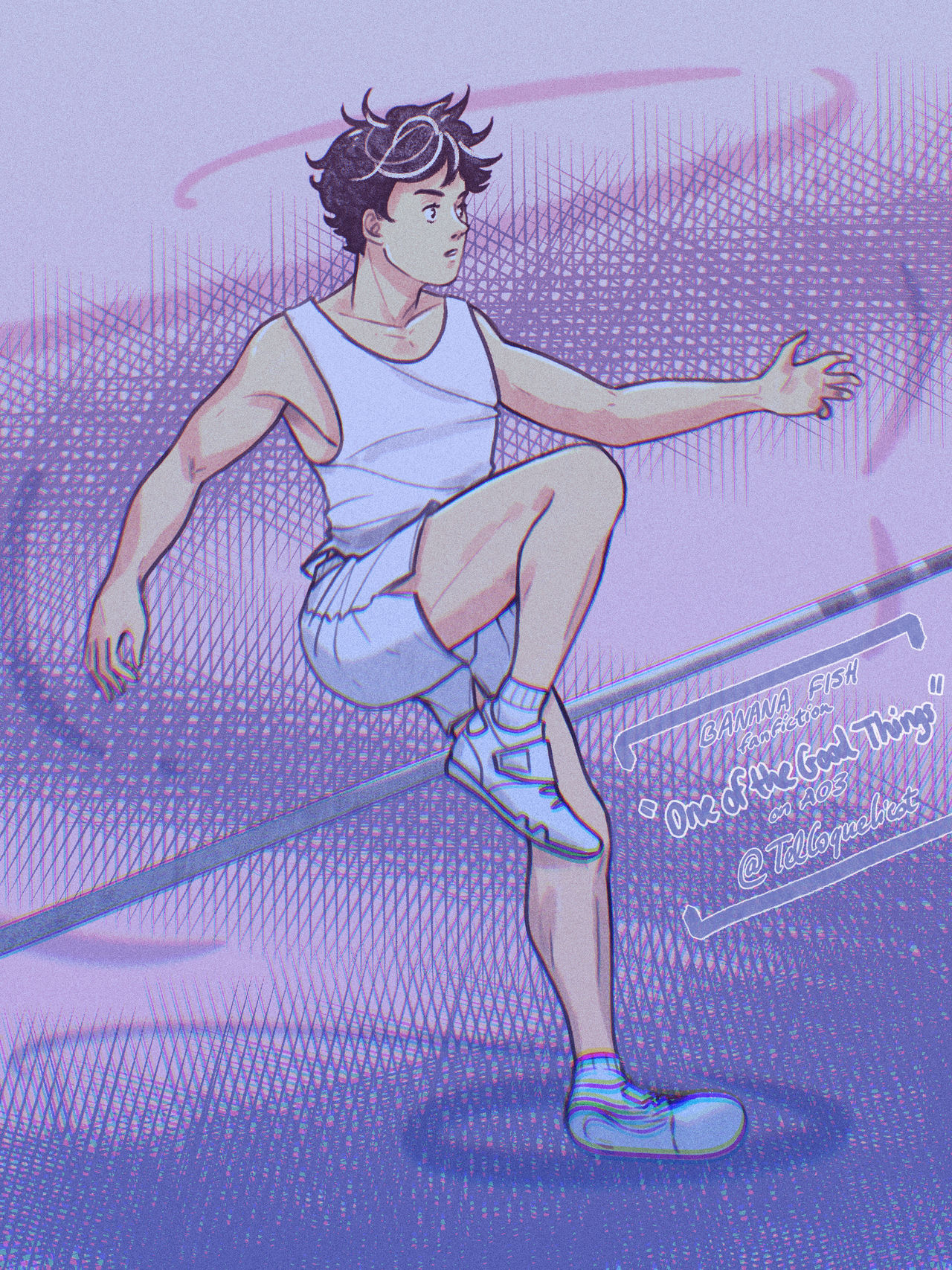
It wasn’t even spectacular. No dramatic fall, no screaming. Just a quick, ugly twist and a hot, sour burst of pain that made him sit very quickly and try to smile so nobody would panic.
Stupid. I’ve done that run-up a thousand times.
“Where’d you go?” Ash asks.
“Hm?”
“You’re doing that thing where you disappear into your own head and look like you’re doing math—and I’ve seen you do math. It’s not pretty.”
Rude—but fair.
“I was thinking about… practice,” Eiji admits. “I used to do worse things to my body than this all the time. Somehow I didn’t get hurt then.”
“Yeah, that’s how it works,” Ash says. “You’re invincible when you’re actually doing the dangerous stuff. Then you trip over a sidewalk and die.”
Eiji huffs out a little laugh, because it’s true—and because the alternative is thinking too hard about how embarrassing this all feels. He hopes the worst of the shame is behind him—when he fell, when everyone started running toward him, when the coach paid for an Uber, when his teammate’s hand hovered awkwardly at his back as he staggered on the club crutches, when he caught their reflection in the stairwell window—him hunched, sweaty, ridiculous.
The body that was weaponized for performance in his teens was now just fragile and… his.
Inside his studio, he’d dropped onto the bed, propped his ankle on a stack of cushions like the coach said, and stared at the ceiling until his brain remembered something worse than pain:
The books.
Three heavy photography books sitting by his door, ready to go back to the library after practice. They were due today. Of course they were due today.
But his shift at the café had started at six that morning, classes had packed the day, practice had run long. He’d told himself he’d return them in the evening. Future Eiji would deal with it.
Future Eiji was now lying on his back with his ankle on a pillow and a late fee creeping toward him. This is what happens when you wait until last minute.
His first instinct was to apologize to the universe. His second was to text Ash.
For the books.
For the habit of it.
For the way his brain had—without asking permission—started filing small problems under maybe Ash can help.
Eiji 📷:
Are you working tonight?
The answer came fast:
Ash:
Yeah why?
The little warmth that bloomed in his chest at that Yeah why? was embarrassing.
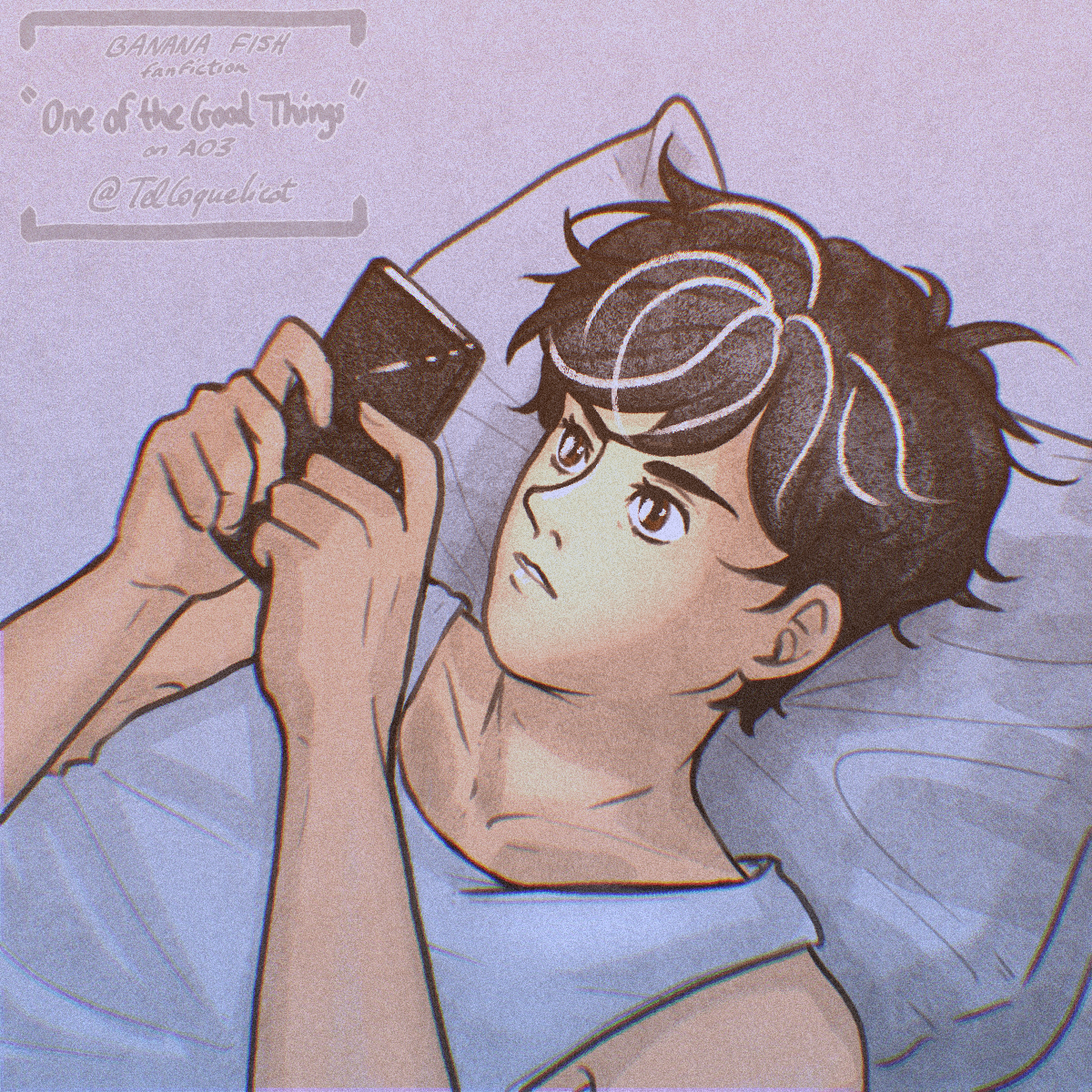
Eiji 📷:
I borrowed some books that are due today. I can’t really walk to the library right now 😅 Is it okay for you to come by my place to pick them up before your shift? 🙏 If it’s too much trouble, I will just pay the late fee
He’d deleted three versions before settling on that one. The first had too many emojis. The second said I hurt my ankle and that seemed… dangerous. Too likely to make Ash worry and cause trouble.
Ash:
I’ll be there in 10
Eiji’s heart had jumped so hard his ankle pulsed in sympathy.
Eiji 📷:
Thank you! 🥺
He’d considered adding Please don’t freak out. He’d deleted it. Ash would freak out anyway. That was the thing about him: he pretended not to care and then cared so intensely it turned the air gold.
Like that sunrise. The memory slides in without asking: Ash following him to the empty field like it wasn’t weird, idling patiently while Eiji took picture after picture. At the golden hour, Ash had gone quiet, staring at nothing, the light turning his hair to actual gold. Almost two months later and Eiji’s brain is still full of that morning.
That morning alone makes collapsing on that park bench worth it. This is just one more good thing on that list.
“The books,” Eiji says, stuck on the thought like a record with a scratch. “Those big photography books. I always keep them until the due date. It’s like I forget I can borrow new ones. I get attached to the ones I have and forget there’s a whole shelf of them waiting.”
“You can always borrow the same ones again.” Ash watches the man in the suit, still pacing and talking too loud into his phone. “Or you can buy one to cherish.”
“Assuming I still have some money left after this.” Eiji gestures vaguely toward his ankle.
Ash snorts, the sound slipping out before he can stop it, and hides his smirk behind his cup. “Your insurance covers this pretty well, don’t—” He cuts himself off. Something flickers across his face as the words catch up with him. The amusement drains; his mouth flattens. He turns fully to Eiji, eyes narrowing in that way that means he’s thinking too hard. “Wait—Were you worrying about money this whole time?”
Eiji’s fingers tighten around his cup. Of course I was worrying about money. I’m always worrying about money.
Rent-money, loan-money, plane-ticket-money.
“Because if I thought this was gonna cost thousands,” Ash adds, slower now, “I wouldn’t have dragged you here. I would’ve found another solution.”
The seriousness in Ash’s voice lands heavy and warm at the same time, like a blanket thrown over Eiji’s shoulders.
Of course you would have, he thinks. You always do.
Something in his chest loosens, and with it comes the nervous urge to complain—the way you do when you’re done crying but not ready to say thank you.
“Didn’t seem like you were gonna let me off the hook earlier,” Eiji argues, but there’s no real bite to it. “You definitely overreacted and dragged me here. Against my will.”
Ash watches him for a beat, like he’s asking for permission to mess with him again. The tension in his jaw eases; he exhales through his nose, and his mouth curves back up into something Eiji has no business liking as much as he does.
“Yeah, well, your will was being an idiot about its ankle,” Ash says. “And it’s not like I had to carry you. Your bossy ass would’ve fought me even in the cab.” He takes an innocent sip, looking over his cup with accusing puppy eyes—if that’s even possible.
“Who are you calling bossy?” Eiji’s voice goes up a notch. The knot in his chest eases a little. Arguing is easier than admitting he’s scared.
“The guy who made Shorter clean his own kitchen,” Ash says immediately.
“He was going to leave the mess for Nadia to clean up after him!” Eiji protests.
Ash just keeps going. “The guy who’s making Bones eat fruits and vegetables at the cafeteria—”
“That was just advice,” Eiji says. Strong advice. “And he agreed with me.”
“The guy who makes Yue shut up. That’s the most impressive one.”
Eiji snorts. “Well, I can’t seem to make you shut up,” he shoots back.
“Can’t seem to make you shut up either.”
“Which is uncanny, because you’re so bossy yourself people stop talking when you open your mouth.”
“That’s just charisma.”
“Or bad breath. Either way, looks like I’m immune.” Eiji sticks out his tongue before he can think better of it.
The realization seems to hit Ash at the same time that it hits Eiji: they are the only ones talking now. Conversation around them has thinned to a low murmur; their back-and-forth stands out under the humming lights. For one suspended second, the awkwardness is almost palpable.
Then their eyes meet, and it breaks. They burst out laughing, too loud, shoulders shaking, the kind of laughter that leaves a little breathless.
A few people glance their way, but no one tells them to be quiet.
The room doesn’t seem quite so cold and blue. Eiji notices it the way he notices good light—first in how it feels on his skin, then in how it changes what he sees. A minute ago the chairs were awful, the lights unbearable, the numbers blinking nonsense an insult. Now, under this gentler glow in his chest, they’re just chairs and lights and numbers. None of them seems that bad with Ash’s shoulder pressed warm against his and his laugh ringing in his ears.
He thinks again of his first day in this city—how he wondered if he’d made a mistake crossing an ocean, wanting a new life, if the universe was punishing him and he should just give up and go home.
He’s glad he didn’t.
He almost missed this—one of the good things.