
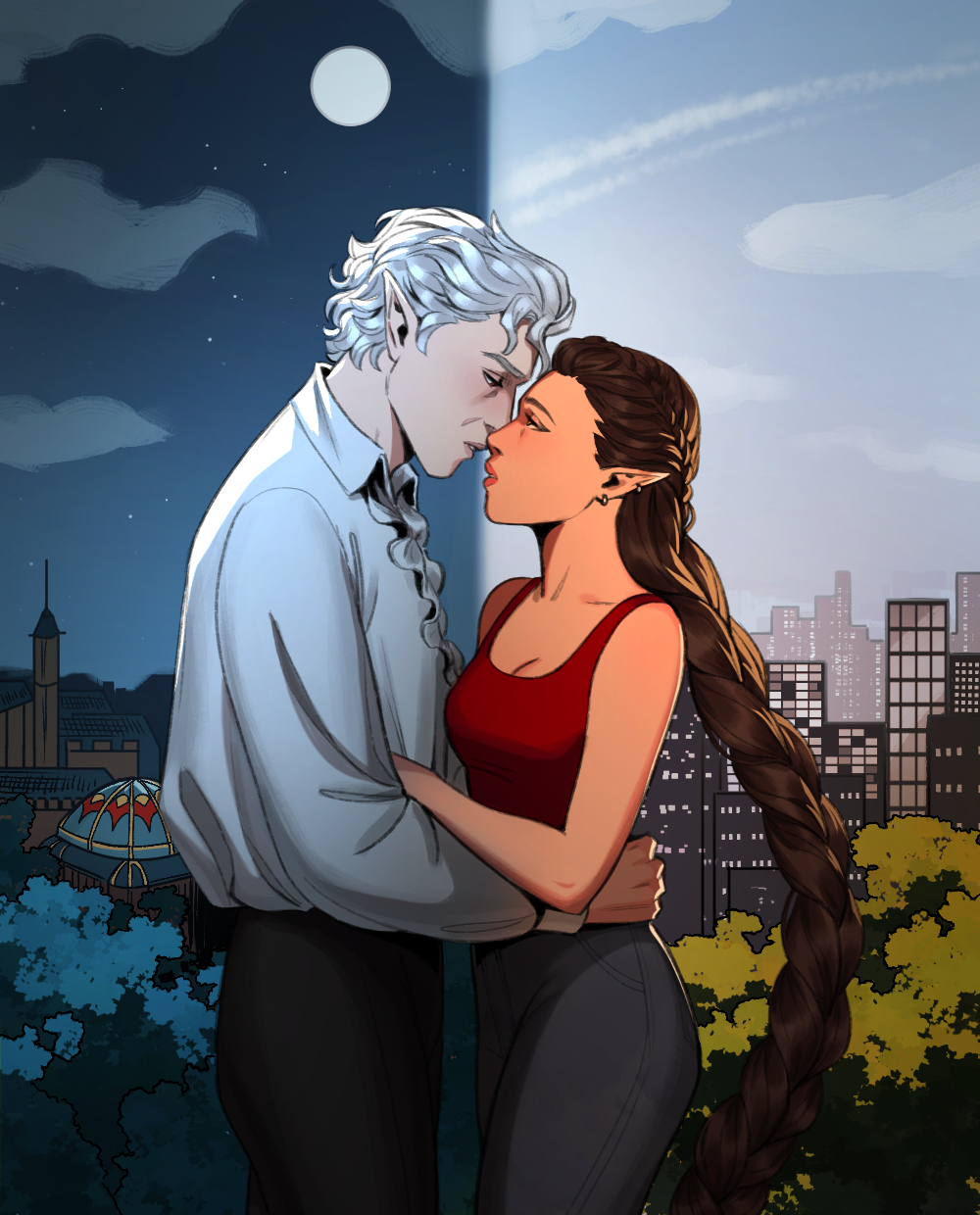
Chapter Text
"I hope you die screaming" were the final words Astarion had uttered to his companions. Never had he envisioned they would manifest with such withering prophecy. But he had not intended them as prophecy.
Death, they say, is the great equaliser; the one certainty that binds all mortal creatures in shared terror and fascination. It is the shadow that stalks every step, the hush that transmutes celebration into remembrance, the final threshold through which all must pass. Philosophers debate its significance, clerics promise salvation beyond its portal, and lovers swear their devotion will transcend it. Yet for all the words spoken and tears shed in its name, death remains the most fundamental fear that drives the beating heart of mortal existence.
In Faerûnian belief, death is not merely an ending but a transition; a passage from the Material Plane to the City of Judgment, where Kelemvor weighs the deeds of the deceased with impartial scales. From there, souls journey to the domain of their chosen deity, to spend eternity in whatever paradise or punishment their faith and actions have earned them. The faithful discover solace in this promise, believing that death is simply a doorway to something greater than the flesh they leave behind.
The elves, those blessed children of Corellon Larethian, carry an even more precious hope. For them, death might not prove final at all; their souls may discover their way back to the Material Plane through reincarnation, granted another opportunity to walk beneath the stars they cherish so deeply.
But there are those who exist outside this divine covenant, those who have made a mockery of the natural order by refusing death's embrace. Vampires—the undead who walk with silent hearts and thirsts that can never truly be quenched—have cheated death through blasphemous means. In doing so, they have severed themselves from the very deities who might have offered them redemption. They exist in a liminal space between life and death, claimed by neither the living nor the dead, forsaken by the gods who once might have shown them mercy: much like the liminal space Astarion himself had occupied in the weeks between the utterance of his inadvertent prophecy and its fulfillment, in which he meandered through the city like a specter, licking his wounds and cursing every god who had ever dared grant him a sliver of hope only to tear it away again. And it was death that occupied his mind on a night six months after that, when Astarion inhaled the fragrance of petrichor and let his gaze wander over an engraved plaque, bathed in silever light: "Heroes of Baldur's Gate," it read.
Heroes. He supposed that remained their ultimate designation. The Baldur's Mouth Gazette had chronicled how they had emerged so valiantly to vanquish the Netherbrain. And they had succeeded, hadn't they? Saved the city, saved the world, saved everyone except themselves.
None had returned from that final battle. And, however much he endeavoured to convince himself otherwise, he missed every one of them. He missed Lae'zel's blunt honesty and fierce loyalty, the way she had taught him that strength didn't always mean cruelty. He missed Karlach's infectious laughter and warm embraces, how she had shown him that touch could be comfort instead of transaction. Shadowheart's understanding and shared darkness had given him someone who knew what it meant to be shaped by pain. Gale's endless patience to his questions about magic, treating his curiosity as worthy rather than tedious. Wyll's unwavering moral compass that had challenged him to be better, even when he resented it. Even Jaheira and Minsc, who had joined them later but accepted him without question, offered the kind of family he'd never dared dream of.
They had all seen something in him worth saving. But they denied him his ordained power; and so, he had thrown it all away.
Death consumed his thoughts when his gaze drifted upward to the group statue above the plaque, settling upon the figure positioned at their centre: a lithe elven woman with an elaborate braid cascading over her right shoulder, garbed in flowing robes that seemed to dance even in stone. He studied her face with the devotion of a penitent, absorbing every detail the sculptor had managed to capture, and concluded with bitter anguish that no artistic endeavour could render justice to the authentic beauty of her delicate features, or those honeyed eyes that had once sparkled in response to his own crimson depths.
His darling Octavia.
Though veritably, she had ceased being his darling the moment he kept walking despite her desperate sobs calling his name behind him in that wretched place, pleading with him to stay, to choose them, to choose her. Octavia, the only person who had truly seen him in over two centuries, died thinking he hated her.
The truth of the matter is that he had loved her with such intensity that her perceived betrayal had shattered something elemental within his very essence. He had intended to confess those three words after his ascension, when he felt sufficiently powerful and worthy to offer her something beyond his traumatised soul. Yet that opportunity had never materialised. He did not ascend, and while he remained to fester in his ignominy, she had perished, never hearing those words pass his lips.
She was six months dead when he stood before that statue of her and slipped his hands into his coat's recesses, thumb discovering the delicate silk nestled there. A ribbon from one of her lace garments; a token he had claimed before everything collapsed, something he had clutched during his more anxious intervals. Astarion wasn't sure he even deserved to keep it.
What had he walked away for, in the end? What grand prize had been worth abandoning everything that mattered? Six months of wandering the shadows alone, feeding on beasts and drunkards, sleeping in derelict structures and wallowing in self-pity. Six months of reliving every moment, every choice, every cruel utterance that had led him to this monument of his failures.
It was death—her death, their deaths—that sent him off chasing rumours that had required months to trace, whispered in the corners of the city's most disreputable establishments. A Wish Spell scroll, they said, locked away in the Counting House's most secure vault. Powerful magic that could reshape reality itself, if one were despondent enough to steal it and foolish enough to use it.
Breaking into the Counting House had been almost insultingly easy; centuries of skulking in shadows had their advantages. The vault's magical wards had been more challenging, but desperation made him creative, and he had emerged with the scroll close to his chest; for it was death he sought to cheat, when he pulled out the parchment with trembling hands, his eyes never leaving Octavia's stone face.
"I'm sorry," he whispered to her likeness. "I'm so bloody sorry, darling—all of you. I will fix this."
Unrolling the scroll, he took a few breaths and spoke:
"I wish," he began, the scroll lighting up in hues of violet, "I could have more time. Time to make it right, to prove I'm not the monster I became, to show them that I—" The magic seized him before he could finish the thought properly, reality fracturing around him and pulling him into a heavy gust of wind.
Then everything went white.
For most, death arrives at the end of a life lived, whether that life was protracted or brief, joyful or tragic. For others, it manifests as violence, as an accident, as the simple failure of flesh to continue its appointed task. But either way, to actually die is to release one's grip on the Material Plane entirely. It is to relinquish ambition and fear, love and hatred, hope and despair. It is the ultimate act of surrender, the final acceptance that some forces are larger than the self.
Yet, what happens when death comes not as an ending, but as an interruption? What occurs when the natural order itself seems to shudder and reverse, when the boundary between life and death proves more permeable than even the gods intended?
What happens when someone who should be dead simply... isn't?